Category Archives: Couples

How to connect more effectively with your partner.

Apology “Fails”.

Hey I’m sorry, but October is “Apology Month.”

Here’s a story problem for you (with no numbers, I hasten to add). It’s a not too atypical sort of mis-communication / mis-understanding / poor choice made by couples early on in their relationship. This is a composite example from some of the situations I’ve helped folks navigate.

I’ll describe the situation. You get to have sympathy for one or other (both or neither) of the protagonists as they stumble through a Christmas party fiasco.

After the damage has been done, I describe 15 hypothetical apologies they might use on one another. My invitation to you is to try these on. How do they feel if you are the one delivering the apology? How do they feel if you are the one receiving the apology. Is there one that would work for you? Or not?

Amos and Zoe are in their mid twenties. They’ve been dating for about a year and by choice each maintains a separate apartment. Over the past 3 months, Zoe has made a practice of staying with Amos after work on Friday through Sunday night so their social and recreational lives can be shared more easily.

Amos landed a decent job with a large firm in town and is finishing up his MBA on nights and weekends. He’s about three years behind the typical curve here since he took a gap year and volunteered in Costa Rica for two years with the Peace Corps. Zoe was a straight A student her whole life and saw no merit in delaying entry into the work force. She cruised through one of the nation’s best MBA programs and is now a rising star in the most prestigious firm in town. She is highly ambitious.

Screen Shot 2015-10-07 at 4.29.26 PM

Zoe has asked Amos to come to her office party. He has mixed feelings. Zoe’s at a huge firm stuffed with type A personalities all of whom – Amos suspects – will look down on his firm, his choices and his salary (not they he’s going to broadcast that but he will be showing up in a Datsun not an Audi ). On top of that, Zoe is tall, wicked smart, drop-dead gorgeous, a flirtatious dancer and Amos can imagine how the wolves will be circling all night. The alcohol and music won’t help and then – wasn’t her old college boyfriend recently hired? Plus, Amos has a game at 9:00am Saturday (he plays for a local soccer league and their main rivals are up tomorrow) so he has to watch his alcohol and hopefully get to bed soon after midnight.

On the other hand, he wants her to come to his office party, and better to be there fending off the opposition than sitting home worrying.

Zoe asked Amos to the office bash because she’s been telling everyone about her “friend” (it’s a fine line at work; she wants the safety of a relationship with the just-off-limits sense of promise for her male colleagues) so she better show up with him. But, it’s not the best plan since she knows he feels insecure about his education and work place (a trait she dislikes) and he’ll want to not drink much and go home early for the game.

They take separate cars and meet in the lobby. Things head south pretty quickly they both reported. A posse of Zoe’s immediate colleagues crowd the elevator with them to the party floor and immediately drop into “shop talk” so Amos is out on a limb and Zoe makes no attempt to either introduce him nor catch him up on the backstory. He literally trails behind the group as they leave the elevator and immediately looses her to a throng of mega decibel conversation and music.

Zoe’s on her game, loving the energy, the vibe, and excitement and the anticipation of dancing. Oh – where’s Amos?

Amos figures he’ll get their drinks and uses this offering to re-enter the group. At this point she introduces him and he’s stunned to hear she says “Oh hey, I’d like to you meet my friend, Amos. Amos this is the start-up team I was telling you about…”
Screen Shot 2015-10-07 at 4.36.25 PM

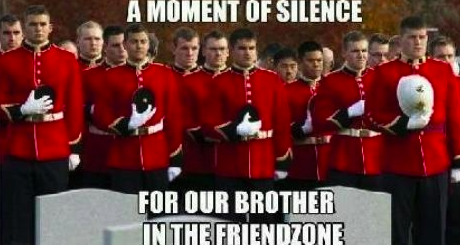
Friend-zoned in the first half hour? Not good. Amos racks his brains to see if he remembers any sort of opening gambit tid-bit about this team he’s apparently heard all about but draws a blank. But hey, all guys… he throws out a “how about the game last night?”

No takers. They seem to turn as one and drift off toward someone else they obviously find more interesting. Zoe pauses . . . then spots her girl friend Lucy. She grabs Amos and brings him to meet her. Lucy’s husband is away and Zoe seems keen for Amos to be attentive to Lucy while she… what did she say? But she’s gone – slipping into the throng.

From here out Zoe and Amos attend different events (experientally) and I’ll spare you the details. Amos leaves at 11:00pm after he finds Zoe on the dance floor to let her know. She agrees that’s a great idea and she’ll see him later and no, she won’t wake him on account of the game and his need for sleep.

By the time they make it to me about a month later their stories are hardened into battle lines. Here is how things played out.

Zoe did meet up with her old college flame. While she knew she did not want to hit the repeat button (he was way too self-absorbed for her long term, in fact “Narcissistic” came to mind as she described him) he was still funny, fascinating, wealthy and great dancer. By 3:00am the following morning she decided to accept his offer for her to sleep at his place rather than disturb Amos.

Amos left feeling angry and vulnerable. He berated himself for not putting on more of an alpha-male show and he wished, not for the first time, that he could Tango. He slept soundly though and it wasn’t until his alarm went on Saturday morning at 7:45 that he noticed Zoe had never come over. His own inner alarms went off but he showed up for his game (they lost) and then found Zoe sleeping off a bit of a hangover on his couch when he got home. In an instant all his frustration, anger, hurt, jealousy, doubt and insecurity erupted and for the first time in their relationship Amos went off on Zoe, calling her names, questioning her faithfulness, insulting her firm, friends, choices and attitude.

Screen Shot 2015-10-07 at 4.39.43 PMZoe – who was feeling a bit guilty – kept calmer, but neither partner felt good about the fight that followed.

********************************************************************

OK – so right here I have 3 questions for you.

  1. Who should apologize to whom?
  2. What for?
  3. Why?

Now you get to weigh in.

First, if you were Zoe, would any of the following apologies make you feel better?

  1. OK, I know I blew my lid Saturday morning and I’m sorry but honestly Zoe you were horrible to me at the party.
  2. I’m sorry you felt hurt by what I said on Saturday morning.
  3. Listen, if that hurt you I didn’t mean it that way.
  4. OK OK I was a total sh*t! I’m so so sorry! I ought to have just kept my peace, not said a word, welcomed you home with open arms and not cared one iota that you’d slept in another man’s house – or was it bed – that night?
  5. Zoe, I made a terrible mistake. Will you forgive me?
  6. I know you’re mad at me Zoe and I feel like a low life. It was horrible of me to get all caught up in being jealous of Jake when I know that’s in the past . And I think I’m hurting more than you are that I lost my cool and yelled at you. I’ve never wanted to be the sort of fellow who screams at his woman . . .I mean, who does that?
  7. While I must apologize, you’ve gotta admit, you brought all this on when you friend-zoned me in the first few minutes at the party.
  8. You know what, here’s the deal. I spent one whole evening and most of the following morning in agony, seeing you schmoozing with all those hot shots and then waking up to find you not home even when I had to focus on the game and everything. Then, sure I have a tantrum so maybe I’m 15% of the problem but you’re packing 75% culpability I’d say!
  9. So yeah, I’m sorry and all that but heck, I’d probably do the same thing again if you treat me like Zoe! What man wouldn’t feel outrage when his girlfriend goes home with someone else after the office party?
  10. Hang on! I’m not sure I even know why you’re so mad at me. What did I do? Expressed my  anger? Is that so bad? Go on, tell me, why are you so mad?
  11. Zoe stop it! I said sorry a zillion times already. I won’t talk with you about this anymore.
  12. I hate it when you bring that fight up Zoe, it hurts. I’m sorry, I’m sorry, OK?
  13. OK Zoe here’s the truth of it. I’m willing to say sorry, I’m willing to make amends and start over. I’m willing to accept you as you are and maybe you just are flirtatious and with a bit of a thoughtless streak. I can get over that.
  14. I’ve said I’m sorry haven’t I? Isn’t sorry enough anymore?
  15. Look, it really pisses me off when you bring up that event. Get over it already!

Now, if you were Amos, would any of the following apologies make you feel better?

  1. OK, so I had a fun night, made a bad choice at the end and I’m sorry but honestly Amos, you were a grump at the party and way out of line on Saturday morning.
  2. I’m sorry you felt hurt by what happened at the party.
  3. Listen, if that hurt you I didn’t mean it that way.
  4. OK OK I was a total sh*t! I’m so so sorry! I ought to have just focused on you and made sure     you had a wonderful evening. It was selfish of me to want to dance with my co-workers and to stay at a friend’s house so I didn’t disrupt your sleep before the game, as you asked, remember?
  5. Amos, I made a terrible mistake. Will you forgive me?
  6. I know you’re mad at me Amos and I feel like a low life. It was horrible of me to get all caught up in work stories and not to dance with you. I think I’m hurting even more than you are that I stayed over at Jakes.
  7. While I must apologize, you’ve gotta admit, you brought all this on when you behaved like a sullen kid at the party and then totally lost your cool on Saturday.
  8. You know what, here’s the deal. I spent one whole evening and most of the following morning   being stressed out by your judgmental attitude. You made no effort to relate to my friends and then blew up because I choose to be thoughtful. So maybe I’m 15% of the problem but you’re packing 75% culpability I’d say!
  9. So yeah, I’m sorry and all that but heck, I’d probably do the same thing again if we go to a party together and you’re no fun. I’ll take care of myself and try to have a good time. Who wouldn’t?
  10. Hang on! I’m not sure I even know why you’re so mad at me. What did I do? Had some fun and stayed with a friend when it was so late. Is that so bad? Go on, tell me, why are you so mad?
  11. Amos stop it! I said sorry a zillion times already. I won’t talk about this with you anymore.
  12. I hate it when you bring that fight up Amos, it hurts. I’m sorry, I’m sorry, OK?
  13. OK Amos here’s the truth of it. I’m willing to say sorry, I’m willing to make amends and start over. I’m willing to accept you as you are and maybe you just are sensitive and a tad jealous. I can get over that.
  14. I’ve said I’m sorry haven’t I? Isn’t sorry enough anymore?
  15. Look, it really pisses me off when you bring up that event. Get over it already!

What do you think? How many of these pretty common forms of apology would work for you? Two or three? None?

Come back next week and I’ll give the therapists’ critique of each of these, plus deliver my  handy-dandy Best Apology Guidelines (maybe with a sexier title!).

Plus – if you’ve stumbled upon this blog and have read this far – thank you! Or if you read it regularly by following the Facebook link, thank you!  I’d love to invite you not to miss next weeks (or any of the remaining weeks) by hitting the “FOLLOW” button to subscribe.

In 2016 I plan to turn these Relationship Skills articles into a book, and having a healthy blog subscriber list all helps when it comes time to publish and market.

Here’s to some conscious apologies this week and come back for the critique.

FIRST TIME HERE?

This is the latest article in a year-long series on the “12-most-important-relationship-skills-no-one-ever-taught-me-in-school-but-I-sure-wish-they-had.”

Click the box for the full list.  Top 12 Relationship Skills

If you’re interested in reading this blog in sequence, below are links to the series to date, beginning with the first posting at the top.

OVERVIEW

SKILLS FOR UNDERSTANDING

SKILL ONE ~ Recognize (and get to know) the many “yous.

SKILL TWO ~ Learn how to be pro-active: choose how y’all show up.

SKILL THREE ~ Accept (and get curious about) other peoples’ complexity

SKILLS FOR CONNECTING

SKILL FOUR ~ Master the Art of Conversation

SKILL FIVE ~ Learn How To Listen With Your Whole Self

SKILL SIX ~ Crack The Empathy Nut

SKILL SEVEN ~ Practice Kindness

SKILL EIGHT ~ Negotiate with a Win-Win Mentality

SKILLS FOR RE-CONNECTING

SKILL NINE ~ Build (or rebuild) trust.

Before You Trust Again

Before you trust again, hit the pause button.

For some, the experience of losing trust in a loved one is a defining moment. Like those falling dreams where you are tumbling through space fearing there will be nothing beneath to catch you. And then you awake with a start. You’ve landed. You’re alive. The world has tilted on it’s axis. Your question might be ~

Now what? How can I survive in a world turned upside down?

For some, trust is a pretty disposable commodity. We give it and lose it and suck it up and do it again. The self-help industry is testimony to our human desire to rise again once we fall. The second, third and fourth marriage stats are a testimony to folks willing to risk the vulnerability of commitment again, and again, and even again. Your question might be ~

So what! Are there any safeguards against betrayal?”

I hope there are helpful things here for anyone who has ever felt the sting of lost trust. And, I realize I have a particular soft spot for people like my mother – who discovered my father was having an affair in the 1960s’ and had to just carry on. As a Catholic stay-at-home Mum she felt she had no options. Maybe I wish I could have shared these ideas with her back then. Maybe maybe she might have been able to guide her marriage into a more healthy harbor.

So indeed, loosing trust can be one of those moments we choose to gloss over. You know, go all British and bellow with false bravado “I say old chap, let’s . . .”

Screen shot 2015-09-30 at 10.35.38 AM

Which, while it worked well enough for Britain’s Shadow Ministry of Information to rally morale and tamp down hysteria during World War II, is really not a workable operating instruction for great relationships.

Instead, I’d offer this as your rallying cry when it comes to rebuilding trust.

Screen shot 2015-09-30 at 10.50.37 AM

WHY?

Great question!

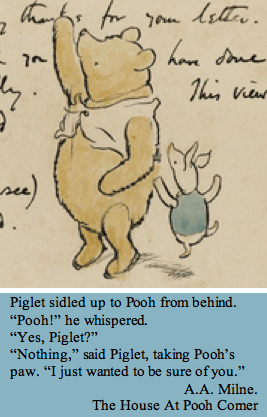
Well, it’s interesting isn’t it  What we want is the depth of trust Piglet has in Pooh.Screen shot 2015-09-30 at 12.09.22 PMWhat we’ve got is doubt, anger and uncertainty. And right there, when you are feeling so sad, betrayed, worried, frightened and alone I’m going to invite you to be curious in three particular ways.

ONE ~ INTERROGATE REALITY

As in, find out all you can about what just happened, from at least 2 points of view.

Think of yourself as the doctor, initially for your own case of pain and breach of trust, and then for the person whose actions have caused this for you.

Get curious about these six things below, for you and for this other person. You are seeking to reduce your uncertainty and confusion by understanding as much as you can about the situation. You are doing the opposite of KEEP CALM AND CARRY ON. You’re investigating with eyes wide open and a determination to understand as much as you can. For each person, let yourself ponder these questions:

  1. ANTECEDENTS – what was happening just before this breach of trust?
  2. BEHAVIORS – what exactly happened? What did each of you do / not do?
  3. COGNITION – what are you thinking? How are you scripting this event? How is the other person scripting this?
  4. DURATION – how long has this been going on… for each of you?
  5. EFFECT – what are some of the outcomes of these actions and reactions?
  6. FEELINGS – what range of emotions have you been through? Have they?

When your trust has been broken, you initially may feel shocked, angry, disappointed. All so understandable. But you’ll also feel frustrated, helpless and uncertain. Letting yourself wrap your head around the initial facts of the situation can really help. There will be a time to go beyond the raw facts, but grasping these things can feel empowering, and even a little hopeful.

TWO ~ LEARN ALL YOU CAN

OK – so now you know the basics of the who / what / when  & where, and it’s time to reach out for some specific help. It could be your child you’ve lost trust with, in which case I’d suggest reading Option A (see below in gold). If it’s your partner you’ve lost trust with, scroll on down to Option B, also in gold.

A)  If it’s your child who’s challenging your trust in them by ~

  • Taking your car without asking
  • Getting a speeding ticket
  • Skipping school
  • Getting into drugs
  • Getting pregnant
  • Hurting or bullying someone else
  • Self-destructing and refusing to accept your (or anyone’s) help

Please do seek help. Here are 3 types of resources to begin with.

BIBLIOTHERAPY

Yes – books are a powerful source of comfort and help so letting yourself do some research up front can make a difference.

Type “Defiant Child” or “Suicidal Teenager” or whatever your particular concern is into your favorite search engine. You’ll see heaps of articles and books.

One caution. Before you read anything (book, blog or article) figure out the credentials of the author. Can you trust this person to be helpful to you? Do they have an obvious bias? Faith tradition? Parenting philosophy” Just be aware that not everything on line or in print is good. That’s why I suggest looking at lots of things. The ones that seem to make sense to you will rise above the others.

Go to the library and search through the books you read about . Stagger out of the place with shopping bags full of books.

Skim the titles, the back cover, the inside jacket. Look at the chapter titles. Dip in and out of whatever catches your eye. Notice the biases of the authors, but hopefully you’ll begin to find some helpful information.

Again, there really is a plethora of good material out there.  I am particularly fond of:

WISE UP

Just because your trust in your child has been challenged or broken, does not mean one of you is “right” and one “wrong.” There’s lots going on with teens and deepening your understanding of what’s happening for them is vital. If the trust challenge has to do with one of the issues below you’ll certainly benefit from the appropriate resource.

PROFESSIONAL HELP

When you reach the limit of your own ability to educate yourself with on-line resources, consulting a professional is enormously helpful.

Two great places to start in terms of finding a qualified professional in your area, with the particular expertise you need, are:

  1. AAMFT (The American Association for Marriage & Family Therapy) Therapist Locator
  2. Psychology Today’s Find A Therapist.

B)  If it’s your spouse who’s challenging your trust in them by ~

  • Not keeping their commitments
  • Being unavailable emotionally or physically
  • Squandering your joint funds
  • Not seeking help for their addictions
  • Having an emotional affair
  • Having a sexual affair
  • Leading a secret life

Please do seek help. Here are 3 types of resources to begin with.

BIBLIOTHERAPY

Yes – books are balm and letting yourself do some research up front is super helpful.

Type “Best resources for rebuilding trust” into your favorite search engine. You’ll see heaps of books. Review some of them that catch your eye. Read the reviews.

One caution. Before you read anything (book, blog or article) review the credentials of the author. Can you trust this person to be helpful to you? Do they have an obvious bias? Faith tradition? Axe to grind? Just be aware that not everything on line or in print is good. That’s why I suggest looking at lots of things. The ones that seem to make sense to you will rise above the others.

Go to the library and search through the books you read about . Stagger out of the place with shopping bags full of books.

Skim the titles, the back cover, the inside jacket. Look at the chapter titles. Dip in and out of whatever catches your eye. Notice the biases of the authors, but hopefully you’ll begin to find some helpful information.

Again, there really is a plethora of good material out there and so much depends upon the nature of the breach of trust.

WISE UP

Just because your trust in your spouse has been challenged or broken, does not mean one of you is 100% “right” and one 100% “wrong.” Life is messy and complex and there are demons within each of us who sometimes take over. If your trust challenge has to do with one of the issues below, learning more about the specifics of the problem is very important.

PROFESSIONAL HELP

If or when you reach the limit of your own ability to educate yourself with on-line resources, consulting a professional is enormously helpful.

Two great places to start in terms of finding a qualified professional in your area, with the particular expertise you need, are:

  1. AAMFT (The American Association for Marriage & Family Therapy) Therapist Locator
  2. Psychology Today’s Find A Therapist.

THREE ~ INTERROGATE YOURSELF

Ask yourself, and really answer, these seven questions.

  1. If there was one thing I was trying NOT to know about my relationship before I lost my trust, what might it have been?
  2. If there was one conversation I ought to have had much sooner, long before trust was broken, what might it have been?
  3. If there was one thing I silently judged about this person, what was it?
  4. If, looking back, there was one change in the way I related to this person who broke my trust – what might it have been?
  5. If, looking forward, there is one change I could initiate now in the way I relate, what do I wish it could be?
  6. If there was one positive outcome almost too good to hope for, that might possibly come about as we heal and move through this breach of trust – what is my most daring wish?
  7. If there was one aspect of my own character I would love to bring more conscious awareness to, what might it be?

So, dear reader, before you trust again, hit that pause button.

Love yourself enough to recognize no matter how powerless and broken you may feel, there is SO much you can do to understand, learn, support and be supported through this journey toward an ever expanding capacity for love, trust, understanding, wisdom, self compassion and that dash of curiosity that will allow you to indeed, after all of this . . .

Screen shot 2015-09-30 at 10.35.38 AM

FIRST TIME HERE?

This is the latest article in a year-long series on the “12-most-important-relationship-skills-no-one-ever-taught-me-in-school-but-I-sure-wish-they-had.”

Click the box for the full list.  Top 12 Relationship Skills

If you’re interested in reading this blog in sequence, below are links to the series to date, beginning with the first posting at the top.

OVERVIEW

SKILLS FOR UNDERSTANDING

SKILL ONE ~ Recognize (and get to know) the many “yous.”

SKILL TWO ~ Learn how to be pro-active: choose how y’all show up.

SKILL THREE ~ Accept (and get curious about) other peoples’ complexity

SKILLS FOR CONNECTING

SKILL FOUR ~ Master the Art of Conversation

SKILL FIVE ~ Learn How To Listen With Your Whole Self

SKILL SIX ~ Crack The Empathy Nut

SKILL SEVEN ~ Practice Kindness

SKILL EIGHT ~ Negotiate with a Win-Win Mentality

SKILLS FOR RE-CONNECTING

SKILL NINE ~ Build (or rebuild) trust.

How To Trust Yourself

In 1984, for reasons I will explain (and you will possibly consider idiotic) I brought our eighteen month honeymoon – traveling in a VW camper through Europe and the Middle East – to a halt because I wanted to nest in my own home and become an upholsterer.

Yes – we traded the charms of small French towns like Cassis

Screen shot 2015-09-21 at 2.48.10 PM

and adventures on an Israeli Kibbutz and the newly-returned-to Egypt vast Sinai Peninsula (which in 1983 was virtually unoccupied following the Israel-Egypt Peace Treaty of 1979)

Screen shot 2015-09-22 at 6.56.43 AM

so I could pull the stuffing out of elderly sofas, become adept at tying internal springs in the classic 8-way-pattern for maximum holding and comfort

20150920_192605and tackle the occasional “Button Back” project.

20150920_192605_2

An odd choice, and one I went on to regret.

What was I thinking?

I had persuaded myself that I was a contemplative craftsperson who needed to work quietly on my own with classical music and scented candles, carefully restoring gorgeous antiques for folks who liked such things. And I wasn’t interested in hearing anything to the contrary.

Until I did. And the contrary voice I heard was loud, insistent, and from within.

I’m miserable! Here I am working away on my own, in the basement with things while what I really love and crave are people, sunlight and ideas!”

I had completely mis-read who I was and what I needed. Talk about undermining my trust in what I knew to be true about myself! I set aside my tools.

Screen shot 2015-09-22 at 7.13.21 AM

In 1980, for reasons I will explain (and you could possibly also consider idiotic) I brought my 2 year back-packing adventure around the USA to a halt Screen shot 2015-09-22 at 7.16.36 AM

by moving in with a man three days after I met him at The Last Exit on Brooklyn, in Seattle.

Me! A convent-boarding-school-graduate-with-two-sisters-nuns-who-had-no-intention-of-getting-married-anyway. But, I made the lightening quick decision to stay with this warm, kind Seattleite.

For a while.

Another odd/out of character choice, and one I’m eternally grateful for.

What was I thinking?

Lots of things!

I really liked this man. He felt familiar and kind and I was an emotional kaleidoscope. Some days I’d feel loving and secure, others I’d panic about my future and our differences. Sometimes I’d feel content at the prospect of choosing “the one”, other times I let myself explore my options. [if you’re curious read this]. I had lengthy phone conversations with my aunts and sisters; I sobbed and laughed with girl friends; I sought counsel from wise folks; and Mark and I went about our lives getting to know one another ever more deeply.

20150921_165819

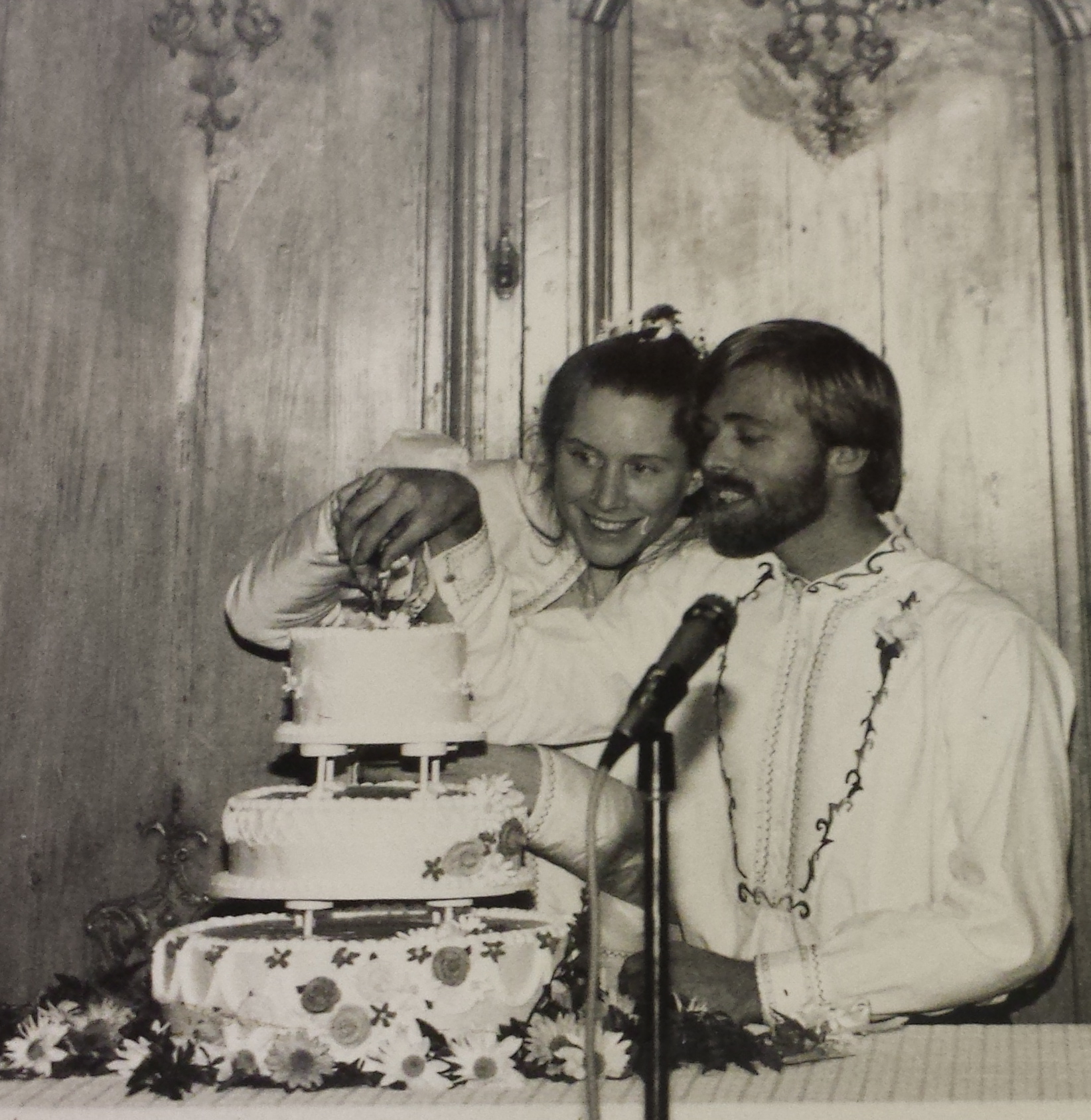
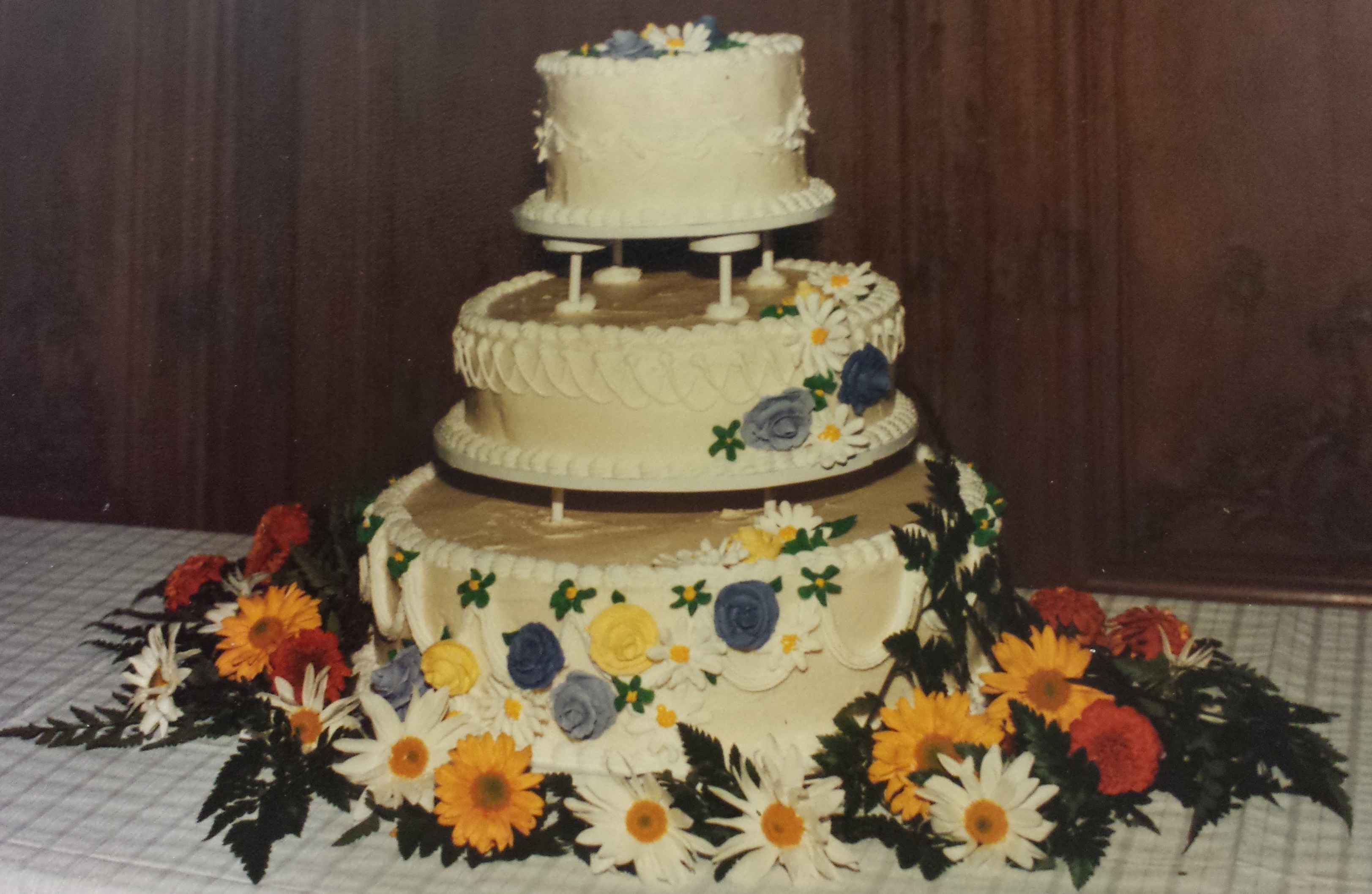
700 days after we met (during which time Mark came to England to meet my family, and we sought a work visa for me) we said our “I dos” at the Burke Museum in Seattle at our pot-luck-home-spun wedding filled with the crazy chaotic kindnesses of friends and family (still grateful for that cake Stuart!). 

20150921_165904

So – how come the trust I placed in my decision to be a contemplative upholsterer was so misguided, while the trust I placed in my spontaneous decision to move in and ultimately spend the rest of my life with Mark, so spot on?

How can we get trust right?

In Can We Trust Too Much, I suggested the way forward lay in “helping a person learn how to nourish their own feedback systems so they can:

  • manage their natural inclination to be either more or less trusting, this Alphabet helps;
  • manage their attachment wounds, if present, so that the fear of abandonment or abuse is recognized and healed;
  • cultivate a clear-eyed, robust sense of self so they can wisely discern what level of trust this or that person or situation safely warrants.”

So, what is this feedback system and how come it’s trustworthy anyway?

Here’s what works for me, and increasingly, for my clients.

Our own infallible-once-we-know-how-to-use-it feedback system is ~

  • Available to us 24/7
  • Body-centered
  • Compassionate
  • Do-able
  • Effective
  • Fair
  • Growth-promoting
  • Honest
  • Individualized for our specific journey . . .

(OK – you get the point. I won’t go through the whole alphabet)

Maybe you can discern what it is as I review the ways I approached becoming an upholsterer versus the way I approached staying with Mark?

In the first instance I listened to only one inner voice. I listened exclusively to that Part of me who was absolutely of the opinion that I was, at my core, destined to be a contemplative upholsterer.

I had shut down the opposition. Any Part of me who might have had doubts about the plan was seen as a threat to my desire for certainty and the poster-child of certainty for me then was a life-long-dedication to the craft of upholstery.

But, in that tiny percentage of my attention I was ignoring, there were Parts gnawing at my gut, tightening in my upper back, and whispering in my heart ~

  • But I hate sewing;
  • Maybe I want to go back to Grad School;
  • Will I earn enough;
  • What if I get lonely?

Too bad for them! My contemplative-hold-tight-to-certainty Part monopolized all the attention in my inner Cabinet, drowning out dissent and shoving aside the President. Until she couldn’t. Until those ignored inner knowings erupted and I could no longer refuse to hear them and I cracked open with frustration, grief, and rage at my inauthenticity.

I was like a President who fills her cabinet with “yes people.” In trusting only one adviser, I was completely oblivious to the larger reality I’d been ignoring.

Enough of the broken chairs already!

Screen shot 2015-09-21 at 5.38.41 PM

With the Mark decision it was the opposite. Within my inner Cabinet I was certainly swayed by my Minister for Spontaneity who argued “Hey, you gotta seize the moment girl..tomorrow you move on. If you don’t spend time with this man now, this moment won’t ever come around again.”

But, this Part had lots of supporters~

  • This man feels safe and kind, this is a great decision;
  • His family is European, so it feels familiar;
  • I like that he has a career already sorted out;
  • Good job finding a man who sings so wonderfully!
  • He loves animals too – an excellent sign.

And lots of opposition too ~

  • What about my volunteer job with VSO in Indonesia  – I want to see that through;
  • I’d be nuts to put my dreams aside for a man;
  • Do I even want to stay in America?
  • I’m still grieving the death of my mother, this is no time for love;
  • Our spirituality is way too different.

But the difference this time was that I welcomed information. I listened to all these Parts. I paid attention not only to my thoughts but to my body, which had plenty to say! I listened to depression, to a spasming back, to knee and ankle injuries, to headaches and to the gnawing in my gut. I worked the issues until I felt I understood what needed to be understood in that moment.  I let reality be messy and complex.

Each Part held a piece of the truth. Each part wanted what was best for me, from her perspective. This idea of listening carefully to multiple competing views is hardly new, in psychology or politics. Fellow history enthusiasts might appreciate the analogy to Lincoln’s cabinet, beautifully described in Team of Rivals. Author Doris Kearns Goodwin explains (in an interview for National Archives)

At the same time, Lincoln was facing a Republican Party that was very young and whose members had come from a variety of other parties. They were former Whigs, former Democrats. By putting his rivals in his cabinet, he had access to a wide range of opinions, which he realized would sharpen his own thinking. It also gave him a way of keeping all those conflicting opinions together. If he didn’t have a unified group fighting against the South, the fight would be impossible to sustain. So having all those opinions in his cabinet not only helped him; it helped the country as well.

So, like President Lincoln, when it was time to make a decision, that decision arose from a deeply informed place. My own inner team of rivals  was led by my inner President (what I usually call my Self) in a way that considered the views of all the Parts. My Self was curious and compassionate toward all the fears, all the stories, all the desires held by these Parts. My Self understood, for example, both how hard it would be to abandon my VSO position in Indonesia and how hard it would be to walk away from an extraordinary relationship.

Each Part of me, each distinct set of beliefs/fears/desires I held, was welcomed, attended to, appreciated for the specific perspective it brought, and considered or negotiated with. Until I realized that I knew what needed to happen. Until I recognized an upwelling of certainty that came from getting to know all the Parts. And, at some point there was no longer a question. I knew I wanted to be with Mark above everything else. And all the Parts felt good about it.

Don’t trust me on this one folks – try it for yourself!

Next time you need to trust yourself with a decision – whether about a relationship, office politics, a move, an issue with your child or parent – let yourself genuinely tune into all the Parts of you who have something to contribute. View them all as helpful. It’s the Parts of us we shove aside as irrelevant or discordant or irritating, or frightening in their implications, that have the most power to unravel whatever version of “trusting myself” you come up with.

If you want some help here are five suggestions for moving forward

  1. Read more about Parts work and Dr. Richard Schwartz’s Internal Family Systems
  1. Read Jay Earley’s book Self Therapy
  1. Read There’s A Part of Me (or anything else that catches your attention) here:
  1. Sign up for a few sessions with an IFS-trained therapist in your area;
  1. See the first three articles in this series

Why bother?

Because every relationship is built on trust. So, what Part(s) of you are doing the trusting? Your ability to trust other people will grow to the extent you get to know which Parts of you are showing up as you decide whether or not to trust. Trust is a process. It ought not be given too quickly. So, the more your President (your Self ) learns how to distinguish and listen compassionately to all your inner Parts the greater the chance you will form a clear and informed assessment.

Before you can trust (or re-trust) someone else, you need to learn to trust yourself.


FIRST TIME HERE?

This is the latest article in a year-long series on the “12-most-important-relationship-skills-no-one-ever-taught-me-in-school-but-I-sure-wish-they-had.”

Click the box for the full list.  Top 12 Relationship Skills

If you’re interested in reading this blog in sequence, below are links to the series to date, beginning with the first posting at the top.

OVERVIEW

SKILLS FOR UNDERSTANDING

SKILL ONE ~ Recognize (and get to know) the many “yous.”

SKILL TWO ~ Learn how to be pro-active: choose how y’all show up.

SKILL THREE ~ Accept (and get curious about) other peoples’ complexity

SKILLS FOR CONNECTING

SKILL FOUR ~ Master the Art of Conversation

SKILL FIVE ~ Learn How To Listen With Your Whole Self

SKILL SIX ~ Crack The Empathy Nut

SKILL SEVEN ~ Practice Kindness

SKILL EIGHT ~ Negotiate with a Win-Win Mentality

SKILLS FOR RE-CONNECTING

SKILL NINE ~ Build (or rebuild) trust.

Trusting Myself

Dear Reader,

In a delicious twist of irony, I’m having to trust my gut that it is OK for me not to publish an article today on how to trust one’s gut.

I think I’ll blame the cat.

Screen shot 2015-09-16 at 3.57.35 PM

I’ll be back here next week!

Warmly,

Gemma

Can We Trust Too Much?

Screen shot 2015-09-08 at 2.38.53 PM

Q   Can we trust too much?

A    Yes!

If you think about your life, I expect you can think of a time when you put your trust in a stranger who let you down.

  • Has a salesperson ever made false promises about a product ?
  • Did you fall for that on-line magical diet only to find you’re still 15 lbs more than you want to be?
  • Has a vacation brochure promised sea views from your balcony but here you are looking at a brick wall?

My guess is however that you still believe strangers, buy stuff, sample new diet aids and are persuaded by good ad copy to take distant vacations.

Why do you do that?

How come you knowingly engage in activities that conned you before?

Possibly, like me, you learn from the feedback you receive each time your trust is betrayed.

You’ll probably consult the Better Business Bureau or talk to friends before believing a particular products’ claims.

If you’re in the market for some self-improvement routine for your body or your mind you’ll probably read the testimonials, or maybe talk at length to some people who have tried what you are considering.

And as for those glossy sea-views or cruise-ship brochures? Two words. Due diligence.

In other words, you cultivate discernment. Hopefully you make fewer dumb purchases, and the economy still thrives because there are so many folks who are on their own particular learning curve so shoddy products, fake diets and ghastly vacations still sell like hotcakes!

Let’s go deeper.

I expect you can think of times when you put your trust in someone you love who then let you down.

  • Did your parents ever say “I’ll be at your game!” only to never show up?
  • Did your partner swear to live within the budget you both agreed to, only to squander $1000s gambling and rack it up as unanticipated debt?
  • Did your spouse promise to be monogamous, only to cheat on you?

Now what?

  1. Did you stop inviting your parents to your events so you’d not feel let down?
  2. Did you invite your parents, give them dozens of chances to redeem themselves, and ride that roller coaster between hope and despair in your childhood home?
  3. Or did you invite your parents, but manage your expectations so whether they came or not you’d be OK?

What about your gambling partner?

  1. Do you file for divorce immediately and unravel your joint finances so you can regain control over your life?
  2. Do you have another budget conversation and trust them to “never gamble again, I swear…”
  3. Or do you create some accountability with a firm-but-fair response that connects your spouse with some version of Gamblers Anonymous and you with resources to help rather than enable the behaviors?

What about an unfaithful spouse?

  1. Do you immediately file for divorce without exploring any of the circumstances because it’s just too darn painful and you feel irreparably betrayed and righteous as in “How could s/he do this to me?”
  2. Do you so fear being abandoned that you put up a modest fight, but let them know you forgive them if they just won’t ever do it again?
  3. Do you insist on clarity, and invite both of you to therapy to explore what led to this affair, to understand what your relationship needs now, begin to heal and renegotiate the contract each of you wants going forward?

It’s not black and white is it?

And while it might seem as if I biased the answers above to favor option 3 in each case, the truth is that how we respond depends upon a whole other layer of trust. We can only end up more or less in alignment with the option 3 responses to the extent we trust ourselves.

We experience our world as predictable enough, as trustworthy enough to the extent three factors are in play:

NATURE – there is mounting evidence that people are born with different predispositions around trust. Don’t take my words for it! Here’s

NURTURE – Since John Bowlby’s work on attachment in the 1950s we’ve understood that parenting matters. Here’s

NOURISHMENT – Is the term I’m giving for this third factor in ones ability to trust. It’s the only one over which you have control, and it’s never too late to begin. Summed up by one of my favorite aphorisms:

“Trust in Allah, but tether your camel first.”

it’s about cultivating conscious awareness for all the factors in play before deciding whether, and how much, to trust.

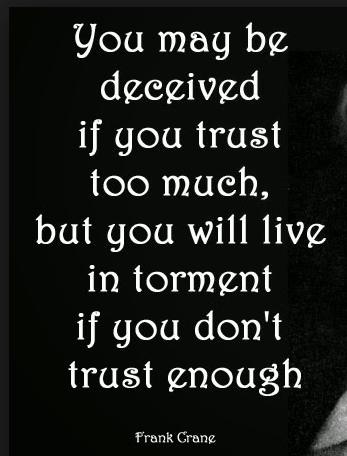
As Frank Crane puts it ~

Screen shot 2015-09-08 at 12.43.19 PM

We need that Goldilocks zone of trust.

Believe me, if a couple comes to me so burdened by one partner’s inability to ever trust again after a painful betrayal it greatly reduces the likelihood the relationship will ever recover.

And, if a couple comes to me with one partner totally committed to trusting their sweetie in the face of overwhelming evidence that this is unwise (refusing to recognize when addictions are present for example) it will bring about their mutual assured destruction.

More and more I find I’m working to help individuals learn how to trust themselves enough to be able to make heart-centered yet informed decisions.

This means helping a person learn how to nourish their own feedback systems so they can ~

  1. manage their natural inclination to be either more or less trusting, this Alphabet helps;
  2. manage their attachment wounds, if present, so that the fear of abandonment or abuse is recognized and healed;
  3. cultivate a clear-eyed, robust sense of self so they can wisely discern what level of trust this or that person or situation safely warrants.

What does this look like in practice? Come back NEXT WEEK where I’ll be writing about how to trust yourself more accurately

FIRST TIME HERE?

This is the latest article in a year-long series on the “12-most-important-relationship-skills-no-one-ever-taught-me-in-school-but-I-sure-wish-they-had.”

Click the box for the full list.  Top 12 Relationship Skills

If you’re interested in reading this blog in sequence, below are links to the series to date, beginning with the first posting at the top.

OVERVIEW

SKILLS FOR UNDERSTANDING

SKILL ONE ~ Recognize (and get to know) the many “yous.”

SKILL TWO ~ Learn how to be pro-active: choose how y’all show up.

SKILL THREE ~ Accept (and get curious about) other peoples’ complexity

SKILLS FOR CONNECTING

SKILL FOUR ~ Master the Art of Conversation

SKILL FIVE ~ Learn How To Listen With Your Whole Self

SKILL SIX ~ Crack The Empathy Nut

SKILL SEVEN ~ Practice Kindness

SKILL EIGHT ~ Negotiate with a Win-Win Mentality

SKILLS FOR RE-CONNECTING

SKILL NINE ~ Build (or rebuild) trust.

Values Worth Fighting For

When you feel a surge of anger, very likely one of your values has been compromised.

I discovered this when another driver took my husband’s parking spot one day.

Screen shot 2015-08-26 at 3.36.37 PM

The perfect storm: a downtown office appointment in a busy city on a hot day. We probably should have taken public transport.

Anyway, Mark finally found a parking spot and pulled past it to reverse in (good parallel parking behavior). As he was in the process of reversing in, someone came from the other direction and zipped into the spot. Almost hitting our then-reversing car.

My even-tempered sweetie morphed into a ranting, raging mad-man. He jerked on the brake, hopped out of our car and started yelling at the “jerk” who’d pulled into “our” parking space.

Needless to say, this did not change the behavior of the parking man. He got out. Locked up his car. Gave Mark the finger and strode off.

Screen shot 2015-08-26 at 4.49.54 PMMarks tells me he nurtured fantasies of sticking spikes under each tire but instead we drove off, went around the block, found another space, parked and got on with our day. It took a while for Mark to flush out all that adrenaline, but later that night we discussed why he’d lost his usual cool.

Mark knew immediately. “It’s the unfairness! I was clearly going for that space. There are certain rules of decency on the road and that guy violated them.

Now of course, to this day we don’t know the other chap’s back-story. Was he in a rush to save the world and our judging him as “unfair!” missed some greater good?

But more relevant to our lives was this lesson about our own values.

We went over other times when one or other of us seemed to loose it out of the blue. We revisited some old fights. Thought about family members and friends. It seemed true to say that for the most part (for folks without a serious anger issue, and for folks who were not living in unduly stressful situations) when we got angry, we could trace it back to a value that had been compromised.

  • Because I value beauty and calm, I can get grumpy and irritable when things are cluttered and dirty;
  • Because I value seeking to understand, I get very triggered by partial truths or secrets;
  • Because I value kindness, I can get triggered by couples whom I perceive are unkind to one another;
  • Because I value authenticity, I get really put-off when I feel someone is acting, or being fake.

You get the idea.

But here’s the neat thing about values.

  • We don’t get to use them to beat up other people because they don’t live our values.
  • We get to use our flash of judgmental anger to identify our values for ourselves.
  • And then we get to honestly ask if we are living our values.

So, when I’m grumpy in the face of clutter and disorder, I get to acknowledge to myself how much I value calm and clean.

Then, maybe I can take it another step and practice this value? If it’s a friend’s home – maybe not. If it’s my own place? Might be time to let myself tackle some decluttering.

This is a tiny example.

But there may come a time in your life when you’re eaten up by an angry knot of judgment about a person or situation. Nothing seems to shift this dead weight inside. I know I go there. It’s like walking around having swallowed a cannon ball.

I humbly offer this exercise as a way to start softening the lead weight inside so you can bit by bit release the power this heaviness holds on you. Not because I’ve mastered this I hasten to add, but because I’m thick in the midst of working the issue.

1. Feel for where you hold the tension or weight in your body.

  • Is it in your gut?
  • Jaw?
  • Shoulders?
  • Fists?
  • How do you sense it?

2. Focus on this area.

Feel the discomfort. The tightness. The clenching. Really let that knot come into focus in your system. This can be painful. Acknowledge that too.

3. Find out what story you are telling yourself.

As you keep your attention on this tight area, let yourself listen to your judgments.

I hate it that X treats Y so badly. It’s unkind. It’s petty. It would take so little for X to be generous and kind…”

Whatever this tight part of you is feeling and judging, let yourself listen without judging yourself as a rotter for thinking these things. You are not putting this on Facebook for heavens sake – just listening to your own fury wash over you.

4. Flush out the Values.

In the critique of X & Y’s relationship above, is it the absence of kindness, big-heartedness and generosity that is fueling the fires of my judgment? Do I value Kindness? Big-heartedness? Generosity?

5. Investigate this.

If you notice your anger seems fueled by your assessment that someone is behaving unkindly, ask yourself: “Do I really value kindness? Could it be I’m so mad because I hate to see folks being unkind to one another?”

For as many possible causes for the anger you discover, see if you can find a value you hold that’s been compromised.

6. Turn It Around

If you discover what seems to be one of your core values, ask yourself:

“Where in my life am I not living up to this value myself?”

As we master this sort of self-awareness, that old familiar (and perhaps unwanted) flash of anger can be put to good use.

Play with the idea.

  1. Next time you experience that flush of rage, stop.
  2. See if you can discover what value of yours has just been violated.
  3. Then, rather than waste energy being mad that this person or triggering event is not honoring one of your core values, turn it around more quickly.
  4. With a hug of self-compassion, let yourself see if there is some area in your life right now where you are not living up to this core value of yours.

Not too sure what your values are?

Here’s a quick way to begin to discover – or remember – what you value.

Print out this List of Values

Read it through (this feels strangely good – to be reminded of all the wonderful ways we humans can show up).

Circle the values that flutter your heart. The words that seem to call to you as worthwhile.

If you have circled more than ten values, read through what you have and see if you can whittle the list down to just ten.

OK – that’s it!

My hunch is that bringing these top 10 core values to mind will allow you to enjoy living them out.

And, it’s a neat way to enjoy all that judgmental anger!

FIRST TIME HERE?

This is the latest article in a year-long series on the “12-most-important-relationship-skills-no-one-ever-taught-me-in-school-but-I-sure-wish-they-had.”

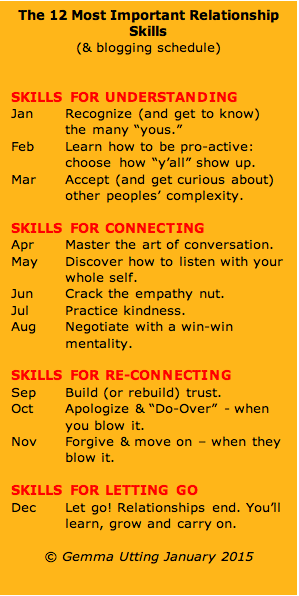
Click the box for the full list.  →Top 12 Relationship Skills
If you’re interested in reading this blog in sequence, below are links to the series to date, beginning with the first posting at the top.

OVERVIEW

SKILLS FOR UNDERSTANDING

SKILL ONE ~ Recognize (and get to know) the many “yous.”

SKILL TWO ~ Learn how to be pro-active: choose how y’all show up.

SKILL THREE ~ Accept (and get curious about) other peoples’ complexity

SKILLS FOR CONNECTING

SKILL FOUR ~ Master the Art of Conversation

SKILL FIVE ~ Learn How To Listen With Your Whole Self

SKILL SIX ~ Crack The Empathy Nut

SKILL SEVEN ~ Practice Kindness

SKILL EIGHT ~ Negotiate with a Win-Win Mentality

The #1 Reason Marriages Fail

And no, it’s NOT what you think!

Despite the fact that numerous couples interviewed after divorce cite things like ~

  • Incompatibility
  • Adultery
  • Boredom
  • Abuse
  • Marrying Young

(from Legal Zoom)

and despite the fact that numerous autopsy studies after a divorce cite things like ~

  • Getting in for the wrong reasons
  • Lack of individual identity
  • Becoming lost in the roles
  • Not having a shared vision of success
  • The intimacy disappears
  • Unmet expectations
  • Finances
  • Being out of touch … literally
  • Different priorities and interests
  • Inability to resolve conflicts

(thanks to Your Tango)

these remain symptoms of a much deeper problem, not the problem itself.

Screen shot 2015-10-26 at 11.55.54 AM

It’s as simple and as challenging as that!

Here’s why.

Core human needs will ultimately trump everything else.

What are core human needs?

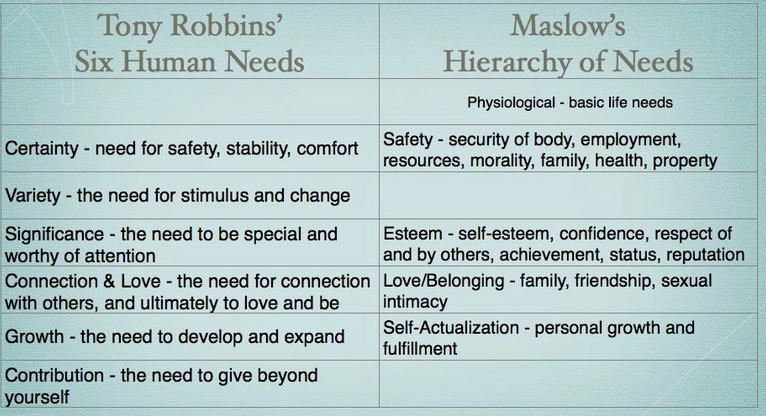
I love using Tony Robbins’ list. It’s short, memorable and in alignment with Maslow – the “grandfather” of needs identification.

Screen shot 2015-08-05 at 7.30.12 AM

Below are some simple stories illustrating how these needs might be unmet in a relationship. I use the six terms Tony Robbins uses:

  • Certainty
  • Variety
  • Significance
  • Love and Connection
  • Growth
  • Contribution

I use actual examples from my clinical practice, with identifying names and circumstances changed, to build my case that it’s not the specific “crime” that brings the relationship down. It’s the inability of partners to negotiate, to advocate for their needs.

CERTAINTY / VARIETY

Max and Ira were international circus performers (yes – I meet fascinating clients!). They met when Ira was hired by the same prestigious group of performance artists and spent three years traveling the world with the group. They fell in love. They committed to one another and spent nearly every waking moment together for five years. Somewhere along the way, Max’s capacity for constant shift and adventure took a toll on another deeper need he felt for stability. For nesting. For settling down into a lifestyle he could count on. He wanted to be sure he’d know where he’d be 3, 6 18 months into the future. He wanted to put down roots. And he wanted Ira by his side.

Ira was still enchanted by the lifestyle that circus performing gave him; international travel, astonishing highs, a degree of fame. That almost lottery-ticket thrill of not knowing exactly what his apartment or city would look like 6, 9, 18 months out. He adored international vagabonding and performance art and he wanted Max by his side.

They knew other couples in their circus community who managed marriages and even families, but they could not negotiate a solution.

Max’s need for certainty, and Ira’s need for variety were, for these two, the stumbling blocks that ended their relationship.

As an interesting aside, the fastest growing segment of the population getting divorced is the over 50 set. It’s super high over 65. But, as Bridgid Schulte writes in The Washington Post  “More than half of all gray divorces are to couples in first marriages. Indeed, 55 percent of gray divorces are between couples who’d been married for more than 20 years.”

Folks have been unable to negotiate sufficient variety in their lives or marriages… they’ve been drowning in their own long-outdated need for certainty!

SIGNIFICANCE

Oh, I could name scores of couples here where one partner was unable to communicate to their spouse / lover / former adored chosen-one how much they ached to be really seen. To be considered as relevant. As special. As worthy of time and attention.

But I’ll tell you the story of Cassandra and Rex. The classic beginning, they met in med school. Rex was a rare male going into Psychiatric nursing while Cassandra had a knack for surgery. They courted in the exhausting crucible of residency and first jobs and both were initially deeply supportive. They had a wide circle of friends, were generous and social, and married with a showy bash funded by Cassandra’s wealthy parents.

They came to me about seven years later. Their careers were flourishing. They were both superb at what they did, well paid, articulate, well-respected in their fields.

The core issue?

Underneath it all, Rex believed Cassandra did not value him, who he was, or his profession. He noticed how certain unkind comments slipped out at gatherings; how she said the word “nurse;” how she’d blow off commitments they had as couple with his friends, for non-emergency get-togethers with her friends (all surgeons).

The way Cassandra treated Rex fed into his own core insecurities. Rex had a core Part of himself who felt insignificant in his own eyes. This part needed Casandra to value him all the more. Meanwhile, Cassandra too had a powerfully insecure part cultivated in her high achieving family home. This part leveraged a sense of significance by looking down on Rex.

The way forward for them as a couple would have been for them each to meet and heal their core insecurities. They each needed to feel significant in their own eyes first. Absent that, their way of meeting their personal need for significance was coming at the expense of their partner.

But because they had spent so many years hiding from themselves, because the system they had evolved had Cassandra managing her insecurities by letting Rex see her as highly significant and Rex managing his insecurities by having Cassandra as his wife, they had caused one another too much pain and decided to divorce and move on.

CONNECTION AND LOVE

Because the need for love and connection is so central in relationships, it’s the inability of partners to negotiate  this prime need that brings most couples in to see me.

Once that loving feeling has worn off, how do two people continue to express and receive love from one another?

We may have moved into the 21st century, but Della and Rob’s situation is repeated with subtle variations in (dare I say this?)  many couples in the USA?

Once the post-romantic-love high has worn off, couples settle into the business of living. Earning a buck. Making a home. Raising a family. Both Della and Rob love their work and in fact, increasingly, getting out the door in the morning to go to work is the highlight!

It’s on the home front that things are a battleground. Della has been totally unable to get Rob to see that “if he loves her” he will ~

  • Pick up his laundry
  • Fold the towels and put them away
  • Do the dinner dishes
  • Cook occasionally
  • Help her teach manners to their hyper-active toddler
  • Help her discipline their overly-sassy-pre-teen
  • Vacuum
  • Be OK with her time spent with girl friends on weekends

And Rob is increasingly loosing the battle to negotiate for the two things that spell love for him ~

  • Weekly sex
  • Weekend TV sports

As these individual but differing recipes-for-love go un-expressed and un-negotiated, they remain unmet. Each partner feels increasingly alone in the marriage, and they begin to drift apart.  By the time Della and Rob  came to see me they were ready to hit the “eject” button out of their marriage without having done the work necessary to prevent them from re-creating this same scenario again. The work? To figure out their core needs and learn how to negotiate for them fair and square.

For too many folks it seems easier to just start over with pockets full of hope than to do the important inner work that no one has taught them how to do anywhere along the way. (Yes, you hear my frustration with our educational system!)

GROWTH

Healthy couples allow space and room for each partner to grow. When one person wants to get a degree, start a business, travel the world, fly airplanes or learn Arabic and work with the International Rescue Committee – how they negotiate this expansion is key.

Both sides have work here – the one negotiating for the new thing will be wise to be mindful of their partner’s needs (maybe for certainty, maybe for significance after this new event) and the partner being invited to embrace these expanded horizons will need to manage their own fears and perhaps invite their own aspirations.

Elise and Frank came to see me on the brink of divorce, but are now in some solid negotiations with themselves and one another.

Elise has a promising break with her acting career which could take her to New York. Frank is heading for tenure at a good University in the mid-west. It’s a crux move in their marriage. Fortunately they are both willing to look inside themselves to see what triggers these two opportunities are igniting, and what needs these opportunities are meeting for each of them, and one another. Thus informed, their negotiations are grounded in self-awareness and understanding which is allowing them both to be creative, flexible and willing to do the work necessary to have a marriage in which growth is not only possible, but supported with enthusiasm.

CONTRIBUTION

Maybe with a twist of irony, think American Sniper here. For those who don’t know the story, here’s a summary lifted from the Amazon publicity spiel on the link above.

From 1999 to 2009, U.S. Navy Seal Chris Kyle recorded the most career sniper kills in United States military history. His fellow American warriors, whom he protected with deadly precision from rooftops and stealth positions during the Iraq War, called him “The Legend”; meanwhile, the enemy feared him so much they named him al-Shaitan (“the devil”) and placed a bounty on his head. Kyle, who was tragically killed in 2013, writes honestly about the pain of war—including the deaths of two close SEAL teammates—and in moving first-person passages throughout, his wife, Taya, speaks openly about the strains of war on their family, as well as on Chris.”

Clearly it sounds as though this couple did a remarkable job of negotiating a way to allow Chris’s desire to contribute to his fellow Seals to continue as long as it did. And, it put enormous strains on their marriage and family.

Living with a “legend” isn’t always easy…

***********************************

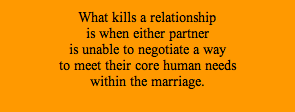
So if – as I have come to believe after nearly 20 years of working with couples – the #1 reason marriages fail and relationships end is because one or both partners is unable to negotiate a way to meet their core human needs within the marriage, then these three things need to happen.

  1. We need to understand more about our own needs

We need to spend time with ourselves and ask ~

  • What needs do I have?
  • How do I meet my own needs?
  • How do I choose which needs to meet if I have more than one and they seem to compete?
  • How do I negotiate my needs when I’m around others?
  1. We need to understand more about our partner’s needs.

As we are getting to know a potential partner, we need to ask ~

  • What needs does my partner have?
  • How does my partner meet his/her own needs?
  • How does my partner choose which needs to meet if s/she has more than one and they seem to compete?
  • How does my partner negotiate his/her needs around others?
  1. We need to understand how to negotiate our needs as a couple.

As we consider building a relationship together, we need to explore ~

  • What needs do we each have in this relationship?
  • How do we each advocate for our needs to be met?
  • What do we do when it seems as if our needs are in competition or mutually exclusive?
  • What does each of us do when we feel our needs are not being taken seriously by our partner?

STAY TUNED!

This is a huge topic and I’ll be exploring it for the next 3 posts.

FEATURED IMAGE

Thanks to the Your Tango article referenced in this piece.

FIRST TIME HERE?

This is the latest article in a year-long series on the “12-most-important-relationship-skills-no-one-ever-taught-me-in-school-but-I-sure-wish-they-had.”

Click the box for the full list.  →Top 12 Relationship Skills

If you’re interested in reading this blog in sequence, below are links to the series to date, beginning with the first posting at the top.

OVERVIEW

SKILLS FOR UNDERSTANDING

SKILL ONE ~ Recognize (and get to know) the many “yous.”

SKILL TWO ~ Learn how to be pro-active: choose how y’all show up.

SKILL THREE ~ Accept (and get curious about) other peoples’ complexity

SKILLS FOR CONNECTING

SKILL FOUR ~ Master the Art of Conversation

SKILL FIVE ~ Learn How To Listen With Your Whole Self

SKILL SIX ~ Crack The Empathy Nut

SKILL SEVEN ~ Practice Kindness

SKILL EIGHT ~ Negotiate with a Win-Win Mentality

  • The #1 Reason Marriages Fail

Independence, Co-dependence and Interdependence

So – I got this great question from a reader:

Whats the difference between independence, co-dependence and interdependence. How do you create a relationship where you can rely on your partner without losing yourself in them, or keeping too much distance? And how do you get your partner on the same page?

Let me start by admitting that – because I have long been haunted by this question – my husband Mark and I actually took separate honeymoons.

Figuring out how to be “me” in the thick of falling in love with “him” was mind-bogglingly hard for me.

We decided to marry after a relatively tumultuous 2-year courtship which I jeopardized spectacularly by testing out a different suitor. This chap (let’s call him Bill) had invited me to help him bring a small gill netter down Alaska’s Inside Passage.

Screen shot 2015-07-16 at 11.00.31 AM

Oh, it’ll be fun. Should take about a week,”

he reassured me and I tried to reassure Mark.

I flew up to Ketchikan against my better judgment and dire warnings from friends. Ten days later I left Bill on a dock in Nanaimo on Vancouver Island.

The boat (and my relationship with Bill) had sprung a leak way beyond the reach of our resources to repair. The boat was dangerously low in the water. I had no money. I was very hungry and I was stranded in Canada without a passport. Not a good idea for a Brit on a work visa.

So when I made a collect call to Mark in Seattle (a 5 hour drive away across an international border) explaining my sorry state he simply responded:

I’ll be right there.”

Clearly I chose the right guy!

So sure, I’d chosen a fabulous man to marry but that was just the first step. Now we had to navigate that tightrope between two of the most powerful human drives – AUTONOMY vs ATTACHMENT – which, when taken to their extremes, cause a whole heap of problems for couples trying to come together.

Essentially there is a continuum that looks more or less like this ~

Screen shot 2015-07-22 at 11.54.59 PM

with folks who choose total isolation on the left and folks who want to be fused with others on the right. If you are in a relationship and noticing issues, it’s unlikely you’re at the extremes. More likely you’ll find yourself somewhere between counter-dependence (where a person strives not to be dependent on anyone for anything, thus avoiding attaching to anyone else) and co-dependence (where a person strives not to depend upon themselves for anything, thus avoiding their own ability to be an autonomous human being).

So, let’s meet those troublemakers

On the extreme end of AUTONOMY and the “I’m all alone in the world and that’s how I like it” team we have, Ladies and Gentleman, the mighty stand-alone COUNTERDEPENDNECE

20150118_211709

Think independent cat, totally disdainful of neediness.

This is our family cat “Mo”. The cat can sit wherever she chooses – including taking the prime spot right in front of the fire.

Counter-dependence occurs in dysfunctional families when a child experiences insufficient bonding and attachment, loss, abuse or the pain of betrayal. (To have loved and lost).

For these folks their  ~

  • Trust issues are “It’s simple. I don’t trust. Anyone.”
  • Core belief is “If I trust, I will be betrayed so I keep my distance.”
  • Favorite anything is “None of your business
  • Their favorite song is “Ill do it my way
  • Communication style is “Ill tell you how I want it
  • Daydreams “Include me, myself and I
  • Senses “What senses? I am disinterested in feedback
  • Control “Is focused on keeping me aloof and separate.” 
  • Assessment of problems “What problems? You lookin at me?
  • Ambition is “To succeed on my own
  • Worst fear is “Being controlled, manipulated, impacted by or vulnerable to anyone
  • Main move is “Whatever it takes to keep my distance”.

And on the extreme end of ATTACHMENT and the “I’m nothing without you and what do you want me to do now?” team we have, Ladies and Gentleman, CO-DEPENDENCE (and support team)

20141215_140925_LLSThink small designer pup who will do anything to please you, especially if treats are involved.

This is our family dog “Bailey”. Here she suffers yet another indignity, persuaded by her need for our love, and her fondness for treats. This is the annual compulsory enjoyment photo-op with The Christmas Antlers.

Co-dependence occurs in dysfunctional families where addiction, abuse, or chronic mental or physical illnesses are present but not addressed. The child in such a home learns to repress their feelings and needs.They don’t trust, don’t talk and don’t rock the boat.

For these folks their  ~

  • Trust issues are “I don’t trust myself to manage life separately from other people.”
  • Core belief is “I manage pain by merging myself with someone else in whose love I am whole, and by controlling the environment to keep everything OK
  • Favorite anything is “The same as my beloveds
  • Favorite song is “Love, Love Me, do
  • Communication style is “If I want my opinion Dear Ill ask you for it
  • Daydreams “Involve lots of obsessing over my mistakes and what others think of me
  • Senses “Are tuned to how everyone around me is feeling
  • Control “Is focused on getting others to think, speak and act a certain way
  • Assessment of problems “Goodness, everyone around me is in trouble.
  • Ambition is “Complete mind-meld with my Beloved
  • Worst fear is “Being pushed away, ignored or abandoned
  • Main move is “Whatever it takes to keep my beloved with me.

These are the extreme ends of the “super drives” that impact a person’s capacity for closeness, intimacy and connection. If you want to dive more deeply into these ideas you might enjoy Dr. David Schnarch – here’s a helpful intro:

One of the most important things in life is becoming a solid individual. And another important thing is to have meaningful relationships. Two of the most powerful human drives are our urge to control our own lives (autonomy), and our urge for relationship with others (attachment). One of the biggest tasks of adulthood is being able to balance these two urges, and one of the most common problems is having too much of one, and not enough of the other. People often feel claustrophobic or controlled in committed relationships, or feel like they can’t be their true self in their relationships, or feel like their sense of self is starting to disappear and they don’t know who they are any more. Others are constantly worried about “abandonment,” or “safety and security,” and constantly press their partner for “commitment,” and “unconditional love.”

Long term relationships are the perfect school-of-life for this journey. Dr. Schnarch refers to marriage as a “crucible” – you know, that feeling of being held “in a container in which two metals melt and undergo a severe trial”. Ouch!

So what new state are we hoping to emerge into after the high heat of relationship?

No matter how we’ve emerged from our childhood experiences – whether they were traumatic enough to plunge us to the far reaches of these positions of counter or co-dependency –  it seems a not unreasonable goal (or at least desire) to find some middle ground, where we can be both ~

  • the best version of our unique Self, &
  • mutually interdependent with the person we love.

Dr. Schnarch again:

The ability to balance our needs for autonomy and attachment is called differentiation. Differentiation is a scientific process that occurs in all species. For humans, it is about becoming more of a unique individual and a solid person through relationships with others.

So, back to that honeymoon.

20150717_161830_Richtone(HDR)Our plan was to spend an open-ended time in Europe, partly touring in our VW camper; partly working on an Uncle’s organic farm in Portugal; partly learning French and skiing in Grenoble; partly working on an Israeli Kibbutz; and partly spending time with our Europe-based family.

For my leaning-toward-the-far-end-of-Independence-since-I-lost-my-mum-whom-I-adored-so-was-reluctant-to-entrust-my-heart-to-anyone-ever-again Self, this was a challenge.

While one happy day passed to the next, I was also increasingly aware of another voice, my “be careful, don’t get too close!” warning voice, that worried I was eroding my ability to ~

  • enjoy my own company
  • make my own decisions
  • sit in silence
  • be spontaneous
  • not care how I impacted anyone.

So, perhaps under the guise of “fun & adventure” (a clarion call for both of us) we hatched plans for a month apart. Mark took himself off to hike the high Alps in Austria. I took myself off to hike part of France’s Grande Randonee.

We took 4 weeks apart (our total Honeymoon was 18 months) and I spent every day of that month witnessing my own enormous inner battle. On the one side was my major Independent Part who dreaded the vulnerability, mourned the loss of my single freedom, worried about the future compromises and found fault with how Mark did things (in his absence of course!). On the other side was my major Dependent Part who yearned for his arms, the closeness, the delight of being seen, known and appreciated, the easy fun we had together and the future plans we were hatching.

Looking back, I think this is what we all have to do – in our own way and on our own time frame – to resolve this issue.

The art of differentiation is finding this middle place where we learn how to become fully ourselves, in the context of another.

Easier said then done – I know.

Here are my TOP FIVE TIPS for finding a happy balance point between isolation and fusion, in your relationship for you and your partner.

1. Wrap your head firmly around these concepts. If it seems like you and your partner might be struggling because you have very different needs regarding time together and time apart, or connection versus independence, check out the links in this article and continue to research the five main terms I’ve been using in this article ~

  1. Counter-dependence
  2. Independence
  3. Interdependence
  4. Dependence
  5. Co-dependence

We don’t talk about them all the time, but they are super helpful to grasp.

2. Be honest with yourself. Figure out where you are on this Autonomy to Attachment Scale.

Autonomy to Attachment Scale

If you’re on the Autonomy, or minus side, you may find yourself ~

  • with an avoidance mindset
  • distancing
  • hiding emotionally
  • withholding
  • keeping your distance

If you are on the Attachment, or plus side, you may find yourself ~

  • with an approach mindset
  • pursuing
  • demanding intimacy
  • giving
  • seeking to blend
  • closing distances

3. Talk About This With Your Partner. It helps to know if your needs for autonomy & attachment are similar, complimentary or problematic. Talk together about what that center ZERO point might look like in your relationship.

4. Do your own personal work. Just because you’ve “caught” your partner does not mean you should give up becoming a more conscious, compassionate “best version” of who you have the potential to become. In fact, you owe it to your partner to keep up the good work. Not sure where to begin? Well – one place to start is with the very first posting in this relationship series with, Part of Me Wants.

5.  Get Help If You’re Stuck.  That’s what folks like me are for. As long as you can do this on your own, that’s fantastic. But a good therapist will help you figure out what needs to happen to help move you over any relationship stumbling block you may be encountering. This is tough stuff – give yourself a break!

So how did the marriage go?

It’s been 32 years since Mark and I tested our capacities for tolerating closeness and separation on our independent honeymoons. Looking back – since I’d not known about these issues nor created the Autonomy – Attachment scale back then – we figure Mark’s a +4 and I’m a -4, so we’ve had our fair share of bumping into one another’s preferred boundaries there.

We’ve achieved a close-enough to Zero balance for interdependence that we’re ever going to attain. We’ve loved and raised 2 children; started and folded companies and earned our living a variety of ways in a variety of countries; we’ve interwoven our lives with extended family and celebrated births, weddings and funerals; we lived with a variety of exchange students, long term house guests and animals; we take vacations together and apart; have overlapping and independent interests; and we work to never be boring – to ourselves or one another. That ever present juggling to foster each of our individual paths in the context of our marriage has become less and less an “either / or” feeling and more and more a both / and.

It’s a journey well worth the taking.

PS: A dear friend (thank you Stuart) who helps edit these posts wrote this:

The journey to zero is not an easy one even when the desire for it is evident. It is a journey that requires a sense of “worthiness, authenticity and vulnerability” that can be elusive at times. It also requires intentionality –  it doesn’t just happen.”

Good point!

* * * * * * * * * * * * * * * * * * * * * * * * * * * * * * * * * * 

FIRST TIME HERE?

This is the latest article in a year-long series on the “12-most-important-relationship-skills-no-one-ever-taught-me-in-school-but-I-sure-wish-they-had.”

Click the box for the full list.  →Top 12 Relationship Skills
If you’re interested in reading this blog in sequence, below are links to the series to date, beginning with the first posting at the top.

OVERVIEW

SKILLS FOR UNDERSTANDING

SKILL ONE ~ Recognize (and get to know) the many “yous.”

SKILL TWO ~ Learn how to be pro-active: choose how y’all show up.

SKILL THREE ~ Accept (and get curious about) other peoples’ complexity

SKILLS FOR CONNECTING

SKILL FOUR ~ Master the Art of Conversation

SKILL FIVE ~ Learn How To Listen With Your Whole Self

SKILL SIX ~ Crack The Empathy Nut

SKILL SEVEN ~ Practice Kindness

Can We Ever Be Too Kind?

  • Do you ever wonder where the line is between kindness and enabling?
  • Do you ever worry you’re becoming a doormat whilst believing you’re being kind?
  • Do you ever sense that someone’s apparent “kindness” feels sticky or needy in some way?
  • Do you ever find yourself torn between being kind to yourself OR being kind to someone else?

Good!

I think there is a deeper story about kindness and it’s worth exploring. Dr. Neil Young (not the musician) taught in the psychology department at Seattle University in the late 1980’s while I was getting my masters degree. He was both well traveled and an excellent observer of human nature. He collected fascinatingly brief, succinct verbal-images of some of the more unusual people he met.

One, I’ve never forgotten. Screen shot 2015-07-14 at 7.51.37 AM
A gentleman standing outside Kings Cross station. He wore a long woolen coat, a bowler hat, and carried an umbrella. He looked comfortably off, but not wealthy. There was an overall threadbare air and the sense that things had once been better.

In my imagination he looks like this →Screen shot 2015-07-12 at 1.50.31 PM

He stood greeting people as they hurried into or out of the station. He’d tip his hat if he felt he’d caught someone’s eye and offer them something.

Neil was curious, so caught the gentleman’s eye.

The gift was a regular sized business card on which was printed:

Screen shot 2015-07-14 at 7.38.53 AM

Neil thanked the man and asked him about the sentiment. Why did this man feel compelled to hand out cards telling us that we can never be too kind?

Apparently, the man’s eyes moistened in response and he patted Neil on the arm but said nothing. He didn’t wish to add anything to the message on the card. This was his life’s lesson. Summed up on a small card, and offered free to those who were open to receiving the message.

Neil found it very moving and brought the card back to our class so we could investigate this idea with the question:

“Can we ever be too kind?”

Without boring you with our lengthy process, what we discovered in those discussions is wonderfully relevant for exploring those muddy edges of kindness that show up as the questions I posed at the beginning. Here’s what I learned about kindness.

  • Being NICE and being KIND are two very different things.
  • Being NICE stems from fear. Being KIND stems from love.
  • One can certainly be too NICE. One can, indeed, never be too KIND.

Let’s break that down.

1.  Being NICE and being KIND are two very different things.

NICE

The origins of the word “NICE” are not nice at all. In fact, it’s a highly imprecise chameleon of a word. It’s earliest roots are Latin, and if a Roman described you as “nescius” they meant you were ignorant or incapable as in “not-knowing,” from ne- “not” + stem of scire “to know”; The term then evolved as follows:

  • 1100s – (in old French) careless, clumsy, weak, poor, needy, simple, stupid, silly, foolish
  • 1200s – foolish, stupid, senseless, and timid
  • 1300s – expanding from timid to fussy & fastidious, “nice” went on to acquire more culturally valued traits such as dainty and delicate
  • 1400s – then precise and careful
  • 1500s – and so it was cleaned up even more and preserved in such terms as a “nice distinction” and “nice and early”
  • 1769 – to agreeable and delightful
  • 1830 – all the way up to blur the lines with kind and thoughtful.

What a journey!

Today the adjective “nice” packs some combination of being pleasing, agreeable and pleasant yet there are some subtle, sticky overtones to the quality of “niceness.”

We are rarely “nice” in private. Being nice matters to the extent it is viewed. Being nice is about making a particular impression on the recipient of our niceness. It’s an externally driven behavior having to do with “perception management.” It is, in brief, “an outside job” produced within a context of judgment.

Parents plead with their kids to “be nice” when Grandma comes, and tell their little darlings that “nice people don’t do that” as toddlers do what toddlers do, but in public.

KIND

Kind has a – well – “kinder” pedigree. It first shows up in middle English having been born in the dark ages to emerge around 900 AD meaning natural, well-disposed, genial.

Kindness is presumed to arise from within and the term describes an internal state of benevolence. There is first this natural state of consideration, indulgence, geniality and helpfulness toward others from which proceeds kindness. It is, in brief, “an inside job” up-welling and not motivated by judgment.

Parents who invite their children to be “kind” are usually involved at the level of conscience, and might be gently nudging their little ones to dig deep within themselves to take an action no one will praise them for. I vividly remember my mother taking me aside after some sort of tiff with a friend and asking me, “What’s the kindest thing you could do here my darling?” And whatever it was that I chose to do was definitely not something that saw the light of anyone’s praise, or even knowledge.

2.  Being NICE stems from fear. Being KIND stems from love.

So, if being “nice” is a state where we behave in a way that is designed to have our audience think well of us, and being “kind” is a behavior that wells up from within a heart that is full of benevolence, I think it’s fair to say ~

  • NICE is motivated by fear &
  • KIND is motivated by love.

So what?

Returning to the questions I began this article with ~

  • Where’s the line is between kindness and enabling?
  • When am I being a doormat in the pursuit of “kindness”?
  • What’s up when someone’s apparent “kindness” feels sticky or needy in some way?
  • Why do I have to sacrifice kindness to myself in order to be kind to someone else?

Let’s see how this idea plays out by way of a guide in discerning the answers to these wonderings.

There are two questions worth asking right off the bat:

  1. What am I afraid of?
  2. What’s the most loving thing I can do, for all involved, in this situation?

I’ll take you through a personal journey to illustrate my point. After Mark and I had been married about 14 years we hit a pretty serious low. Mark had started a hydrogeological consulting company and commuted into Seattle from our home in Port Townsend several long days a week. I worked half time at the local Community Mental Health Center as a marriage and family therapist. By mid 1997 we had two children aged 2 and 6. We thought we’d found a good balance of personal-to-couple-to-family life by organizing each weekend so Saturday was a “day off” for one of us, and Sunday was family-day. And my part-time schedule allowed me to do the household management while Mark commuted.

But, as Mark grew increasingly stressed by long days, high-stakes projects and the inevitable dip in marital satisfaction that comes for 67% of couples with small children, I let “niceness” set in. Weekend after weekend I offered Mark “my” day off. Months went by when Mark would take one day each weekend and we’d have a family day the other, yet we both grew increasingly burned out. I thought I was being kind to Mark – surely he could see how I was “sacrificing” my weekend day for him? But, was this kindness?

  • Was I enabling an unhealthy pattern?
  • Was I being a doormat?
  • Was my “kindness” sticky with gooey unspoken resentments?
  • Why did it  feel impossible to be both kind to myself and kind to Mark?

OK, so let’s try those two questions.

1. What was I afraid of?

  • I was afraid that Mark’s stress would make him grumpier and grumpier (which was happening).
  • I was afraid we’d fight.
  • I hated the distance I felt when he was exhausted and drained.
  • I felt resentful since I worked half-time and had full time home-and-kid duty.
  • I was afraid, deep down I suppose, that he’d burn out on his job and put us in a precarious financial position.

So, the truth was, I was being “nice” to Mark because I was far more fearful for us than loving of us.

2. What was the most loving thing I could have done, for all involved, in that situation?

  • Love myself enough to listen to my resentment and doubt.
  • Share these deeper truths first with myself, and then with Mark.
  • Talk together about what was the most loving thing for all of us – the children, Mark and me.

In fact, I slowly did this. I committed to an inspiring Artists Way therapy group and admitted I was frustrated, resentful and afraid to rock the boat. And then began a journey back toward what felt most true about who I was and how I wanted to live.

Eventually I began to talk with Mark. Each one of us digging deep toward an honest self-reflection  until bit by bit we were able to release our fears and share from a place of love once more.

This resulted in a radical lifestyle change, and when our children were 5 and 10, we rented out our Port Townsend home and took a family sabbatical in a small beach-side Mexican village for a year.

Screen shot 2015-07-14 at 7.57.21 AM

But that’s another story.

3.  One can certainly be too NICE.

So yes, in light of all this, I believe there are all sorts of dangers to being too nice. If you choose to behave a certain way because you are fearful of the truth and you wish to present an acceptable “image” the odds are good you are being NICE, not KIND. And with NICENESS comes all those tough dilemmas I began with, and you run the risk of;

  • Enabling unhelpful patterns, false beliefs, and distance from someone who deserves your deepest truth;
  • Doing the martyr thing, behaving like a doormat whilst believing you’re helping;
  • Manipulating with sticky false behavior designed to be judged favorably;
  • Seeing the world as a “me” versus “them” scenario, which denies that there might be a thoughtful, genuine and honest win/win.

One can, indeed, never be too KIND.

NICE is born in fear and expressed by denying the deeper, honest truth.

KIND is born in love and expressed by engaging honesty with courage.

So yes, I agree with the Kings Cross gentleman’s business card: Screen shot 2015-07-14 at 7.38.53 AM

NEXT WEEK A reader’s question. “What’s the difference between independence, co-dependence and interdependence. How do you create a relationship where you can rely on your partner without losing yourself in them, and be sure your partner also understands and strives for the same balance?”  

FIRST TIME HERE? This is the latest article in a year-long series on the “12-most-important-relationship-skills-no-one-ever-taught-me-in-school-but-I-sure-wish-they-had.”

Click the box for the full list.  →Top 12 Relationship Skills

If you’re interested in reading this blog in sequence, below are links to the series to date, beginning with the first posting at the top.

OVERVIEW

SKILLS FOR UNDERSTANDING SKILL ONE ~ Recognize (and get to know) the many “yous.”

SKILL TWO ~ Learn how to be pro-active: choose how y’all show up.

SKILL THREE ~ Accept (and get curious about) other peoples’ complexity

SKILLS FOR CONNECTING SKILL FOUR ~ Master the Art of Conversation

SKILL FIVE ~ Learn How To Listen With Your Whole Self

SKILL SIX ~ Crack The Empathy Nut

SKILL SEVEN ~ Practice Kindness

Cultivating Kindness

It’s not hard to make the case for kindness.

People are yearning for it.

  • Personally, it’s the vital glue in my close relationships;
  • My article Kindness is Key got more “hits” than anything I’ve written for over a year;
  • Google reports that searches for “kindness quotes” and “acts of kindness” are rising rapidly.

It’s good for us.

  • The study of positive psychology has gathered persuasive hard evidence about the benefits of qualities like kindness, compassion and happiness, a small sampling of which can be enjoyed (and even studied) at The Positive Psychlopedia;
  • An Atlantic article is calling kindness and generosity the Masters of Love.

Humans are possibly hardwired for it.

Primates do it.

  • Professor Franz De Waal has been studying emotions in primates, including cooperation, altruism and fairness, for over three decades, touching off a whole field of primate cognition that continues to inspire.
  • There are fresh new studies of pro-social behavior in primates which continue to reinforce the idea that our close animal relatives instinctively exhibit “altruistic” looking helping behaviors.

So – if kindness is yearned for, good for us, innate at birth and alive and well amongst certain primates, why does it become so hard to come by between people who love one another?

One clue to answering this might lie in the research of David Rand, assistant professor of psychology, economics, and management at Yale University, and the director of Yale University’s Human Cooperation Laboratory

In his paper spontaneous giving and calculated greed Dr. Rand discusses his findings that given a brief decision-making window, people will instinctively choose the pro-social (or kinder) option. But, give them time to think it over and they’ll be more selfish.

So, let’s slow that down.

Our first, innate instincts are pro-social and kind.

But once we get to thinking, we over-ride this instinct.

And we tend to over-ride this instinct a lot with the people we love:

in our long-term relationships where familiarity can breed discontent.

Right there in that pause between stimulus and response when your partner (to continue the examples from last week) ~

  • Looses the car keys – again
  • Trumps your punch line and finishes your story – again
  • Burns the fresh wild Alaskan King Salmon fillets – again
  • Forgets your birthday – again
  • Surfs the channels until you’re dizzy – again
  • Grunts at you over morning coffee – again

and you’re frustrated and disheartened because you’ve tried a thousand different ways to communicate that this behavior drives you nuts,

and right then you quell any instinctual kind response and instead go Hamlet and ask yourself a version of “To be (kind), or not to be (kind)?”

In that moment of thought, your natural kindness instinct is gone – Pooft!

And instead you feel an upsurge of anger and think to yourself,

How the blazes do I play the kindness card when I’m frustrated and disheartened and my partner is unreasonable and forgetful?

Screen shot 2015-07-07 at 12.30.55 PM

And in that moment of thought

a huge gulf opens up within you

and your heart divides.

On one side lurks the story you tell yourself about what has happened.

On the other side lies your ability to respond kindly.

As an IFS-trained couples counselor, I think David Rand is onto something important about what happens when we replace instinct with reason.

The moment we stop to think, we open our inner Pandora’s Box. And this box is always very full of opinions and judgments, the belief in which allows us not to feel what we feel. Particularly our thinking protects us from feeling the pain of ~

  • isolation
  • vulnerability
  • unworthiness
  • unlovability
  • shame.

See if any of these feel familiar.

THE GOLDEN SCRIPT IS THE ALL TOO FAMILIAR TRIGGERING INCIDENT

  • The blue script is the thought that interrupts your instinct to be kind
  • The red script is the feeling you may be trying not to feel.

* * * * *

LOST KEYS

  • My partner’s needs and chaos are interrupting me and my life far too much.
  • I feel overwhelmed by all the demands on my time.

STOLEN PUNCH LINE

  • Why does my partner have to steal my thunder all the time?
  • We get so competitive around others. I feel like I’m not interesting enough.

BURNT FISH

  • My partner can’t even focus and accomplish one thing for “us” at home.
  • I feel so alone when we can’t pull off a simple team effort like a meal .

FORGOTTEN BIRTHDAY

  • I make a big fuss over everyone’s birthday in this family, so why can’t they do the same for me?
  • I feel invisible, unlovable & too vulnerable to remind folks when my birthday is coming.

CHANNEL SURFING

  • He’s so twitchy and uncentered. Why can’t he just settle on a program?
  • I feel ashamed that I waste time like this but can’t find anything more interesting to do for myself.

NO COMMUNICATION OVER MORNING COFFEE

  • I have to make all the decisions around here – my partner’s non-functional every morning.
  • I feel so isolated when I can’t connect with my partner before we both leave for work.

So now you’ve got ~

A behavior in your beloved that you once found endearing and met with kindnessyou used to help find the keys, and you used to find it reassuring when your beloved knew your stories so well  they could finish them

is now immune to your original kindness response  – because your story about this behavior interrupts your initial pro-social instinct

and instead your story about this incident triggers your core vulnerabilities – and the accompanying not-so-great-feelings inside of you

and you lash out, tilting at the windmills outside of you, when actually the pain is all internal.

Because your cup is empty. Because you are not happy. Because you have not been kind enough to YOU.

WHAT TO DO?

My new friend and Buddhist teacher Kathleen Rose of the Boise Institute for Buddhist Studies connected me with a wonderful teaching I’d love to share briefly here, with a link to a fuller article.

In the face of inner overwhelm when you are underwhelmed by kindness for yourself or others, remember the RAIN of Self-Compassion. I quote briefly from this article here, or click that title link for the whole piece.

The acronym RAIN, first coined about 20 years ago by Michele McDonald, is an easy-to-remember tool for practicing mindfulness. It has four steps:

Recognize what is going on;
Allow the experience to be there, just as it is;
Investigate with kindness;
Natural awareness, which comes from Not identifying
with the experience. Or, more simply Non-attachment.”

To cross that enormous gulf of pain that opens up when thinking interrupts your instinct and separates you from your original pro-social drive, you only have to eliminate the story!

You already have everything you need to be kind.

You are an innately kind person who has lost touch with your instinctual ability to be kind because you’re drained. You’ve exhausted yourself by first creating these inner protective beliefs and then by believing these tales you tell.

SO TO CULTIVATE KINDNESS

in yourself and others, the next time someone in your life does what they do that you normally find so irritating, try 3 things:

  1. Recognize anything other than a kind instinct within as a self-diagnosis of inner overwhelm. All is not well if you are separated from your naturally compassionate self.
  2. Remember RAIN of Self-Compassion.
  3. Turn toward this person with a refreshed heart and remember what you used to do that was instinctively kind. You’ll know. If not, simply say “You know, here we are again – with you doing this and me on the verge of reacting. But I’m done reacting negatively. I’m sorry I’ve been so grumpy. I’ve been running on empty but I’m taking better care of myself. What do you need right now?”

See what happens.

I’d love to hear about it!

 * * * * * * * * * * * * * * * * * * * * * * * * * * * * * * * * * * * * * * * * * * *

FIRST TIME HERE?

This is the latest article in a year-long series on the “12-most-important-relationship-skills-no-one-ever-taught-me-in-school-but-I-sure-wish-they-had.”

Click the box for the full list.  →Top 12 Relationship Skills

If you’re interested in reading this blog in sequence, below are links to the series to date, beginning with the first posting at the top.

OVERVIEW

SKILLS FOR UNDERSTANDING

SKILL ONE ~ Recognize (and get to know) the many “yous.”

SKILL TWO ~ Learn how to be pro-active: choose how y’all show up.

SKILL THREE ~ Accept (and get curious about) other peoples’ complexity

SKILLS FOR CONNECTING

SKILL FOUR ~ Master the Art of Conversation

SKILL FIVE ~ Learn How To Listen With Your Whole Self

SKILL SIX ~ Crack The Empathy Nut

SKILL SEVEN ~ Practice Kindness