Category Archives: Couples

How to connect more effectively with your partner.

2 Magic Ratios for Great Relationships

Math that makes sense for your relationships . . .

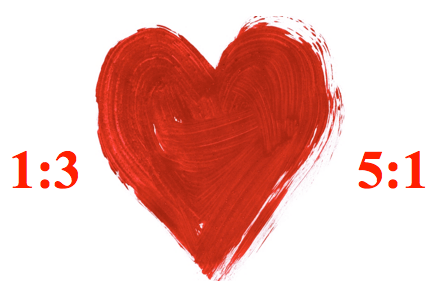
 The 1 : 3 Rule

Every time you interact with another human being one of three things happens.

  1. You feel closer to them
  2. You reinforce what you already feel
  3. You feel more distant

Yes. Every time.

Day in and day out, you are constantly shifting position on some internal ratings scale on your partner’s scorecard. On your kid’s score card. On your boss’s score card. Though in truth these 3 constituencies are each tracking and scoring different things.

Partners want to know “Are we securely attached? Does h/she still love me?”

Children want to know “Is my parent on my team? Am I lovable?”

The boss wants to know “Is this employee worth what I pay him/her?”

More or less anyway.

We humans are counters, quantifiers and score-keepers when we are together.

Evolutionarily speaking it helped us – Is this person safe? Really safe? Not so safe?

Today we’re less evaluating physical safety (though this can be present to a certain degree), but we are evaluating emotional safety. And the thing is, this calculator never gets turned off!

Screen shot 2015-03-17 at 4.06.59 PMIf your spouse looks up in the morning when you come into the kitchen and smiles, or better yet gives you a big hug, they’ll get a point in your “I feel loved by this person” box.

Screen shot 2015-03-17 at 4.09.04 PMIf they behave in a way that seems – to a neutral observer – to be neither particularly loving nor particularly unkind, you probably won’t bother to score them. No new points get added either for or against. This simply reinforces what you already feel.

Screen shot 2015-03-17 at 4.11.03 PMIf, when you walk into the room, your partner walks out, or buries themselves in the newspaper, or gets busy with the social media so you feel excluded and unwelcome, then this person will get a point in your “I feel unloved and pushed away by this person” box.

Have you noticed this?

WHY THIS MATTERS

This matters because we live word by word. Look by look. Gesture by gesture.

Screen shot 2015-03-18 at 7.58.26 AM

Relationships are built or destroyed moment by moment.

Not “in one moment” – don’t get me wrong. But by the accumulation of moments, recorded on your scorecard. The way the stalactites and stalagmites grow in caves – one drop at a time until they are sharp enough to pierce your heart.

Moving on to a money metaphor, every day you are doing one of these three things in your relationships:

  1. Depositing good feelings.
  2. Ignoring the bank account (whilst either paying bank fees or accruing interest)
  3. Withdrawing or subtracting good feelings.

If you keep on withdrawing – you go broke. This is not rocket science!

If you are not paying attention to the balance sheet, you’ll find yourself suddenly out of love. You’ll have squandered numerous small occasions where you could have made a deposit.

And, just like your bank, if you drop below a certain minimum balance you get charged bank fees and if you are above a certain threshold the bank pays you interest, it’s the same difference with our emotional scorecards.

Even if you are behaving “neutrally” (being neither nasty nor nice) your partner will “score” you depending upon whether you’ve met certain minimum standards. If you are typically seen as loving and supportive, even your neutral behaviors will get the benefit of the doubt. But if you are typically seen as distant and unsupportive, your neutral stance will be judged negatively. You could be draining your love bank unwittingly…

WHAT TO DO?

Forewarned is forearmed.

Be aware of how anything you say or do might be received. Which scorecard will get a point if you say what you want to say right now? Can you afford this?

If what you plan to say is more likely to be perceived negatively – you better keep on reading . . .

The 5 : 1 Rule

If you want great relationships, you need to keep the ratio of positive interactions to negative interactions at a ratio of at least 5 positive to 1 negative – even in conflict.

Yup – negative interactions don’t immediately kill relationships.

You can slip up and be ~

  • Thoughtless
  • Unkind
  • Critical
  • Forgetful
  • Selfish
  • Defensive.

As long as you are also ~

  • Thoughtful
  • Kind
  • Supportive
  • Attentive
  • Generous
  • Responsible

 ~ five times more often,

And then, the odds will be ever in your favor.

This research was conducted by Dr. John Gottman and you can find out lots more on his web site.

So, no more excuses.

If you want to build a great relationship with someone remember:

1:3 ~ Every time you interact with this person you are doing one of three things

  1. Building a stronger relationship
  2. Maintain status quo (which might be good or bad)
  3. Undermining what you’ve got with this person.

&

5:1 ~ You want to have 5 positive interactions for every 1 negative one.

In April I’ll be talking more about  how to connect with people – what makes an encounter positive rather than negative (beyond the obvious!).

That’s all for now folks.

NEXT WEEK?

“Why Under-standing is Over-rated”.

FIRST TIME HERE?

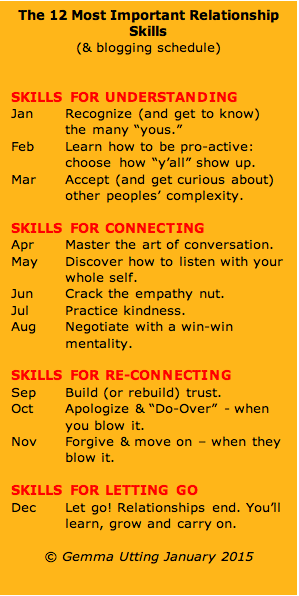
This is the twelfth article in a year-long series on the “12-most-important-relationship-skills-no-one-ever-taught-me-in-school-but-I-sure-wish-they-had.”

Click the box for the full list →    →    →Top 12 Relationship Skills
If you are interested in reading this blog in sequence, below are links to the series to date, beginning with the first posting at the top.

OVERVIEW

SKILLS FOR UNDERSTANDING

SKILL ONE ~ Recognize (and get to know) the many “yous.”

SKILL TWO ~ Learn how to be pro-active: choose how y’all show up.

 SKILL THREE ~ Accept (and get curious about) other peoples’ complexity

How To Change Someone Else

I know. I know.

All those Self-Help books tell you to totally abandon any hope of changing anyone else.

Chapter upon chapter insist you recognize THE only things you have any control over are what you think and what you do.

Could the self help panoply of experts be wrong?

Could they be accused of keeping you overly ~

  • Deferential       “Goodness, it wouldn’t be right to impose my desires on someone else”;
  • Doubtful          “Oh I don’t think it ever works to try and change anyone else;”
  • Defeatist          “I tried once to change my partner and it didn’t work.”

Or maybe you’re more “It’s my way or the highway Bud!” and you wonder why you shed friends faster than an escaped lion empties a zoo.

If you’re in a relationship with someone you love (otherwise it’s not worth the effort) I hope you’ll let me persuade you to ~

  • Drop the deferential attitude – of course you are worthy of interactive relationships.
  • Ditch the doubt – trust in the power of relationship to transform.
  • Dump that defeatism – update your skill set instead.
  • Soften up the  “you’re with me or against me” attitude –  if we let them, other people help us grow in ways we could never devise on our own.

If you want to change the way someone close to you behaves, and maybe even how he or she thinks, here are four things to try.

1.   Meet them half way.

Screen shot 2015-03-10 at 11.40.36 AMLike God and Adam, both make a bit of an effort…

Depends on what you believe needs changing of course. But here are some examples I’ve seen where person A really wants person B to change. Could be a profound life transformation is desired, or a more modest habit change or temporary abatement.

Check these out.

  • A and B are married. A wants to adopt a Vegan lifestyle. B loves meat.
  • Mother A wants 15 year old daughter B to avoid all piercings while she is living at home under A’s roof. B wants a small tattoo and a belly ring.
  • A has fallen in love with B and wants to accept them as they are. But, B smokes a pack a day and A hates the habit.

Do these have to be win / loose?

If you want someone you care about to make a big change, think about it first from their point of view. What’s in it for them to make this change? Why might they want to? Is there something you can offer that might make this change more appealing? If you are inviting this person to get a bit uncomfortable, what discomfort might this request invite you into?

  • Might the Vegan be OK with their partner eating Vegan fare 3 nights a week and enjoying meat for the other 4?
  • Might the anxious Mum let go enough for a henna treatment, or one small, removable piercing?
  • Might the non-smoking partner be willing to discuss a cut-down, or smoking in designated areas?

Maybe give it a try?

2.   Get On Their Team

Screen shot 2015-03-11 at 12.23.41 PM

A man convinced against his will is of the same opinion still.”

A classic Ben Franklin quote.  So what might this look like?

Let’s take another stab at the 3 scenarios above using this idea.

What if the meat eater, the would-be body piercer, and the smoker actually wanted to make some changes?

A terrific way to “get” someone to make changes you wish they’d make, is to find out if there are any changes they want to make.  Maybe they’ve been thinking about a shift more or less in the direction you’ve been proposing. Find out. Join them. Get on their team.

Has the meat-lover ever expressed a desire to lower their blood pressure? Or grow a garden? Or only eat animals raised in humane conditions? Pay attention. Join them where they already are and support a desire they already have.

Yes great! I’d love to help you lower your blood pressure. What do you want to try? I’d be happy to research foods that might help…

Has the 15 year-old ever commented on how lovely Henna art is? Or has she noted other forms of body art that might be different and edgy but not full on tattoos and peircings – like coloring her hair or dressing differently? If she talks about some of these ideas,  get excited. Support her in expressing herself differently.

I love that you’re experimenting with new “looks.” I heard about a Thrift Shop up in Sun Valley that sells quality styles very cheaply.  Shall we check it out this weekend?

Has the smoker ever wished they could cut down? Maybe they worry that cutting down on cigarettes means they will ramp up on eating, or have no other way to manage their stress. Acknowledge their fears, join with their desires, get on their team.

You mentioned wanting outlets for managing stress as you think about lightening up on the smoking. I heard the local library is hosting a month-long series on meditation starting next week. I picked up this flyer for you.”

Screen shot 2015-03-11 at 12.25.22 PM

The solution might not be exactly what you had in mind. But your support for their goal is far more likely to be a wiin-win.

And hey – even a cat can find a way to join a duck in the water.

 3.   Feed The One You Love

Screen shot 2015-03-10 at 12.51.02 PM

     Remember this tale?

Well it works with the wolves around us as well as the wolves within.

We’ve all got an inner zoo. We show up in different ways. As angry wolves or serene wolves for sure. But also as ambitious and lazy; as extroverted and introverted; as nurturing and as harsh; as supportive and as critical.

Think of how often you find yourself saying “Part of me wants this, but another part wants that.”

(Check out Robin Williams as Mork and more about is idea here.)

If we can have multiple competing versions of ourselves, so can everybody else.

One of the most valuable lessons I’ve learned as a therapist is that in any relationship, we get the wolf we feed.

If we indulge or put-up-with whiny behavior from our pre-schoolers; rude behavior from our middle schoolers; disrespect from our teens; unkindness or indifference from our partners, the truth is, we’ve been feeding those wolves.

Once we get to the point of recognizing “Dang, I wish this person wasn’t  like that”  we get to behold our creation. Chances are we’ve been cultivating those very behaviors we now dislike for years.

What to do?

Feed a different wolf!

And yes – it takes time. But so did creating the wolf you’ve come to dislike.

When your toddler asks for something in a strong, clear, pleasant voice go overboard in your delight. You’ve glimpsed a different version of who this toddler is and how she can act. You want to build a relationship with that toddler – much more than you want to continue with the whiny one – right?

You can make it fun.

Well hello little Miss Sunshine, I love it when you show up. You’re way more fun than Old Grumpy! I’m certainly happy to push the swing for Little Miss Sunshine… let’s go!”

When your middle schooler rips a mighty belch and (for a change) quickly covers her mouth and says ‘Excuse me,” celebrate small victories. So easy to be sarcastic here – don’t be. Feed this polite wolf. “Thanks Betsy. Hey – I really appreciate this more polite “You”. She’s welcome to come eat in a restaurant with me any time!

When your teen momentarily thanks you for some kindness and forgets the eye roll as you say ‘You’re welcome” feed that wolf. “You know Son, I like being on your team. I hope you never forget that.”

When your partner one day asks, out of the blue, “Do you need help?” for heavens sake feed that wolf! I know how easy it can be when you’ve been hurt before to come back with some snide “Now you ask! Where have you been hibernating all winter when the drive-way needed shoveling and the kids were all sick…” but remember. When you show up like that – being that person, you’re only going to encourage the unkind and indifferent parts of your spouse.

Feed the “helpful wolf.”  “You know, you asked at just the right moment. I’d love help. Could you grab the rest of the groceries from the back of the car? I really appreciate it when you notice what I need and just show up for me like that – thanks!”

The secret here is remembering that IF this person in your life has ever exhibited the sort of behavior you wish s/he did more often, then that behavior is possible. It is already in their repertoire. That “Part” of them can be invited out more often. It’s not that you are inviting them to be someone new. You are just asking them to show up in a way that works better for you.

You are not saying

  • I don’t love you.
  • Or
  • “I want (all of) you to change.”

You are saying

  • “I particularly love this Part of you.”
  • &
  • “I love it when this Part of you shows up.”

4.   Be the change

Screen shot 2015-03-11 at 12.33.19 PMI’m sure this is not about you, but I’ve noticed that sometimes, in long-term relationships, when partner A feels stuck-in-a rut or gets bored with life, they believe it is up to partner B to “do something.” And this effort, A believes, will magically get both of them out of the rut and life will once more be  fascinating. Or at least, less boring.

So, in the unlikely event this ever happens to you and you find yourself feeling stuck and bored, and notice you are keen for your partner to ~

  • loose weight
  • try something new
  • suggest cool vacation plans
  • learn new stuff
  • get in shape

listen up and go find a mirror.

That person right there – staring glumly back at you – tell that person to

  • loose weight
  • try something new
  • suggest cool vacation plans
  • learn new stuff
  • get in shape

If you are bored in the relationship, you get to do something about it. And it’s way more liberating to grasp that fact than it is to play the grumble-criticize-hint-whine-complain game with your partner.

Be the change you want to see. Believe me – fresh energy is contagious!

That’s all for now folks. See you next week.

FIRST TIME HERE?

This is the tenth article in a year-long series on the “12-most-important-relationship-skills-no-one-ever-taught-me-in-school-but-I-sure-wish-they-had.”

Click the box for the full list →    →    →Top 12 Relationship Skills

If you are interested in reading this blog in sequence, below are links to the series to date, beginning with the first posting at the top.

OVERVIEW

 SKILLS FOR UNDERSTANDING

 SKILL ONE ~ Recognize (and get to know) the many “yous.”

 SKILL TWO ~ Learn how to be pro-active: choose how y’all show up.

 SKILL THREE ~ Accept (and get curious about) other peoples’ complexity

Join me for the whole series. You can sign up at the top of this page, on the right.

NEXT WEEK?

Find out what you are – unwittingly – doing all the time in relationships.

Report The News – Don’t Act It Out

Welcome!

This is the fifth article in a year-long series about the “12-most-important-relationship-skills-no-one-ever-taught-me-in-school-but-I-sure-wish-they-did.”

Click the box for the full list →    →    →Top 12 Relationship Skills

January’s tip was to Recognize (and get to know) the many “yous.

See January 7th14th, 21st & 28th).

The next important skill I wish I’d learned builds upon these ideas: I wish I’d learned how to be pro-active and choose how I show up in my relationships.

Put another way, who is really in charge of all these inner parts? Do they duke it out and the Part with the meanest emotions gets to win? It can certainly feel like that. What happens when I swear up and down I’m going to be ~

  • A calm good listener when my teenager has a melt down – but I end up screaming too;
  • Trusting as my spouse goes through job interviews – but I end up offering advice and we fight;
  • Open to feedback at my annual review – but I’m defensive and whiny;
  • Patient with my aged parents – but frustration totally takes over.

Not that I’m comparing or anything, but it seems to me that some folks can actually stay on script. If they decide to be good listeners, or trusting or open minded or patient – astonishingly they are. They have “a decider” and they listen to him or her.

They seem to have some on-board leadership.

This month I’ll help you discover and strengthen your own self-leadership.

************

WHAT DOES SELF-LEADERSHIP LOOK LIKE?

Being self-led is in the same area of self-mastery as ~

  • self-control
  • being conscious
  • having the lights on in the attic
  • being awake
  • being enlightened.

They are big ideas and can seem too grand or unattainable.

But, when you bite off one small ability at a time, this is a very do-able skill. Brings to mind my motto for this year which is on my favorite mug .Cup & PotThe goal (or “aim” since this is not a goal-oriented journey) of self-leadership is that you become increasingly aware of what you ~

  • Feel
  • Think
  • Believe
  • Say
  • Do

This idea underpins every self-improvement journey – emotional, cognitive, spiritual, narrative & behavioral  – that you undertake. What we are looking for here is a way to take a meta position in our day to day experience. This means we are able to cultivate a little distance between the ~

  • one who feels, and the one who notices that you have certain feelings
  • one who thinks, and the one who notices that you have certain thoughts
  • one who believes, and the one who notices that you have certain beliefs
  • one who speaks, and the one who notices that you are saying certain things
  • one who acts, and the one who notices that you are acting in a certain way.

Do you see it?

You are already more than one person. You are the one feeling, thinking, believing, speaking and acting, as well as the one who notices your self doing all of this.

Of all the 12 relationship skills I’m exploring this year, getting your heart and mind around this one point will probably pay the biggest dividends.

The best metaphor I can come up with today is . . . the weather report.

Yup – the weather report on TV. It’s not meant to be entertaining. It’s meant to give you useful news-you-can-use as you go about your day. It’s usually delivered in a similar format you come to count on, and it’s not too hyped up or prone to exaggeration.

Here’s one from the BBC describing the weather expected on June 12, 2011. You don’t need to watch much to get the idea. The reporter calmly observes what is happening and what might soon be happening. There’s not too much drama and this allows you to take it all in.

Now watch the one below and notice the difference.


The second one is goofy and fun, I know. But here’s how to use this contrast to think about the first step in becoming more conscious about your own emotional, Parts-driven process.

There is a BIG difference between reporting the weather with some perspective of the big picture, and reporting the weather by acting out each possible meteorological event. The first method gives a reassuring sense that the BBC and its reporters will prevail – no matter what the weather. The second one has us feeling buffeted and concerned that the studios themselves will be knocked off-kilter by the storms they are reporting on.

Same for how you report on your inner Parts. If you can cultivate that bit of distance from their emotional content, and report on them from a distance, the listener will have the sense that there is someone in charge. But if you get pulled into any particular Parts storm (screaming, crying, arguing, playing victim, etc) the listener gets buffeted about and will be reacting to just that Part. Instead, you want them to be in relationship to you. The all of you. When that one who notices does the reporting, he or she can see the big picture and take the lead.

Here is what it looks like to report FOR your Parts versus FROM your Parts.

A) FOR YOUR PARTS – “You know, Part of me feels a bit skeptical about this explanation and another Part is frustrated since finding just the right metaphor is tough. But I gotta tell you this is playful and fun and there are Parts of me really hoping you like this.”

Versus

B) FROM YOUR PARTS – “You might hate this and I’m having a really hard time figuring out how to describe my main point. But I really hope you like it.”

What do you notice about your reaction to these two ways I’ve just communicated with you?

What I notice is that when I speak FOR my parts (example A), I am able to hold my ideas and agenda more lightly. I’m able to see which Parts of me are showing up. Noticing and reporting lets me slow things down. And as I name the Parts I don’t feel so overtaken by them. In fact, just the act of reporting on them give me some perspective and distance.

When I speak FROM my parts, I feel less resourceful, more wedded to an agenda (that you like my work) and somehow I feel more needy. Like my happiness is dependent upon your response to me. Yuk!

OK, let’s go back to the 4 examples at the start of this bog written in blue type. These are examples of how I want to behave in one way, but end up behaving quite differently. Here’s how these situations could be transformed by this one skill: The skill of Reporting FOR instead of speaking FROM your Parts.

READY?

 You want to be ~

1)            A calm good listener when your teenager has a melt down, but you end up screaming too;

  • Think S.O.S.
  • STOP                    and take a deep breath.
  • OBSERVE             your impulses. What Parts are up?
  • SPEAK UP            Report on your inner Parts situation, like the weather person does.

e.g.; “Oh boy Molly. When you end up screaming at me, Part of me wants to scream right back at you. I’m a whole mix of emotions. Part is just plain mad for sure. But Part of me is frightened – I always worry when you are out in the car late. Part of me is disappointed since I thought we’d been through this last week and made a plan. And Part of me totally empathizes with you. I did things like this when I was your age.”

2)            Trusting, as your spouse goes through job interviews, but you end up offering advice and  having a fight;

  • Think S.O.S.
  • STOP                    and take a deep breath.
  • OBSERVE             your impulses. What Parts are up?
  • SPEAK UP            Report on your inner Parts situation, like the weather person does.

e.g., “You know Bill, when you tell me about your interviews I have all these mixed responses. Part of me wants to help by giving advice but I know that bugs you and makes you think I don’t trust you. Part of me feels so proud of you – that you keep on going even after several rejections. Part of me wants to rescue you and say to give up – it’s too hard! What do you need from me right now?”

For the above examples, you could give your Parts report out loud.

These next two are more subtle because you’ll be better off giving yourself your own inner Parts Report before you say anything. You want to be ~

3)             Open to feedback in your annual review – but you are defensive and whiny

  • Think S.O.S.
  • STOP                    and take a deep breath.
  • OBSERVE            your impulses. What Parts are up?
  • SPEAK UP           Report to yourself on what is happening for you.

e.g., “Humm I can feel my cheeks reddening and I’m mad this guy hasn’t noticed all the great things I’ve done. I want to defend myself but don’t want to come off as defensive and whiny. Let me think of what to say that keeps me respectful but powerful.”

 4)            Patient with your aged parents – but frustration totally takes over.

  • Think S.O.S.
  • STOP                    and take a deep breath.
  • OBSERVE            your impulses. What Parts are up?
  • SPEAK UP           Report to yourself on what is happening for you.

e.g., “Ok deep breath time. I know Dad is lonesome and loves to tell his tales. But I’ve heard that story what — 1,000 times now? Part of me is about to hit the walls and another Part wants to interrupt and head him off at the pass. Can I think of a story that I might actually enjoy hearing again?”

WANT TO TRY SOMETHING?

See if you can report on your inner Parts – like the BBC reporter. You can try saying what you notice out loud to someone “You know, Part of me wants to go to that movie with you, and Part of me really wants to stay home with a good book.”

NEXT

Once you know how to notice and report on your inner Parts activity, you’ll be ready to know how to make decisions, based upon this information. Like the “go-to-movie-or-stay-home” dilemma above. Now you notice the varying points of view, how does your decider decide?

HINT – it has a great deal to do with the wisdom of your inner “one who notices.”

FEATURED IMAGE

Prince Charles reading the Scottish weather forecast on the BBC, back on May 10th 2012.

Little Miss Sunshine & Family

Welcome!

This is the third article in a year-long series about the “12-most-important-relationship-skills-no-one-ever-taught-me-in-school-but-I-sure-wish-they-did.”

Click the box for the full list    →    →    →Top 12 Relationship Skills

January’s tip I’m guessing no one taught you in school is the idea that there’s not just one you. And in fact it really helps to recognize (and get to know) the many “yous.”

Last week we talked about learning to recognize this phenomenon by noticing how we are constantly buffeted by mixed emotions. And since we can all relate to having mixed emotions, it’s perhaps not such a leap to think of these differing perspectives as representing important-but-separate aspects of ourselves. As different Parts of ourselves:

  1. We are all made up of different “parts” that together form our basic nature and personality.
  2. What we call “thinking” is often conversations among these different parts, each with its own point of view. Many of the emotions we feel come from these parts of ourselves.
  3. All parts of us want what is best for us, and all of them contain valuable qualities and resources. But even though they want what’s best for us, sometimes our parts have bad ideas about how to achieve this.

From “There’s A Part of Me” by Jon Schwartz and Bill Brennan.

Taking it one step further, it can help to think of these Parts as being in relationship to one another. Like family. Some families work to balance the needs of individual members with the needs of the group. Some not so much. Some family members speak up loudly and often, some are silent. And all have their outliers and eccentrics like . . .  Olive Hoover’s family from the movie Little Miss Sunshine.

Let’s play with this for a moment. So the idea here is to imagine those conversations you hear in your head are taking place between distinct inner characters, or Parts-of-you, each with his or her own narrow view of what’s needed to keep you functioning and safe. Olive has a loud-mouthed self-medicating grandpa intent on his next “fix”; a brilliant but tortured uncle processing multiple losses; a teenage brother focused on getting into the air force academy and who refuses to talk until he does; an exhausted over-working mother desperate to keep the family eating, sleeping and safe; a self-obsessed father focused on his career as a motivational speaker, and, of course, Olive who is close to her grandpa and who wants the chance to participate in the Little Miss Sunshine Beauty Pageant. Yet, as you’ll see below,  “no one gets left behind.”

If you’ve never seen the film, do treat yourself. Meanwhile, whether you’ve seen it or not, take a peep at the official trailer. Even this 2.5 minute clip makes the point: we’re a mess of well-meaning contradictions striving to get along, both inside and outside the family.

* * * * * * * * * * * *

This week?  Where do these “Parts-of-me” come from, and what do they do?

In brief, your Parts (which contribute to your overall personality) are a mash-up of your biology and your environment. You were born with the predisposition to thrive in two realms;

  • Your outer system, by figuring out how to get along with (and even love) other people;
  • Your inner system, by figuring out how to get along with (and even love) yourself.

Predisposed to get along?” I hear a Part of you sneer! What about Olive’s grandpa screaming about the chicken dinner? He seems to hate everybody. Or brother Frank wanting to kill himself. He seems to hate himself.

Those are fair observations but my guess is, both Grandpa and Frank weren’t born with these extreme perspectives. At birth they, and all of us, were perfect little babies born with everything they needed to contribute their unique way of being to the world.

Problem is, they (and all of us) were born into an imperfect world. They (and all of us) were born with unique abilities to feel and think and express  but, because they (and all of us) exist only in relationship to others (other people with feelings, needs and agendas in your outer realm and other Parts of you with feelings, needs and agendas in your inner realm) things don’t always go smoothly.

Parts are forced out of their valuable roles [ . . . ] by life experiences that can reorganize the system in unhealthy ways. A good analogy is an alcoholic family in which the children are forced into protective and stereotypic roles by the extreme dynamics of their family. While one finds similar sibling roles across alcoholic families (e.g., the scapegoat, mascot, lost child), one does not conclude that those roles represent the essence of those children. Instead, each child is unique and, once released from his or her role by intervention, can find interests and talents separate from the demands of the chaotic family.

While some people get understandably pushed into destructive roles because of trauma and abuse,

more often, it is a person’s family of origin values and interaction patterns that create internal polarizations which escalate over time and are played out in other relationships.

from Richard Schwartz’s overview of IFS.

Which leads me to talk about what Parts do?

Going back to the idea that we are intended to thrive or at least, to take it down a notch, to-get-along-well-enough-with-our own self and our family or chosen community, then each of these inner personalities has a role to play to help us thrive.

According to Richard Schwartz (in his book Internal Family Systems, page 19) human systems (both our inner system of Parts and our outer system of relationships) thrive to the extent they enjoy ~

1)  BALANCE It’s a fairness thing. Parts and families need their fair share of ~

  • influence on decision-making – they need to know their ideas count
  • access to the groups resources – they need “enough”
  • responsibility – they need to contribute
  • safety – they need boundaries that are neither too rigid nor too loose.

2)  HARMONY It’s a cooperative thing. Parts and families thrive when an effort is made to work cooperatively toward a common vision whilst recognizing each person has specific styles, gifts, ideas and abilities. Our Parts are tasked with helping create and maintain this harmony.

3)  LEADERSHIP It’s a “Who’s in charge?” thing. Parts and families need help to ~

  • Mediate disagreements and polarizations and manage the feedback they give one another;
  • Ensure all members are protected and cared for;
  • Allocate resources, responsibilities and influence fairly;
  • Provide the broad vision and perspective for the whole system;
  • Represent the system to other systems;
  • Honestly interpret feedback from other systems;

4)  DEVELOPMENT It’s a learning thing. We may be born with all these wonderfully sensitive Parts designed to help us thrive with balance, harmony and leadership but, as I noted up top, perfect babies are born into an imperfect world. Our Parts have to grow and mature yet all of us to some extent, have parts who get stuck. They hold on to old beliefs and fears or, through trauma, freeze in place.

This is a lot for one week. But bottom line, you’ll be ahead of the game in your relationships if you can recognize that in any given moment ~

  1. You’ve got mixed emotions – you’re a mash-up of your biology and environment
  2. Your mixed emotions are expressed through your own inner family of Parts – and each Part is trying to keep your inner and outer worlds more or less balanced, harmonious, well-led and adaptable.

WANT TO KNOW MORE?

  • Click here for an overview of IFS.
  • Click here for articles, books and other media about IFS.
  •  * Jon and Bill’s book excerpted above comes as a downloadable eBook for $10, or a paper bound book for $15. Both can be found at the IFS store.

WANT TO TRY SOMETHING?

Bring to mind a dilemma you are having. A “should I do this or that” sort of dilemma. This is a terrific way to see your inner family at work. You are having a dilemma because two Parts of you are polarized. It’s like watching an inner ping-pong match – right?

  • Your I want to be happy Part says “Quit your job – you’re miserable!” and
  • Your I want to be secure Part says “You’ll never find another job. You’ll be destitute in two months. What are you even thinking!”

And some other Part is striving to find the wisdom of Solomon and be The Decider.

Now what you do about all of this is another article. But if you can at least find these Parts, you’ll be several important steps along the way to resolving the impasse.
NEXT?

  • How do these Parts relate to one another?
  • Who’s really in charge of all these Parts?
  • And how on earth does any of this help my relationships?

Part of me wants . .

. . . to finish writing this article, while another part of me really wants to go skiing.

Welcome to a conversation about mixed emotions. This is the second in a year-long series about the “12-most-important-relationship-skills-no-one-ever-taught-me-in-school-but-I-sure-wish-they-did.”

#1 ~ Recognize (and get to know) the many “yous.”

* * * * * * * * * * * *

Whether or not you’ve ever met Mork from Mork and Mindy (an American sit-com which ran from 1978-1982 about a space alien, played by Robin Williams, who’d been dispatched from his planet Ork to observe human behavior) you might appreciate what a great job Mork does of observing his own inner chaos. See if you can relate ~

Mork’s a mess and we love him for it. No matter what organized, calm, more-Mindy-like demeanor we might present on the outside, our insides can be quite different. In there, we’re a slowly simmering soup of sentiment – and that’s on good days. On bad days when we blow it, or someone blows it with us, that low simmer steams into a rolling boil and the inner chaos spills out all over.

You’ve seen it, right?

  • You’ve done what you consider to be good work and then someone gives you “feedback.” Suddenly your confidence vaporizes and you feel as capable as a mole on a unicycle.
  • Your teenager is late home. Your catastrophizing worrywart is about to call the hospital when you hear the car pull into the garage. In an instant your worry is engulfed by a volcano of rage and despite that slight whisper you hear back-stage to “Listen first!” you explode through the door like a banshee.
  • Your heart is full of love and ready to share. Candles. Mood music. Surprise dinner-for-two in the oven. Your phone bleeps for an incoming text: “Running late. Don’t wait up.” Poof! Your secure lover is sucker-punched and replaced by a green-eyed jealous, suspicious gut-chewing-monster.
  • And how about those inner tug-o-wars between the Part of you who craves cake after dinner and that Part who champions height-weight proportionality? Or between your straight-laced Banker who advises putting 10% of your income away each month and your Zesty “Carpe Diem” who’s just put a deposit down on that Hot Air balloon ride?
  • Or, much harder, the Part who wants to leave the marriage and never come back and that other Part, who is afraid of being alone and worries there’s no one better out there?

~ There’s not just one YOU ~

Have you noticed that your personality is more multicolored than monochrome?

That nothing is as simple as it seems?

Even when, to expand upon an example from the above list, you may feel confident about a piece of work, that confidence was probably a negotiated alliance between your ~

  • WORDY PART who wrote and wrote and over wrote
  • EDITOR who sliced through the word count
  • RESEARCHER who can’t stand unsubstantiated claims
  • POET who delivered gorgeous prose
  • TEAM PLAYER who sought buy-in from all the necessary stake-holders

and that sense of incapacity following the “feedback” was probably not just one flavor but a blend of your inner ~

  • CRITIC who warned you all along this was rubbish
  • PERFECTIONIST who actually agreed with the feedback you received
  • INSECURE teen who craves the positive attention of others
  • NAY SAYER who always warns you against risk-taking.

As I said, we’re often a mess on the inside. But the truth is, this is actually very good news! This is news-we-can-use, if we’d only learn how.

I’ve come to understand myself more clearly than ever before thanks to the work of Dr. Richard Schwartz and the model he developed called Internal Family Systems (IFS). As a brief intro I’m quoting from a short, accessible book* called There’s A Part of Me by Jon Schwartz (the founder’s brother) and Bill Brennen.

Normally, our parts work extremely well together. They coordinate, calculate, weigh in, and contribute to every decision we make, and they help us navigate a complex and sophisticated world. When they don’t work together, we experience conflict. As we will examine in this book, ironically it is mainly the parts of ourselves that want to protect us from potential harm that tend to cause emotional upset in our lives. We will look at situations in which our parts are in conflict, learn how we can recognize when this happens, and understand what we can do about it. (page 8)

Now this is useful stuff. Here’s a model which normalizes the chaos and offers a way into it, and then through it, that makes sense to me.

They go on to share their 3 main ideas about Parts:

  1. We are all made up of different “parts” that together form our basic nature and personality.
  2. What we call “thinking” is often conversations among these different parts, each with its own point of view. Many of the emotions we feel come from these parts of ourselves.
  3. All parts of us want what is best for us, and all of them contain valuable qualities and resources. But even though they want what’s best for us, sometimes our parts have bad ideas about how to achieve this.

WANT TO KNOW MORE?

  • Click here for an overview of IFS.
  • Click here for articles, books and other media about IFS.
  •  * Jon and Bill’s book excerpted above comes as a downloadable eBook for $10, or a paper bound book for $15. Both can be found at the IFS store..

WANT TO TRY SOMETHING?

Tune in to yourself. Can you identify a conversation you’re having in your head and notice the different perspectives? Or, have you noticed that you show up one way with this person, and another way with that? What Parts are those? Is there already a familiar set of thoughts and beliefs that tend to pop up, unbidden? A critical voice, a fearful gut, a vulnerable heart, or a Part who whisks you into some nice numbing behaviors like mindless eating, smoking, drinking, spending? Just be present with awareness, rather than judgment.

Next?

January 21st  – building upon a great question from a reader’s comment to me in an email about the idea of Parts. Thanks SS.

The “angry you,” the “mean you,” the “gentle, loving you.”  Where do they come from?  From experiences we have had, from people and situations we’ve been in – to an unholy degree, from our parents and the “attachment” experience of our early years: What?

Featured Image (above)

Robin Williams as Mork. Still missing his fire on the planet.

Worse Than Infideilty…

A re-post today. From The Huffington Post

Thought this was interesting, and I quote:

“Infidelity is to blame for fewer divorces today than it was in the past, according to new research.”

To connect to this whole article, click here.

Identity Lies

For about five years, in our late 40s, Mark and I tried ‘Pretirement.”Mark on Grand Ronde

Never heard of it?

It’s where you live as if you’d retired, even though it’s not sustainable.

This meant that Mark stopped wearing casual-but-smart slacks and shirts while working as a reasonably well paid hydrogeological consultant with Pacific Groundwater Group, (which he co-founded with 2 friends in our living room in 1987) , and instead  wore whatever he wanted while rafting, playing, hiking, biking and working part-time taking care of a few rental homes we’d managed to buy in Boise, Idaho. 

I stopped working in the trenches at a community mental health center, re-trained as a Life Coach, and took on  painting and gardening at the rentals.

So, we didn’t really put our feet up so much as become totally flexible. Most days we could work to a human rhythm. Breakfast and walks to school with the kids; tea and toast after school for our two, plus any friends of theirs who needed a second home. We could play in the big back-yard wilderness of southern Idaho according to the season’s dictates – biking, rafting, hiking, and skiing. All close by and affordable*.

So – why in the midst of living the “good life” did we lie?

Remember – we were new to Boise, Idaho and had left family, community and professions in the Pacific Northwest. So, here’s how it looked to start with:

  • New friend #1          Hey Mark, so what do you do?
  • Mark Utting               I’m, er, a Hydrogeologist.
  • New friend #1           Oh, with which firm?
  • Mark Utting               I had my own company up in Washington State.
  • New friend #1           So, you’re commuting, or starting Boise branch?
  • Mark Utting               No, right now I’m, well . . . managing some rental  property.

Note – the initial need to identify himself as ~

  1. his profession (Hydrogeologist)
  2. his most recent success (company owner)
  3. the most acceptable form of work he could muster (managing rentals)

We began to notice ourselves not speaking the truth of our new lives in all sorts of ways. 

We were shocked to realize how much we had bought into the status anxiety of our times. We apparently still believed it was somehow preferable to identify ourselves by our professional titles and past successes. We were embarrassed to tell the truth – that we’d had enough of the fast track and had chosen to dramatically simplify, foster our creative sides, work on some rentals, re-tool, downsize – call it what you will. But we were massively guilty of lying-by-omission.

So we took a long hard look at our choices and ourselves and decided to embrace our new life by telling the truth.

  • New friend #2           Hey Mark, so what do you do?
  • Mark Utting                Have fun!
  • New friend #2            Yea, but where do you work?
  • Mark Utting                You know, I don’t identify myself by my work right now. I’m committed to following my own path to see where it leads. I play music in a group, I write songs, I ride my bike, raft and hike in summer, and ski in winter. We swapped out our nice single-family home in Port Townsend for a tiny one and some rentals, which we’re fixing up. We’re long on time and short on cash – but I’m having more fun now than I ever have!
  • New friend #2             [Responses ran the gamut! From pity to envy and lots in between]
  • Mark Utting                And you, what makes you happy?

So – my questions to you today are these:

How do you identify yourself?

  • married
  • doctor
  • divorced
  • sister
  • therapist
  • engineer
  • cancer survivor
  • college graduate
  • high school senior

Are these enough? Is it enough to be defined by what you’ve done (high school or college) or what you do (doctor or therapist) or what you’ve survived (cancer, divorce)?

And is this identity big enough to hold the all of you?  Not just the you who goes to work, but the you who loves, cares, creates, raises kids, walks dogs, grows petunias, feeds wild birds, dreams, grows?

If not – what else might you call yourself?

And, can you tell this truth to anyone, or is this still your closet self?

Rocky Canyon* “Affordable” skiing? Yes, if you back country ski you drive to snow, stick skins on your skis and hike up what you plan to ski down. Mark shot this photo of me about 5 miles from our home in Boise. When you wake up to this it’s wonderful to have a flexible schedule!   Also, if you live in Boise it costs all of $228 USD for an early purchase discount pass to Bogus Basin .

Fifth Breath of Apology ~ Forgiveness

If you’ve just stumbled upon this post, it will make more sense if you read the summary below, and then Breath 1, Breath 2, Breath 3 and Breath 4.

If you’ve read all this, skip down to the parrots below.

Summary

When someone you love does something that hurts you emotionally, it’s quite common to find yourself caught between two opposing desires:

  • Revenge – make ‘em pay for your hurt
  • Forgive – and forget as quickly as possible to remove the pain.

Neither is great.

If you practice revenge you reinforce your own pain since (think about this) emotional pain arises from our story about an event – not the event itself.

If you rush to forgive, forget and avoid having an honest conversation with yourself and whoever hurt you, you practice being a coward in the face of your true experience.

A robust reconciliation, based upon an artful apology, avoids both these problems. In my work I’ve found there are five stages or “breaths” you need to take. Why “breaths”?

  1. When we are stressed it really helps to breathe: Keep breathing!
  2. There are in-breaths and out-breaths.  To stay alive, you need both.

A reconciliation between 2 people that avoids revenge or victim-hood needs both these perspectives.
Breath 5  ~ FORGIVENESS

Screen shot 2013-06-15 at 4.37.40 PMACCUSED

Seek forgiveness.

After ~

  • you’ve heard your loved-one’s tale of woe;
  • you’ve listened to all the dreadful feelings this incident evoked for them;
  • you’ve shared a heartfelt “sorry!”
  • you’ve taken ownership for your role in this affair

it can be terrifically liberating to seek some sort of forgiveness ritual.

Not everyone needs this. For many, the first four strategies bring about so much shared understanding and individual light-bulb moments that the need for forgiveness seems moot.  However, as a child of Catholicism, I get the catharsis of penance!   So – if it seems as though closure would be useful, try it.

“Fiona – I’m really glad we talked this through. I feel we know one another a bit more. Understand things we didn’t before.  I’d love to feel this was really behind us though. Do you forgive me now? Is there anything else I need to do so you can let this go and we can move on, both feeling better?

Screen shot 2013-06-15 at 4.45.38 PMACCUSER

  • Forgive when you’re ready
  • Check in with yourself.
  • Can you let this go?
  • Really?
  • Do you need some sort of final ritual?

 “Yes. I’ve appreciated this too. I felt so hurt I thought it was the beginning of the end of us. But I see things much more clearly now. I feel I’ve un-muddled what was me and what was you – I’m ready to move on.  So hummm, I’d say forgiveness will cost you a dinner for two at that new Thai place next week!”

 This is the last of all five posts on The Art of Apologizing in Five Calming Breaths. Thanks for following this series. Let me know if you have another thorny issue you’d be interested in exploring with me.

Fourth Breath of Apology ~ Ownership

If you’ve just stumbled upon this post, it will make more sense if you read the summary below, and then Breath 1, Breath 2 and Breath 3.

If you’ve read all this, skip ahead to the crazy duck below.

Summary

When someone you love does something that hurts you emotionally, it’s quite common to find yourself caught between two opposing desires:

  • Revenge – make ‘em pay for your hurt
  • Forgive – and forget as quickly as possible to remove the pain.

Neither is great.

If you practice revenge you reinforce your own pain since (think about this) emotional pain arises from our story about an event – not the event itself.

If you rush to forgive, forget and avoid having an honest conversation with yourself and whoever hurt you, you practice being a coward in the face of your true experience.

A robust reconciliation, based upon an artful apology, avoids both these problems. In my work I’ve found there are five stages or “breaths” you need to take. Why “breaths”?

  1. When we are stressed it really helps to breathe: Keep breathing!
  2. There are in-breaths and out-breaths.  To stay alive, you need both.  A reconciliation between 2 people that avoids revenge or victim-hood needs both these perspectives.

Breath 4  ~  OWNERSHIP 

Screen shot 2013-06-14 at 8.25.11 AM

ACCUSED

Accept responsibility for the parts you feel you can genuinely accept responsibility for. This empowers you to see how you could have done things differently.

Not everything is 100% within our control so the trick here is to take ownership of what is. Own up to the parts you can own up to.  You don’t have to lie down and be a whipping boy however. If there are things beyond your control, or actually more within your accuser’s control, don’t take those on.

Fiona, I totally see how I blew it with the introductions. Truth was I blew it even more by not remember those guys names. I could have just spoken up and said ‘Hey – I’d like you to meet my wife” and hoped they’d have offered their names! And I did get way too interested in the things Sonia had to say – that woman you spoke of. She’s from corporate so I was being a bit of a brown-noser I know. I can see how that must have looked to you.”


Screen shot 2013-06-14 at 8.23.24 AMACCUSER  

Listen as your partner accepts responsibility.

You’ll know if this is genuine. You may find he or she is not taking responsibility for absolutely everything.  This is actually good. If you choose to notice what items were left of the table, you could – under calmer conditions – explore the extent to which you could have done something to help yourself under those circumstances. Own your piece.

Well thanks. I know I blame you for the two bores I sat between too – but I see I could have asked them about their kids and maybe sparked some sort of conversation I was interested in. Hey – I possibly could have asked to swap seats with someone after coffee too.”

This is Part 4 of 5.

Check back tomorrow for Fifth Breath of Apology ~ FORGIVENESS

Third Breath of Apology ~ Compassion

If you’ve just stumbled upon this post, it will make more sense if you read the summary below, and then Breath 1 and Breath 2.

If you’ve read all this, skip ahead to the photo below.

Summary

When someone you love does something that hurts you emotionally, it’s quite common to find yourself caught between two opposing desires:

  • Revenge – make ‘em pay for your hurt
  • Forgive – and forget as quickly as possible to remove the pain.

Neither is great.

If you practice revenge you reinforce your own pain since (think about this) emotional pain arises from our story about an event – not the event itself.

If you rush to forgive, forget and avoid having an honest conversation with yourself and whoever hurt you, you practice being a coward in the face of your true experience.

A robust reconciliation, based upon an artful apology, avoids both these problems. In my work I’ve found there are five stages or “breaths” you need to take. Why “breaths”?

  1. When we are stressed it really helps to breathe: Keep breathing!
  2. There are in-breaths and out-breaths.  To stay alive, you need both.  A reconciliation between 2 people that avoids revenge or victim-hood needs both these perspectives.


Breath 3  ~  COMPASSION

ACCUSED

Say Sorry  Screen shot 2013-06-12 at 1.01.54 PM

It’s a lost art.

But here’s THE most effective way I’ve found to re-connect to a heartfelt “Sorry!”

Ask yourself, “Am I sad that this person, whom I love, is in a whole heap of pain?”

You’ll probably answer “Yes!”  Yes you are sorry they are in pain.  It’s that sorry you can say out loud.  It’s effectively “I’m so sorry you’re hurting!”

I’m not suggesting you rush in and apologize for everything you said or did that may have been the trigger for this pain (not yet anyway).  Nope – just that you pause to empathize that this person is in the midst of some perfect-storm-of-hot-button-vulnerabilities that were ignited by something you did or didn’t do – unwittingly or otherwise.

This is compassion – right?

You are there with (com) [their] feeling (passion).

Again, this is not about you.

You do not need to show up with guilt, judgment or a repair-kit.

Just compassion.

“I’m so sorry! I’m so sorry you felt abandoned by me and jealous and boring and all those awful feelings you just shared with me.”


Screen shot 2013-06-12 at 1.12.15 PMACCUSER

Receive the compassionate “Sorry!”

Listen with your heart.

If the accused has genuinely put themselves in your shoes, and has sought to understand how dreadful you felt, you can most likely be sure that they are genuinely sorry you felt that way.

I can imagine you may not feel all done even after you hear “the magic word” (which isn’t always “Please” ).  You are doing SO well! This is a process, not a magic bullet.  Do your best to resist the urge to say something like  ~

  • “Sorry doesn’t fix it.”
  • “It’s always like this with you – you’re fabulous and then you blow it big time.”
  • “How can I trust you won’t do this again?”

You are still smarting. You need more. You need to know the other person sees that even if he/she understands how much you’re hurting, and even if you both know you’re doing a certain amount of this to yourself (it’s the story you’re telling yourself about the trigger that’s hurting you so much) you still need for this person to get a hold on their words or deeds. Absolutely!

Hang in there.

The Fourth Breath of Apology talks about ownership – who takes responsibility (and is thus accountable for) what; and the Fifth Breath invites some ritual of forgiveness.  You can do this – you’ll both benefit so much if you do.

This is Part 3 of 5.

Check back tomorrow for Fourth Breath of Apology ~ OWNERSHIP