This.
Moment.


This.
Moment.
What if we could all emulate Bhutan, where they measure Gross National Happiness? Apparently the United Nations agrees and in support of this “emerging shift in priorities, the very first United Nations International Day of Happiness is being held on 20th March this year.”
You can read a fuller article by Dr. Mark Williamson in The Daily Good.org. In continued celebration of my March 20th Birthday (since it’s now March 20th all the other time zones!), I’m reprinting Mark’s Manifesto for a Happier World. Enjoy!
PS: Fun to note he advocates prioritizing relationships and happy homes.
For our political leaders:
Ensure a Stable Economy. A healthy economy is the foundation for happiness and wellbeing. We need an equitable economic system which puts long-term stability and high levels of employment ahead of “growth at all costs”.
Focus on Wellbeing. What we measure is what we get. In addition to conventional financial indicators, we need our governments to measure people’s wellbeing and consider the impact on wellbeing – for both current and future generations – in all policy decisions.
Support the Disadvantaged. Priority should be given to improving the wellbeing of those who are most in need, not just through financial support but also by empowering people and helping them to help themselves.
Prioritise Human Relationships. Relationships are central to our wellbeing. We need to prioritise healthy relationships in all policy areas, especially through support for troubled families and children in their early years.
For our institutions:
Healthcare for Mind And Body. Mental health is just as vital as physical health. We need a healthcare system that prioritises both mental and physical health and provides high quality support for all those struggling with anxiety, depression or other mental illness.
Education For Life. Education is about learning for life, not just gaining academic qualifications. We need schools that help children develop character and learn essential life skills, like emotional intelligence, mindfulness and resilience.
Responsible Business. Truly successful businesses have happy employees and a purpose beyond profit. We need workplaces where people feel valued and trusted and where sustainable and ethical behaviour is at the heart of all decision-making.
Balanced Media. The way we perceive the world affects what we do and how we treat each other. We need a media that portrays a balanced view of what’s good as well as bad in our world, not a constant diet of cynicism and negativity.
For each of us as individuals:
Family Values. Happy homes are the bedrock of a happy society and, above all, we need to cultivate warm and loving family relationships. For our children, our priority should be their emotional health and helping them to develop positive values and attitudes.
Contributing In The Community. When we connect with and help others around us, everyone benefits. We need to get involved in our local communities, be good neighbours and support those in need. Our actions can help to build trust and reduce isolation.
Making A Difference. Our working lives should be about more than just earning a living. Whatever job we do, we should aim to make a meaningful contribution – and help create a workplace culture which is trusting, friendly and responsible.
Taking Care of Ourselves. We can’t contribute to a happier society unless we take care of our own well-being too. We all need to look after our health, both physical and mental, and develop within us the life skills and attitudes needed for a happy and fulfilling life.
Together our actions make a profound difference. We can call for change from our leaders but we can also “be the change” in the way we approach our lives and the way we treat others. So if you share this vision for a happier and more caring world, please take the pledge to create more happiness and do whatever you can to support the Day of Happiness on 20 March.
Since today is my birthday, I’m offering you 3 things:
First, in no particular order, here are 20 Gratitudes for the year just past.
I’m deeply grateful that I ~
OK – now my TWO BEST GIFTS EVER ( I am not prone to hyperbole). One for children and one for adults. They are free, meaningful, build community, are easily stored, will be enjoyed into future generations, and guaranteed to leave everyone involved feeling terrific.
KIDS ~ The “Bound” Birthday Letter
When Charlie turned 14 I realized he’d grown so much and while I kept family scrapbooks, I was worried I might forget who he was on the inside. So Mark and I wrote an extended letter to Charlie. I started simply with ~
My Darling Charlie, Today you are fourteen. Somehow this seems so much older than thirteen.
And off I went. I spoke about what I had seen him struggle with, and overcome. I remembered funny quotes he’d come up with, observations he’d had about life, school, our family, his future. I noted his interests – books, movies, games. Mark spoke about things they shared – becoming a man, music, skiing and snowboarding and the values Mark holds as important for life: expressing feelings, being thoughtful, becoming a good listener.
I wanted to make the gift a bit more interesting than “just” a letter, so I printed it on card stock, and found some photos of Charlie through the year.
Around lunch time I took the pages and photos over to Kinkos. I asked to have the pages laminated in a particular order and then spiral bound.
“And you need this when?”
“By 6:00pm tonight” I pipe up – “It’s Charlie’s birthday dinner and this is our gift.”
The 30 something employee looked at his watch, looked at the backlog of work, looked at this funny collection of pages and photos and sighed.
“I dunno lady. Call before you come. I’ll see what I can do.”
“Oh thank you – it will make the whole event!” I beamed. And set off to make the lemon poppy-seed cake Charlie loves.
I came back at 6:00pm I didn’t call first.
As I walked in I saw my helper beckon to me, so I sidestepped a long line.
“Hey” he said, thrusting the brown bag over to me with no obvious invoice. I looked up – there were tears in his eyes,
‘Tell Charlie Happy birthday from me. He’s one lucky kid.”
He turned away before I could pay.
Before dinner, as we sipped sparking apple juice from champagne flutes, I told Charlie the story of his gift before Mark and I read it aloud to him. This was the first of what has become a treasured tradition for both Charlie and our daughter Mona. We 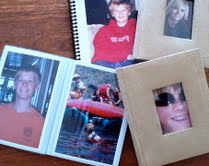 all wiped tears from our eyes at the kindness of this Kinkos worker who – granted he had read the letter (wouldn’t you?) – understood the simple value of a loving letter, and added his gift into the mix.
The first Kinkos bound book is there on the upper center. His books for ages 15, 16 & 17 are there too.
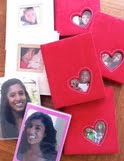 Since Mona is 4 years younger, we started her Bound Letters with her 10th birthday. Here’s her current stash to the left.
In early preparation for his 18th, we asked Charlie what he wanted. Mark proposed a new guitar. Charlie said no – he couldn’t think of anything he needed or wanted beyond a “Dad’s famous meatloaf dinner” with family and a few friends. Maybe an art book.
I saw a possibility for “More letters”! I wrote to extended family and friends who’d been special to Charlie over the years. 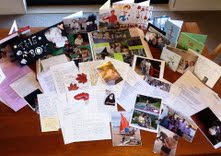 I let them know he was turning 18. I sent them a one page summary of who he was now – and a photo (some folks had not seen him since he was tiny). I asked if they could please use the addressed enclosed envelope to send something for Charlie’s 18 – a poem, some advice, a comic, a funny anecdote. Maybe a photo.
Over 30 letters, cards, notes and a few gifts turned up. It took almost the whole day to go through them all. Some made us laugh. Some cry. 
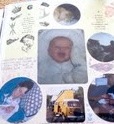 I turned them into a larger album which had one page dedicated to each year of his life, with the letters stored in the back. To the immediate right is the Birth to One page, and to the right of that, Charlie s last year of high school complete with Prom photo.
Mona turns 18 this June 2nd. Her only request so far? “Mum, can I have the letters?”
ADULTS ~ The Birthday Retreat
Why wait for the wake?
For my 50th I took the liberty of letting my friends and family know – as I sent out our Annual Christmas letter – that I’d be turning 50 on March 20th. My plan was to spend 4 glorious days in solitude (well – with the 2 dogs) at Rocky Ridge Yurt and I’d love to bring in any letters anyone felt inspired to write in return for a long, hand written response. I said I’d love anything along the lines of “Now you are turning 50 here’s what I want you to know…” or whatever anyone felt moved to send. In all honesty, I figured I’d have 12 things to bring in (I counted on the loyal aunts, immediate family and a few close girl friends). This would have been bliss enough. I adore snow, silence, chopping wood, and the company of wild things. No letters would have been fine too actually!
In the end, I hauled 55 letters and packages into the Yurt. I skied in, pulling an unwieldy sledge – here I am staging things in our front garden.
And all unpacked at the Yurt (below) . I apportioned the letters out over the 4 days I was there – reading and responding to each, one at a time. I had 55 mini tea-parties and birthday conversations, all alone up there with people I love. Bliss! This too has become a simple album – with all the letters in plastic pages.

Too much more to write.
I could dedicate a small book to how these letters have impacted our years and lives. I’d love to think the idea might catch on.
I would adore to hear of other non-material, meaningful gifts you’ve thought of for yourself or others.
Happy (un) Birthday to you all.
. . . for prioritizing needs and wants
HELP! Is there a way to make decision-making both more informed and faster to effect?
Decisions large and small come up for couples and families all the time and often prove fertile ground for a good bicker or an outright fight.
Here’s what we came up with in our family. Essentially, each person involved in making the decision gets to assign a level of urgency, or a priority rating, to his or her option.
We call it simply “The ABCs.”
A = This really matters to me. I care about this choice and not getting this will be hard for me. I feel strongly about this.
B = This matters. I’d prefer this option. But if someone else has an A, I’m OK with some negotiation.
C = I’m neutral. If we’re all pretty neutral maybe I’d lean this way – but it’s all good.
Then of course, there’s the fine-tuning.
A+++ = Say no more!
A- = I feel strongly, between a B+ and A: it’s important, but I can hear all options.
B+ = It’s up there – not quite an A
And so forth.
At first this seems either “duh!” obvious, or plain silly since of course everyone will claim their choice is an A to them. But, let me explain the subtle rules and show you what tends to happen in practice.
Three key rules-of-the-game if this is to work
This system works when you all recognize that for the most part, without this system, everything is an A. You want what you want now – regardless of the consequences it might have for your relationships or other peoples’ choices. Essentially, you’ve always seen the A, but not discerned the B and C priority levels.
This method introduces the ideas that ~
Try it out for yourselves. Talk through how you want to describe the A, B & C options. Agree an A has to be limited and very important. I think you’ll find, as we did, that people are keen to be honest, and to only call an A when they really really need it. My hunch is this will build more self-awareness, other-awareness, restraint, anticipation and a few good doses of fun.
It’s tough to get our needs met, so do try
Requests not demands.
A communications tip as Haiku! Seriously now, when you want something from someone you love, how do you typically go about getting it?
Do you ~
WISH – you need a fairy godmother (or mind-reader); how’s that working for you?
HINT – you need Sherlock Holmes, so better be ready for clues to be misinterpreted.
INVITE – you better make what you need done sound exciting and be prepared for better offers to come up for the invitee.
REQUEST – you get to be clear about what you want, and prepare to be OK with a “Yes”, “No” or “Maybe”.
DEMAND – you feel fully entitled to what you want and you may even get it, but be prepared for some push back.
COMMAND – you have authority and “vil have zis done Macht schnell”. “Yes Sir!” Captain Von Trapp tried it for a while but can’t say it won him much love and affection.
There are pro’s and con’s to each.
How do you usually try to get your needs met?
Is this working for you?
What might be a more effective approach?
Coming up.
An “Easy as ABC” way to get needs met.
Do they make a difference?
Thinking of Pope Francis I as he anticipates becoming leader of the world’s 1.2 billion Catholics I find myself wondering what sort of vow he makes in relationship to those he serves. And if he does make a vow, does it help guide his behavior in any way?
Since 1688 in Great Britain, for example, Parliament changed the Oath an incoming monarch would say to identify that ultimately (unlikely as this might seem) power lay with the people through Parliament and the monarch had to swear they would act “according to their respective laws and customs.” There is of course also a whole bunch of obedience to the Protestant Church who originally held great power – but that’s for another blog post! However, if a King or Queen gets too uppity, in theory, we can get them out. There is a public pledge of understanding about the expected rules of reciprocity: “You be King but don’t get too out of hand, we’ll all enjoy the pomp and circumstance.”
Which has me wondering about marriage vows. Working with so many couples — some married formally with the big white wedding; some married simply in a back yard but none-the-less legally bound; some cohabiting, maybe with a housewarming bash to mark the event; some who drifted together with no “promises” in place; and of course, gay and lesbian couples who’d love more legal status yet who get creative in terms of formalizing their unions — I see a huge variety in the degree of Vows, or “expected rules of reciprocity.”
I’ve yet to conduct a survey exploring the correlation between these agreed-upon “rules of reciprocity” and marital satisfaction – but it might prove interesting.
Here are the vows Mark and I said to one another on November 20th 1982. We adopted these from dear friends Julia and Stuart. Feel free continue adopting and adapting if they fit for you!
I take you to be no other than yourself
To love and comfort you
Honor and keep you
In sickness and in health
In sorrow and in joy.
Loving what I know of you
Trusting what I don’t yet know
With respect for your integrity
And faith in your abiding love for me
Through all our years
And in all that life may bring us
I greet you as my husband/wife.
Reading these again now (and as we do around each anniversary) I have to say, without wanting to be trite or corny, I think they’ve played their part on our successful journey toward one another over the past 30+ years. I’ll start my survey tonight by asking Mark what he thinks!
Your spouse gets home, flings down their bag and snaps “What a hell-of-a-day! I need to go for a run. What’s for dinner?”
Your knee-jerk REACTION might be “Ask me about MY day why don’t you! You’re so selfish you think the entire planet revolves around you!”
Your more thoughtful RESPONSE might be “Sorry you had such a terrible day. I’m pretty bushed too. Go for your run, and then can you finish dinner prep? I think 30 minutes of Yoga will cure what ails me.”
When we REACT we’re so deeply zoomed in on our own perspective there’s no room for any more information. We lead with our egos, assume we know enough to make snap judgments, take everything personally, and are entirely vulnerable to outside conditions for our mood.
When we RESPOND we swap out the zoom lens for the wide-angle. We pull our focus out beyond our immediate, limited perspective so we can see self-in-context. We become the director of our movie rather than the actor. As director, we can change the script at any time. We become “the one who watches” rather than “the one who reacts.” In the pause, or space, this zooming-out creates, we can choose our response.
We humans tend to dwell in (and between) one of two psychological states most of the time
Most psychological growth is about shifting the balance of these two states from REACTIVE toward RESPONSIVE. Meditation, mindfulness and therapy are all focused on teaching and practicing the three “Conditions of Responsiveness” (for want of a better term!)
Here are my Top 3 Tips for Boosting Your Mastery of Each Condition
1. Cultivate Self-Awareness ~
Inhabit the Pause ~
Expand Possibilities ~
As with any of my suggestions, I’m always interested to know what works and what else you’ve tried that works for you.
PS: Another longer posting – sorry! This just over 800.
Dear Reader,
Do you, like me, swing from gripe to gratitude throughout the day? Today’s gripe? A costly sewer repair. Today’s gratitude, I have not lost any family members to war ~ see BBC World News.
I call this my BBC News Therapy. I just have to listen to a story about rape in India, some new Gaza bomb, brutality anywhere, anything that hurts animals or children and my gripes (even about expensive sewer replacements) seem utterly trivial.
Clients have agreed with me – there is something very helpful about getting perspective on your life this way. My friend Julia asked me once, “Gemma, if you could dump your problems into a big pot and pick out someone else’s problems instead, would you?”
Yipes – dump my expensive sewer for my friend’s recent diagnosis of a brain tumor, or the sudden death of a beautiful 21 year old daughter, or a failed pregnancy, or a Tsunami divorce or or or…no way!
So – in this spirit of gratitude and abundance I was drawn to an interesting challenge from Chris Guillebeau, whose quirky project and Blog The Art of Non-Conformity Dispatch I’ve been following for several months. Chris is inviting us to participate in a social experiment by offering something of what we have or do for free.
Well – I’m not long on stuff. But time? I have 86,400 seconds a day, remember?
So, might some of these seconds be useful to someone who has never met me, as a free gift? Someone who normally can’t afford good counseling? Someone who could use someone on thier team for a bit, to listen and help sort an issue out? Here’s what I do:
So, here’s my FREE Attitude Adjustment OFFER
I am giving away two FREE two-hour counseling sessions (we’ll meet twice, each time for one hour) to two NEW people ( sorry existing clients, but you can offer this to a friend ) who contact me at gemma@gemmautting.com with FREE ATTITUDE ADJUSTMENT in the subject line.
In the body of the email, I’d like you to tell me 3 things:
If you are new to this blog, visit my web site https://gemmautting.com/ to learn more. Then, pop me that email. I’ll even pay for your long distance phone call too – I live in Auckland New Zealand – using skype. If you too have skype – all the easier!
I’m going to be reading responses through the month of March. On April 1st I’ll write to everyone who wrote to me and let you know whether or not you’ve “won” the two free sessions.
I’m a relationship expert, so don’t limit yourself (or someone you think might benefit). Think how two hour-long sessions, focused on your ~
might make a world of difference.
Can’t wait to hear from you,
Warmly,
Gemma
PS: Three people have asked for this already and I’m too much of a softie to say no. But this offer does need to be officially closed as of today – March 21st 2013. Thanks to those three for inviting me to share! Excited to work with each of you.
Would you let an elephant stand over you?
If you’ve never met Tara and Bella their love and trust are inspiring. 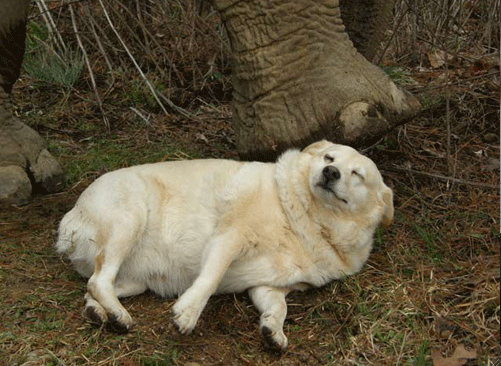
For someone whose spouse has been unfaithful, it can seem easier to imagine a huge elephant foot hovering over their ribcage than it can be to imagine offering their heart to this person again.
What IS trust?
How do we earn it in the first place, and is it possible to restore trust once it’s broken?
Trust is earned as we run 3 criteria* through our emotional and logical filters.
We probably all know folks who seem to trust way too easily, becoming vulnerable with no logical input. Conversely, too much logic and we’ll never allow ourselves to be vulnerable . That’s the “magic” if you will, of trust. It’s that Goldilocks place where we are “advisedly vulnerable.”
So – how did Bella come to trust Tara, and visa versa? How can we begin to rebuild trust with someone who has hurt us badly?
For Tara and Bella – they sensed their mutual “Lets-be-friends” intentions; they were both capable of bringing joy through play and loyalty; and historically, day by day, they built up evidence to support these truths. Bingo – massive trust such that Bella can lie on her back and know the vast foot rubbing her tummy will be comforting, not crushing.
I have found that even when two partners both want their relationship to heal after a breach of trust, the process is confounded by ~
Try this.
Both partners focus on the unfaithful partner’s 3 compromised Trust Tanks ~
Considering these three tanks, the hurt partner gets to answer the question:
“When you hear your partner tell you they want to do whatever it takes to win your love and trust back, how full is each of their tanks?”
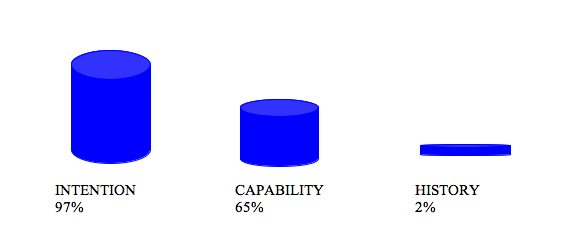
This is a more-or-less typical response.
INTENTION is at 97% ~ The hurt partner believes their unfaithful partner genuinely wants to repair the damage. This tank will notch up to 100% as the unfaithful partner keeps reassuring the hurt partner that this is exactly what they want – their intention is to keep doing everything they possibly can to win back the trust.
CAPABILITY is at 65% ~ The hurt partner is somewhat encouraged. He/she has noticed that in the effort to re-build trust, their partner has done everything asked of them: made their phones and computer fully transparent; switched departments at work; put a block on the affair partner’s number; worked extra hard to be there for the kids, etc. This tank will slowly fill as the couple discusses the twists and turns of what the hurt partner needs that the unfaithful partner is capable of delivering. E.g., “I realize I need us to have a plan for what happens if we bump into your affair partner one day together.”
HISTORY is at 2% ~ It sounds like bad news to be at only 2%. However, the good news is that this tank can fill one faithful day at a time as history is re-written. The couple can decide if one year is enough to have this tank refilled, or if it will never go above say, 90% in recognition of this event.
Now you have ~
May your journey toward “advised vulnerability” bring you to a place of safety so, like Bella and Tara, you can walk in the woods and wag your tails together.
* I heard these distinctions of trust at a Family Therapy conference ages ago. Long since lost my notes and can’t remember whom to credit. If you know – do write me. I’d love to be able to give credit and read more by who-ever-wrote about this first.
Here’s the question ~
Is it possible to have real, juicy, effective and intimacy-building conversations without sounding like you’ve morphed into some self-help sap, or are reading aloud from a psychologist’s best-practices manual?
Of course!
Listen up.
Inspired by Dan Wile – a wonderful California-based couples therapist whose work champions building intimacy one conversation at a time – I’m presenting my own take on how you can show up as the non-communications-major, bumbling, inarticulate, feisty and often forgetful self that you are and still have the real, juicy, effective and intimacy-building conversation you both crave.
I would dearly love to know if any of these suggestions are helpful – or not! Thanks in advance. Gemma
 Gemma Utting MA, LMFT, CLC