Author Archives: gemmautting

Unknown's avatar

About gemmautting

A licensed Marriage and Family Therapist, I specialize in pre-marital preparation and relationship repair. A committed, long-term relationship is going to call you into places of deep personal awareness and growth like nothing else can. Learning how to allow this, how to respond without defensiveness and how to gracefully expand into the best possible version of yourself - whether before you say "I do" - is my joy and life's work.

Narcissist ~ Healing From One

If you’ve stumbled upon this article, it’s the last in a 5 part mini-series about living in relationship with “Narcissism.”  (Click here for Part 1, 2, 3 & 4.)

This final piece offers you my humble “take” on what others more experienced than I  (see Resources below) have identified as 6 significant rest-stops along the spiral of healing. I offer one “Top Tip” per rest-stop.

1.  Re-encounter Yourself  ~  Most everyone who emerges from time around a narcissist looses something of themselves. No matter how long this contact with narcissism has been, there will be less of the essential, unapologetic, robust, connected-to-your-own-soul YOU now than there was before this contact.  First job is to find that person once again.

Top Tip: Do The Artists Way.  Julia Cameron’s 12-part process will help you discover you are a unique, worthwhile, creative being whose only job is to express yourself. This book is a life-saver!

 2.  Embrace reality  ~  Question every assumption; examine every thought. Is this truth, or is this still crazy-talk? Come on back to the community of earthlings where you belong. Try listening to a reliable news source; go to the public library and watch normal people come and go; call a childhood friend and reminisce.

Top Tip from Blogger Lisa Arends (sent as a comment to my last postI found it invaluable to have “reality anchors,” tangible reminders of reality that kept me anchored while I navigated through the world he created through his lies. My favorite? I kept a copy of his mugshot with an article about the bigamy in my purse for several months. One glance at that paper reminded me of who he really was and motivated me to keep fighting to get away.  (Thanks Lisa!)

3.  Set boundaries  ~  It’s hard to be in relationship with someone who has no idea who they are or what they want. This is where boundaries come in: you get to say “I feel X and I need Y” and then let go. Just the fact of naming what you feel and need is a huge boundary-setting skill.

Top Tip from Life Coach Cheryl Richardson (on Oprah.com) walks you through How to Set Boundaries.

4.  Cultivate reciprocal relationships  ~  You’ve been giving, giving, giving – right? You need to discover that it’s OK to receive: To imagine you are worthwhile enough for someone to want to share with you.  If you want the safest possible two-way friendships I’d recommend animals or small children. They are genetically engineered givers.

Top Tip (not scientifically tested, but from my experience, this Tip’s from me).  Volunteer some time each week at your local Humane Society. For the gift of your time and presence, you’ll be rewarded with unconditional love from most of the four-footed brothers and sisters in the shelter. Lap up their love. Bask in it. Slowly make the transition to humans.

5.  Integrate Your Past  ~  It’s tempting to want to forget the past – especially if it now seems so false (Did my partner ever really love me? Was it all a sham?) But burying your past in an ugly bin in the basement will cause it to rot and smell.  Putting it instead in a pleasing, open wooden-frame box, turning it over, splashing it with some fresh insights, tumbling it with compassion, mixing in some understanding and wisdom will deliver a deliciously usable compost.

Top Tip  Write!  You’ll find lots of people on the Internet who have turned their difficult pasts into fruitful books, blogs, and even full “recovery courses.” 

6.  Help Others  ~ Once you’ve climbed back from the brink, re-calibrated your sense of “normal”, practiced setting boundaries and expressing feelings and needs, re-joined the larger community, made a few genuine friends and gained some perspective on your past, you’re ready for the fulfillment that comes from reaching out and helping someone else.

Top Tip Be inspired here 

RESOURCES

Caveat emptor” ~ 3 Main Points

  1. Be slow to trust.  There’s a lot of unhelpful information in print and online. Look for resources authored by professionals in the field of mental health. If you are considering a book, or reading an article on-line, read the brief author bio. Check to see if the author has an advanced degree from a reputable University. Are they working the field? Do they have a website and testimonials? Can you call them or email them if you want to? Not all information is equal.
  2. Free is good.  The library is your friend. You can spend a small fortune on books and courses and consultations.  You do not have to.
  3. Value a second opinion.  Part of your “reality check” work here. If you feel drawn toward a book you want to buy, or someone you might want to consult with – run it by someone you know and trust.  If your friend is suspicious, maybe wait a bit. Or seek a third opinion. The topic of narcissism has created a very “narcissistic” (i.e. exploitative) on-line environment and you don’t need to get burned.

That being said, there are lots of books you should be OK to review at your local library. Here is a short list. You can also go to Amazon.com and type “Narcissism” in the subject box for a longer list.

  • Why Is It Always About You? : The Seven Deadly Sins of Narcissism, by Sandy Hotchkiss
  • Disarming the Narcissist: Surviving and Thriving with the Self-Absorbed by Wendy Behary
  • Freeing Yourself from the Narcissist in Your Life by Linda Martinez-Lewi
  • The Wizard of Oz and Other Narcissists: Coping with the One-Way Relationship in Work, Love, and Family by Eleanor Payson

In terms of on-line resources. You can trust articles posted on ~

www.psychologytoday.com   (You can type “Narcissism” in the search box top right, or visit Topics and browse by Parenting, Divorce, Personality etc.).

http://divorcesupport.about.com   (Again, type Narcissism in the subject box top left. This is a direct link to a good article on  co-parenting with a narcissist )

Marc Hafkin also posted on this Blog – his web site seems worth reviewing.

One of my clients found this site, and I figured it might help others:  http://www.daughtersofnarcissisticmothers.com/

This seems helpful (if anyone has feedback feel free to post) http://blog.melanietoniaevans.com/

And I follow Lessons From The End of a Marriage because I’m inspired by it’s author, Lisa Arends. Lisa’s been through what she describes as a “Tsunami Divorce” but has emerged with a terrific sense of self, a good job, a luscious pen and some piercingly clear insights.

For the other posts in this series see ~

Narcissist~Leaving One

If you’ve stumbled upon this article, it’s Part 4 in a 5 part series on Narcissism*.  Today’s article offers the Top 10 Tips for how to successfully exit a relationship with someone suffering from severe narcissism.

  1. Do The Math  ~  If you’re unhappy, seem to have always been and can’t see things changing; if you’re beginning to feel you’re crazy; if fights far outnumber fun, take stock. Start a daily log of the lies, infidelity, insults, rages and abuse. After a few weeks or months do the math. Calculate what percentage of your life with this person is happy. If unhappy is a much bigger percent than happy and if every attempt to change things has resulted in things getting worse for you – it’s time to go.
  2. Prepare to Prepare  ~  Most people who leave abusive, narcissistic relationships report several “false starts.” Spontaneous “I’m leaving you” tantrums (initiated by either partner) do not last. If this is to be a true break from this nightmare you need to plan.
  3. Get Emotional Support  ~  By the time you’ve recognized how bad your relationship is and are making your plan to leave (which is right when you need to be super strong) you are probably feeling drained, lost, fragile, alienated, crazy, stupid, worthless and more. Priority #1 is to find someone who understands the nature of narcissism to help you: a therapist, minister, support group for abused women, or a forum on one of the many web sites about being involved with a narcissist. You need someone to confirm you’re not nuts, it’s not your fault and you deserve better.
  4. Get Tangible Support  ~  Since you’re planning to leave someone for whom life is “all about me” you are unlikely to get a fair distribution of your shared assets. So, get strategic. Do you have anything in your name? A car? Jewelry? Savings?  It can be wise to have a plan for where to go for the first few months – family out of the area, old friends? Take an inventory of what you might be able to hang on to, and what you are most likely to have to leave behind.
  5. Get Financially Savvy  ~  To the extent you can, take stock of where you stand financially. Familiarize yourself with credit card balances; bank balances; the mortgage; other monthly debt. You may be in for some surprizes. As you can, start a cash-stash. Even $1000 is better than ending up on the street with nothing.
  6. An Element of Surprize  ~  Be careful to keep your plan a secret. As you know, you are overly connected / addicted to the charms and terrors of the narcissist in your life and can easily fall prey to the pleas to stay, hand over money, take care of him/her etc.  Consider your safety above all else.
  7. Burn Your Bridges  ~  As miserable as you may be, the majority of people who have successfully made the break from a narcissist report it takes every ounce of their strength not to go running back. You’ve been so emptied, manipulated, put down, “rescued” and oriented by this toxic system that life beyond it seems vapid, empty, frighteningly without meaning. This is where your support system comes in. Buy a one-way ticket; have someone expecting you; make it impossible to go back.
  8. Build Your Boundaries  ~  You fell prey to the narcissist because you weren’t sure about the line between  “being nice” and “being used/abused.” There is one and it is never too soon to start building stronger boundaries. A great place to start is by reading Melody Beatie’s Codependent No More.
  9. If There Are Children  ~  Many divorces are caused by the narcissistic behaviour of one or other parent so you are not alone. Your children will survive. It will pull forth more from you than you thought you had to give but parents who’ve had the courage to leave their narcissistic partners will tell you that they are particularly motivated to make this break for the children.
  10. Harbour Hope  ~  Hold on to your self. There is no greater gift you can give yourself (or your children) than to make this move. No amount of money, real estate nor high roller distraction is worth the sacrifice of your very essence. You are not alone. Others have walked this path before you. You can make it!

*I am running a 5 part mini series ( 25-29 March 2013) on Narcissism. I am seeing more and more clients impacted by living with someone who suffers from NPD and the first step in the healing process is to learn as much as you can about this disorder.  I’ll print a list of helpful resources in Part 5.

Narcissist~Living with one

If you’ve read my two previous posts Narcissism – Symptoms and Narcissism – Now What, you may be wondering whether it’s possible to have a successful relationship with someone on the narcissism spectrum.

Both my research and my clients tell me it is possible. I’m always a little surprized by the number of people who knowingly continue to live with, or work for, a narcissist once they understand why they’ve been feeling so awful for so long. However – knowledge really is power. This post is for those of you who, for whatever reason, are choosing to stay involved with someone suffering with symptoms on that narcissism spectrum.

3 Key Practices for Surviving (Even Thriving in)  Life with a Narcissist

  1. Inform yourself fully ~ Learn all you can, scour the local library and internet, so you may fully understand the sort of pain, hurt, sadness and possible abuse you will be up against.
  2. Decide where you will take your stand ~ As you review the list of “Things You Cannot Change” about a narcissist below, identify any you feel you need to take a stand against. If it’s the rages you hate,  then figure out how you will behave in the face of the rages. And stick to it.
  3. Commit to on-going self-care ~ Daily contact with a narcissist can be crazy-making, isolating and lonely. If you are in this for the long haul you’ll need to identify how you’ll stay healthy, not burst a blood vessel, keep your self-esteem/self-compassion tanks topped up and meet your emotional needs outside of this relationship.

According to Dr. Judith Orloff, if you are to live or work with a narcissist, it is wise to accept that there are some things you cannot change. As you review this list  below, notice if any of these inevitable traits are particularly bugging you.  It is OK – even wise – to take a stand against those traits that you find most draining.  As we might respond to any bullying behaviour, if you say “I find your rages too huge for me and the kids. When you raise your voice I will leave the room,” and if you stick to this, you will eventually get that pattern changed between you. (Note – the narcissist does not stop raging. But what you do in the face of the rages is what can change.)

  • Be aware that the narcissist can respond negatively if you complement other people while you are in the narcissist’s company. The narcissist is likely to see a compliment paid to someone else as an indirect insult to the narcissist (e.g. the narcissist might say something like “you are always saying good things about X but you never say anything good about ME”).
  • Don’t expect the narcissist to understand jokes the way that non-narcissists do. Just accept this and go and enjoy telling jokes to people who are not narcissistic.
  • Give the narcissist what he or she wants when he or she wants it and do not expect the narcissist to reciprocate any favours.
  • Don’t expect the narcissist to take any real interest in you (unless he or she is very eager to please you, in which case the narcissist will be very good at pretending to be interested in you).
  • Do not expect the narcissist to apologise or to show any consideration for your feelings.
  • Be careful about making any expression of affection towards the narcissist as the narcissist might respond to this in a nasty manner, particularly if the narcissist thinks that you are becoming dependent upon him or her. Also, do try to keep your independence and, if possible, try to make the narcissist to some extent dependent on you.
  • Expect to have to clean up after the narcissist but don’t expect the narcissist to clean up after you.
  • Expect the narcissist to try to demand all of your time but don’t expect the narcissist to give up his or her time for you.
  • Expect the narcissist to be impossible to please. Just think how unfortunate you would be if nobody was able to make you happy.
  • Expect the narcissist to be unhappy when he or she discovers that you actually want to do what they want you to do. When you actually want to do the task which the narcissist has given you the narcissist may perceive this as being a bit like sharing, and this can make the narcissist feel disappointed.
  • Don’t ever say to the narcissist anything like “please have a heart”. Trying to appeal to the narcissist in this way is likely to make matters worse rather than better.
  • Never invite a narcissist to apologise.
  • Don’t expect a narcissist to pay attention to things which do not affect them personally (unless, of course, the narcissist is eager to impress the present company, in which case he/she will try hard to take an interest in the topic of discussion).
  • Don’t expect the narcissist to tell you the usual personal information about themselves (e.g. the narcissist may be reluctant to reveal much information about his/her childhood other than those things which he/she chooses to reveal).
  • Accept that most of the time (but not all of the time) the narcissist will find it difficult to remember back to events in his or her childhood.
  • Accept that narcissistic women will try to force their daughters to be exactly like them.
  • Don’t expect the narcissist to give you what you ask for (unless the narcissist is very eager to please you). If you actually do want what he/she gives you it will not be fun for the narcissist to give it to you.
  • Often remind members of your family that you genuinely love them. This will help to heal the family rifts which the narcissist is continually creating through his/her backbiting.
  • When a narcissist walks off in a rage, expect a return appearance with questions and criticisms. Use this time before their return to ready your answers and responses to them. Try to maintain a low tone, raising it over them will only increase the intensity of the conversation (and lead to a full-on argument).

And some helpful tips? Adapted from Connie Dieken’s Talk Less Say More

  • Give them options. Beneath their bluster, narcissistic people fear being left out of the loop. They crave control. It’s far better to offer them options to choose from, rather than feeding them ready-made decisions. They’ll tear other people’s decisions to shreds. Giving them options helps them feel respected and in control. It also prevents nasty hissy fits.
  • Focus on solutions, not problems. When you explain a problem or a challenge to a narcissist, direct their attention to the solution. Don’t allow them to dissect the problem over and over again. Narcissists love drama and revel in the chaos. They’re easily agitated when frustrated. Define problems and present possible solutions, so they don’t smell blood in the water and tear you apart.
  • Make them the hero. Narcissists are preoccupied with power and truly believe they are special and unique. They live for attention and admiration. Want them to do something? Tell them how great they are at it and watch them perform. Better yet, praise their performance in front of others. Just keep it real, please.
  • Let them think it’s their idea. Narcissists often steal the credit for ideas that aren’t theirs. Why do they do that? Strangely, they truly believe that hijacked results are their own. Grabbing credit is a driving force for them. If this gets things done, I say learn to live with it. Over time, everyone will catch on — wink, wink. Meantime, graciously transferring credit for ideas to them makes things happen.
  • Manage their emotional blind spot. Egomaniacs lack empathy. They’re so caught up in their own world that it doesn’t occur to them to consider your feelings or viewpoints. It’s a huge blind spot. You must put your own feelings on the table, if you choose to do so. Just be smart about sharing feelings with a narcissist. Brace yourself for the guilt trips and disparaging criticism that narcissists often dole out when others explain how they feel.

I am running a 5 part mini series ( 25-29 March 2013) on Narcissism. I am seeing more and more clients impacted by living with someone who suffers from NPD and the first step in the healing process is to learn as much as you can about this disorder.  I’ll print a list of helpful resources in Part 5.

  1. Narcissism – Symptoms                       
  2. Narcissism – Now What?
  3. Narcissist – Living with one
  4. Narcissist – Leaving one
  5. Narcissist – Healing from life with one            
Narcissism~Now What?

If you read my last post and find yourself wondering whether you are in a relationship with (or related to) someone suffering from (NPD) Narcissistic Personality Disorder, I have to start off by saying, ‘I’m so sorry.”

This is a tough situation. However, despite all the oncoming tumult, if you’ll allow yourself to open your eyes, move forward and come out the other side,  you can count on 3 things:

  1. You will survive
  2. You will need support.
  3. Time does heal.

WHY this fuss?

If you’ve connected the dots correctly, reading further will have you beginning to realize that your life will never be the same again. Your (formerly?) beloved husband / wife / partner / father / mother / sibling cannot simply “decide to get better.”  You are now the adult in charge. You will need to do all the research, clear thinking, decision-making, due-diligence, self-protection, possible exit planning and face all the consequences by yourself.

You will be alone. Worse than alone – you may be actively undermined.

WHAT are you telling me?

If indeed you are discovering that you are married to / living with / being parented by someone whose symptoms are highly correlated to NPD, and if they are pretty far along (because this is a spectrum disorder – the person you are worried about may have only a few of these traits, or they may be text-book classics) you will experience ~

  • Only They Matter

You are peripheral. The narcissist orbits his/her own sun. You matter only to the extent you have what the narcissist wants. Be honest – after spending how long with this person – do they know you, cherish you, love you, help you, care for you. Do you matter just because you are you?

  • Constant Tension

In an effort to avoid feeling the emptiness inside, a narcissist depends upon external factors for their inner life. There is no stable, predictable place. In any moment this person may spin from a hyper-inflated sense of brilliance after a moment of praise, to outrage and loathing after a perceived snub. While their modus operandi is “It’s all about me” in fact the narcissist lives in a frightening smoke and mirrors reality with a capricious Oz pulling the strings.

  • Ineffective Communication

To avoid feeling vulnerable, the narcissist will come out with guns blazing. Think a large two-year-old having a tantrum. They’re prone to attack, blame, criticize, banter rudely or accuse in public. This makes having genuine friends almost impossible.

  • Being Controlled

Understanding the narcissist is reliant on the external world for their internal reality, you’ll see why they need to control everything – timing, events, people, and finances. Any breach in the choreographed plan is devastating for the narcissist, who will employ any means to prevent it.

  • Lack of Responsibility

If you believe the world revolves around you (as a narcissist does) then common, shared morality is meaningless.  The narcissist typically suffers no guilt; can’t be shamed into behaving; they’ll see no point in accepting responsibility for anything that has gone badly. In fact, because the narcissist must see themselves as superior and blameless in all situations, this trait will possibly uncover a whole heap of lies.

  • Zero Empathy

Since his or her own emotions are too painful for the narcissist to experience, they are certainly not good at empathizing with others. While you may have been told that you need to attend to the narcissist’s feelings, you’ll not get any reciprocity here.  He/she is neither interested nor capable of attending to your emotional realm. This includes never having to say they are sorry.

  • Spontaneous Rages

Living with an ugly void where a healthy self should reside, the narcissist’s inner realm is a painful mess. This means they are highly unstable. A waiter, hotel clerk, teacher, you – might trigger a violent outburst totally disproportionate to the “issue” at hand.

  • Being Exploited

Remember #1 – Only They Matter? You’ll be used. You’re a finite resource that will be mined, polluted, depleted, and possibly destroyed. All your resources – your time, expertise, help, connections, income are up for grabs.

Thanks to Clinton Power for some of this ideas.

NOTE

I am running a 5 part mini series ( 25-29 March 2013) on Narcissism. I am seeing more and more clients impacted by living with someone who suffers from NPD and the first step in the healing process is to learn as much as you can about this disorder.  I’ll print a list of helpful resources in Part 5.

  1. Narcissism – Symptoms                                
  2. Narcissism – Now What?
  3. Narcissist – Living with one
  4. Narcissist – Leaving one
  5. Narcissist – Healing from life with one            
Narcissism~Symptoms

According to the DSM IV (Diagnostic and Statistical Manual of Mental Disorders – Fourth Edition), someone who suffers from Narcissistic Personality Disorder (NPD) has at least 5 of the following characteristics:

  • Has a grandiose sense of self-importance (e.g., exaggerates achievements and talents, expects to be recognized as superior without commensurate achievements)
  • Is preoccupied with fantasies of unlimited success, power, brilliance, beauty, or ideal love
  • Believes that he or she is “special” and unique and can only be understood by, or should associate with, other special or high-status people (or institutions)
  • Requires excessive admiration
  • Has a sense of entitlement, i.e., unreasonable expectations of especially favorable treatment or automatic compliance with his or her expectations
  • Is interpersonally exploitative, i.e., takes advantage of others to achieve his or her own ends
  • Lacks empathy: is unwilling to recognize or identify with the feelings and needs of others
  • Is often envious of others or believes that others are envious of him or her
  • Shows arrogant, haughty behaviors or attitudes

The DSM IV goes on to note NPD often comes with the associated features of Depressed Mood (Dramatic or Erratic), and/or Antisocial Personality Disorder.

Developmentally we all move through two stages of appropriate and necessary narcissism – as toddlers and as teens – so versions of these are for the most part familiar, maybe common and even celebrated traits today as anyone who has read much about Steve Jobs might have noticed. As Albert J. Bernstein puts it “there may be narcissism without success, but there is no success without narcissism”

However, try to live with someone who has five or more of these traits and you’ll be in your own private hell. If you want a fuller picture for what this might look like, day-to-day, I encourage you to read this.

I am running a 5 part mini series ( 25-29 March 2013) on Narcissism. I am seeing more and more clients impacted by living with someone who suffers from NPD and the first step in the healing process is to learn as much as you can about this disorder.  I’ll print a list of helpful resources in Part 5.

  1. Narcissism – Symptoms                                
  2. Narcissism – Now What?
  3. Narcissist – Living with one
  4. Narcissist – Leaving one
  5. Narcissist – Healing from life with one            

A Happier World

What if we could all emulate Bhutan, where they measure Gross National Happiness? Apparently the United Nations agrees and in support of this “emerging shift in priorities, the very first United Nations International Day of Happiness is being held on 20th March this year.”

You can read a fuller article by Dr. Mark Williamson in The Daily Good.org. In continued celebration of my March 20th Birthday (since it’s now March 20th all the other time zones!), I’m reprinting Mark’s Manifesto for a Happier World. Enjoy!

PS: Fun to note he advocates prioritizing relationships and happy homes.

For our political leaders:

Ensure a Stable Economy. A healthy economy is the foundation for happiness and wellbeing. We need an equitable economic system which puts long-term stability and high levels of employment ahead of “growth at all costs”.

Focus on Wellbeing. What we measure is what we get. In addition to conventional financial indicators, we need our governments to measure people’s wellbeing and consider the impact on wellbeing – for both current and future generations – in all policy decisions.

Support the Disadvantaged. Priority should be given to improving the wellbeing of those who are most in need, not just through financial support but also by empowering people and helping them to help themselves.

Prioritise Human Relationships. Relationships are central to our wellbeing. We need to prioritise healthy relationships in all policy areas, especially through support for troubled families and children in their early years.

For our institutions:

Healthcare for Mind And Body. Mental health is just as vital as physical health. We need a healthcare system that prioritises both mental and physical health and provides high quality support for all those struggling with anxiety, depression or other mental illness.

Education For Life. Education is about learning for life, not just gaining academic qualifications. We need schools that help children develop character and learn essential life skills, like emotional intelligence, mindfulness and resilience.

Responsible Business. Truly successful businesses have happy employees and a purpose beyond profit. We need workplaces where people feel valued and trusted and where sustainable and ethical behaviour is at the heart of all decision-making.

Balanced Media. The way we perceive the world affects what we do and how we treat each other. We need a media that portrays a balanced view of what’s good as well as bad in our world, not a constant diet of cynicism and negativity.

For each of us as individuals:

Family Values. Happy homes are the bedrock of a happy society and, above all, we need to cultivate warm and loving family relationships. For our children, our priority should be their emotional health and helping them to develop positive values and attitudes.

Contributing In The Community. When we connect with and help others around us, everyone benefits. We need to get involved in our local communities, be good neighbours and support those in need. Our actions can help to build trust and reduce isolation.

Making A Difference. Our working lives should be about more than just earning a living. Whatever job we do, we should aim to make a meaningful contribution – and help create a workplace culture which is trusting, friendly and responsible.

Taking Care of Ourselves. We can’t contribute to a happier society unless we take care of our own well-being too. We all need to look after our health, both physical and mental, and develop within us the life skills and attitudes needed for a happy and fulfilling life.

Together our actions make a profound difference. We can call for change from our leaders but we can also “be the change” in the way we approach our lives and the way we treat others. So if you share this vision for a happier and more caring world, please take the pledge to create more happiness and do whatever you can to support the Day of Happiness on 20 March.


Best FREE Birthday Gifts

Since today is my birthday, I’m offering you 3 things:

  • The best ever birthday gift idea for your child
  • The best ever birthday gift idea for adults with milestone birthdays
  • A self-indulgent birthday reflection from me that puts this blog well over my attempt to stay under 500 words ~ with no apology!

First,  in no particular order, here are 20 Gratitudes for the year just past.

I’m deeply grateful that I ~

  1. Started a private Relationship Therapy Practice in Auckland ( a whole new hemisphere, continent, country and city);
  2. Hiked the Tongariro Crossing with Mark
  3. Visited Hobbiton, Rivendel, Mount Doom & The Shire
  4. Became a vegetarian (too many cute lambs in NZ – am confining myself to plants and fish)
  5. Celebrated 30 years of a darned good marriage to Mark by renting a “Wicked Camper” and exploring New Zealand’s South Island for 10 days
  6. Grew even closer to Mark, Charlie and Mona
  7. Stayed in touch as best I could with dear friends and family far away
  8. Started to learn to sail
  9. Celebrated some fun July/August and December/January family adventures in NZ
  10. Tried fishing (NZ’s national sport, up there with Rugby). Didn’t catch a thing, felt  sea-sick, and now I can “retire” from this sport
  11. Made some dear new friends in New Zealand
  12. Became a regular guest on a weekly, national Live Radio Show
  13. Created a native bush front garden in our Beachlands home
  14. Started some regular clinical conversations with Dan Wile
  15. Swam many times in a turquoise ocean with my dogs at Shelly Bay Beach
  16. Started SUPing (Stand Up Paddle Boarding)
  17. Created a 4x1x1/2 meter raised bed filled entirely of grass clippings and horse poop which has yielded fabulous toms, spinach, courgettes and several unrecognizable brassicas  (I bought a bunch of starts)
  18. Hand fed the Lemurs at Auckland zoo
  19. Started this blog (thanks to the Radio Show’s nudge)
  20. Made some blogging friends (Hi Guys!) . So wonderful to make friends with no geographic limitations.

OK – now my TWO BEST GIFTS EVER ( I am not prone to hyperbole). One for children and one for adults. They are free, meaningful, build community, are easily stored, will be enjoyed into future generations,  and guaranteed to leave everyone involved feeling terrific.

KIDS ~ The “Bound” Birthday Letter

When Charlie turned 14 I realized he’d grown so much and while I kept family scrapbooks, I was worried I might forget who he was on the inside.  So Mark and I wrote an extended letter to Charlie. I started simply with ~

My Darling Charlie, Today you are fourteen. Somehow this seems so much older than thirteen.

And off I went. I spoke about what I had seen him struggle with, and overcome. I remembered funny quotes he’d come up with,  observations he’d had about life, school, our family, his future. I noted his interests – books, movies, games.  Mark spoke about things they shared – becoming a man, music, skiing and snowboarding and the values Mark holds as important for life: expressing feelings, being thoughtful, becoming a good listener.

I wanted to make the gift a bit more interesting than “just” a letter, so I printed it on card stock, and found some photos of Charlie through the year.

Around lunch time I took the pages and photos over to Kinkos. I asked to have the pages laminated in a particular order and then spiral bound.

“And you need this when?”

“By 6:00pm tonight” I pipe up – “It’s Charlie’s birthday dinner and this is our gift.”

The 30 something employee looked at his watch, looked at the backlog of work, looked at this funny collection of pages and photos and sighed.

“I dunno lady. Call before you come. I’ll see what I can do.”

“Oh thank you – it will make the whole event!” I beamed.  And set off to make the lemon poppy-seed cake Charlie loves.

I came back at 6:00pm I didn’t call first.

As I walked in I saw my helper beckon to me, so I sidestepped a long line.

“Hey” he said, thrusting the brown bag over to me with no obvious  invoice. I looked up – there were tears in his eyes,

‘Tell Charlie Happy birthday from me. He’s one lucky kid.”

He turned away before I could pay.

Before dinner,  as we sipped sparking apple juice from champagne flutes, I told Charlie the story of his gift before Mark and I read it aloud to him. This was the first of what has become a treasured tradition for both Charlie and our daughter Mona.  We Charlie's Booksall wiped tears from our eyes at the kindness of this Kinkos worker who – granted he had read the letter (wouldn’t you?)  –  understood the simple value of a loving letter, and added his gift into the mix.

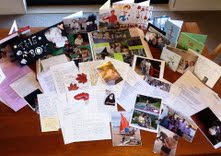
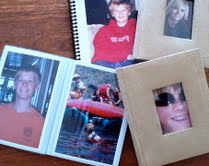
The first Kinkos bound book is there on the upper center. His books for ages 15, 16 & 17 are there too.

Mona's BooksSince Mona is 4 years younger, we started her Bound Letters with her 10th birthday. Here’s her current stash to the left.

In early preparation for his 18th, we asked Charlie what he wanted. Mark proposed a new guitar. Charlie said no – he couldn’t think of anything he needed or wanted beyond a “Dad’s famous meatloaf dinner” with family and a few friends. Maybe an art book.

I saw a possibility for  “More letters”! I wrote to  extended family and friends who’d been special to Charlie over the years. Charlie's 18 I let them know he was turning 18. I sent them a one page summary of who he was now – and a photo (some folks had not seen him since he was tiny). I asked if they could please use the addressed enclosed envelope to send something for Charlie’s 18 – a poem, some advice, a comic, a funny anecdote. Maybe a photo.

Over 30 letters, cards, notes and a few gifts turned up. It took almost the whole day to go through them all. Some made us laugh. Some cry. Charlie 18 Album

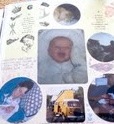
Charlies 18 album babyI turned them into a larger album which had one page dedicated to each year of his life, with the letters stored in the back. To the immediate right is the Birth to One page, and to the right of that, Charlie s last year of high school complete with Prom photo.

Mona turns 18 this June 2nd. Her only request so far? “Mum, can I have the letters?”

ADULTS ~ The Birthday Retreat

Why wait for the wake?

For my 50th I took the liberty of letting my friends and family know – as I sent out our  Annual Christmas letter – that I’d be turning 50 on March 20th. My plan was to spend 4 glorious days in solitude (well – with the 2 dogs) at Rocky Ridge Yurt and I’d love to bring in any letters anyone felt inspired to write in return for a long, hand written response.  I said I’d love anything along the lines of “Now you are turning 50 here’s what I want you to know…”  or whatever anyone felt moved to send. In all honesty, I figured I’d have 12 things to bring in (I counted on the loyal aunts, immediate family and a few close girl friends). This would have been bliss enough. I adore snow, silence, chopping wood, and the company of wild things.  No letters would have been fine too actually!Into the Yurt

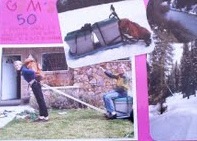
In the end, I hauled 55 letters and packages into the Yurt. I skied in, pulling an unwieldy sledge – here I am staging things in our front garden.

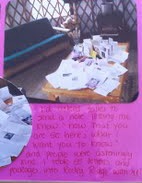
And all unpacked at the Yurt (below) . I apportioned the letters out over the 4 days I was there – reading and responding to each, one at a time. I had 55 mini tea-parties and birthday conversations, all alone up there with people I love.  Bliss! This too has become a simple album – with all the letters in plastic pages.

50 Largesse50th Album

Too much more to write.

I could dedicate a small book to how these letters have impacted our years and lives. I’d love to think the idea might catch on.

I would adore to hear of other non-material, meaningful gifts you’ve thought of for yourself or others.

Happy (un) Birthday to you all.

An Easy A B C . . .

. . . for prioritizing needs and wants

  • Are we renting Argo or Silver Linings Playbook?
  • Do I help Mandy with math or Ben with Biology first – both need me right now?
  • Shall we go with Sage or Aqua blue for the bedroom walls?
  • Shall we eat out or stay home?
  • Are we hiking or biking this weekend?

HELP! Is there a way to make decision-making both more informed and faster to effect?

Decisions large and small come up for couples and families all the time and often prove fertile ground for a good bicker or an outright fight.

Here’s what we came up with in our family. Essentially, each person involved in making the decision gets to assign a level of urgency, or a priority rating, to his or her option.

We call it simply “The ABCs.”

A = This really matters to me. I care about this choice and not getting this will be hard for me. I feel strongly about this.

B = This matters. I’d prefer this option. But if someone else has an A, I’m OK with some negotiation.

C = I’m neutral. If we’re all pretty neutral maybe I’d lean this way – but it’s all good.

Then of course, there’s the fine-tuning.

A+++ = Say no more!

A- = I feel strongly, between a B+ and A: it’s important, but I can hear all options.

B+ = It’s up there – not quite an A

And so forth.

At first this seems either “duh!” obvious, or plain silly since of course everyone will claim their choice is an A to them. But, let me explain the subtle rules and show you what tends to happen in practice.

Three key rules-of-the-game if this is to work

  • “A” needs to be your least-used priority rating.
  • Be honest with yourself, and wise in how you assign your priorities
  • When someone calls an “A”, do your utmost to honour it.

This system works when you all recognize that for the most part, without this system, everything is an A. You want what you want now – regardless of the consequences it might have for your relationships or other peoples’ choices. Essentially, you’ve always seen the A, but not discerned the B and C priority levels.

This method introduces the ideas that ~

  1. That there are grades of needs and wants;
  2. Decisions with others involve a fuller picture, a larger context
  3. In that larger context, there is a simple way to calibrate the groups’ needs
  4. Most likely, your level of priority is between B+ and C-, so chill a little
  5. Each time you process these priority levels you have a chance to build relationship by listening to each person and honoring the As.

Try it out for yourselves. Talk through how you want to describe the A, B & C options. Agree an A has to be limited and very important. I think you’ll find, as we did, that people are keen to be honest, and to only call an A when they really really need it. My hunch is this will build more self-awareness, other-awareness, restraint, anticipation and a few good doses of fun.


“From Hints to Commands . . .

It’s tough to get our needs met, so do try

Requests not demands.

A communications tip as Haiku!  Seriously now, when you want something from someone you love, how do you typically go about getting it?

Do you ~

WISH – you need a fairy godmother (or mind-reader); how’s that working for you?

HINT – you need Sherlock Holmes, so better be ready for clues to be misinterpreted.

INVITE – you better make what you need done sound exciting and be prepared for better offers to come up for the invitee.

REQUEST – you get to be clear about what you want, and prepare to be OK with a “Yes”, “No” or “Maybe”.

DEMAND – you feel fully entitled to what you want and you may even get it, but be prepared for some push back.

COMMAND – you have authority and “vil have zis done Macht schnell. “Yes Sir!” Captain Von Trapp tried it for a while but can’t say it won him much love and affection.

There are pro’s and con’s to each.

  • I have to admit to wishing my family would spontaneously apply the Harpic and clean the loos after each usage, and occasionally I’m duly surprised. The fairy Godmother has sprinkled her dust and  – hey Presto – lovely loos! So – the Pro is the possibility for pleasant surprises, the con is the intermittent nature of these rewards.
  • Hinting? “Well, I’m pretty tired, I think a lazy afternoon would be great” could turn out as I’d hoped and we all loll about with good books and gentle background music, or be misconstrued as “Let’s invite the neighbours over to chill with us –  I’ll BBQ!”
  • Inviting? I’ve tried inviting my children to share their English homework for my “oh-so-gentle” review. Strangely they prefer to suffer the praise or scorn of their teachers. Clearly I’ve made one too many “It could be good to expand on this point…” remarks. But at least my kids are still speaking to me, and they are making (and have made) their own steady progress as writers.
  • Requesting? Much better. I get to be clear and feel that I’m entitled to ask for what I want just as those of whom I’m requesting something are entitled to say “Yes”, “No” or “Maybe”. Takes a bit of creativity but leaves everyone feeling engaged and resourceful.
  • Demanding? Has a bit of a negative connotation. With no clear hierarchy, having one person demand something from another – with a snippy  “Clean up!” “Pass the salt!”  “Ask nicely!”  – it tends to elicit a surge of resistance and an indignant “No!” even if, and here’s the rub, you actually wouldn’t mind doing any of these things if asked nicely.
  • Commanding? Reminds me of that scene in Young Victoria where the newly married Queen tries commanding Albert to stay with her one night after they’ve had their first newly wed power struggle. He knows he’s being commanded by his Queen, but because he is first of all her husband, he turns on his heel and walks deliberately from the room. Yes! It does not work to command anyone you love. Period.

How do you usually try to get your needs met?

Is this working for you?

What might be a more effective approach?


Coming up.

An “Easy as ABC” way to get needs met.