Category Archives: Couples

Kindness Is Key

. . . to great relationships.

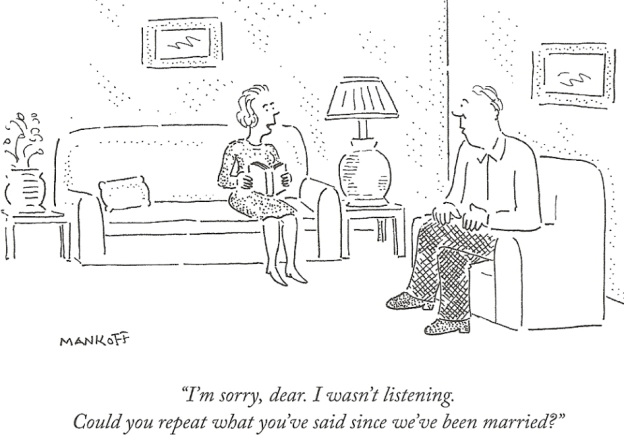
Triumphed again my darling!” exclaimed my uncle as my aunt produced yet another burnt offering. Cooking was not her forte but she was taking lessons and insisted on trying out new things before she was quite ready.
20150701_132257_Richtone(HDR)My uncle was a kind man. He never resorted to sarcasm. He never gave her anything other than glowing feedback. He adored her culinary triumphs and made light of her kitchen disasters. He exuded an air of “Aren’t I lucky to be sharing my life with this woman!”

I think they were the most joyful couple I’ve ever known and staying with them was deeply restorative.

Were they “perfect?”

Of course not!

They came from very different backgrounds; had different interests; enjoyed different music; had different appetites for socializing; he was a quiet private man, she was an extrovert; they could rub one another the wrong way as much as any couple.

But they were (almost) always kind to one another.

They were my first role models for the power of kindness in creating great long-term relationships.

* * * * * * * * * * * * * * * * * * * * * *

Sometimes living together gets tough. You have issues. You want to fix something. You work hard.

And yet, after all the ~

  • communicating;
  • counting to ten before you speak;
  • concentrated listening;
  • patient “So what you’re saying is . . . ” active reflecting;
  • negotiating, and giving one another space, and problem-solving;

after you’ve cycled through your arsenal of relationship skills in the effort to both understand and grow closer to the person you love (or thought you loved) ~

you may still be mystified by your partner.

You may still feel exasperated, irritated, disappointed, exhausted, frustrated, righteous.

So then what?

This person whom you’ve committed to spending the rest of your life with may still;

  • Loose their car keys every day;
  • Finish your story;
  • Overcook the fish;
  • Forget your birthday;
  • Channel surf;
  • Grunt at you over morning coffee.

Nothing you’ve said or done or negotiated has worked and there is this issue, this “pebble in your shoe” (as the Mexicans say) which threatens to undermine your whole marathon.

It’s hardly a crime against humanity. It can’t possibly be grounds for divorce:

Your Honor I’m done. He burns the fish!”

But, dammit, there’s this issue that bugs you. Whether you’re the partner who looses track of fish cooking times and hates that this matters, or you’re the partner who hates that fish gets burnt, you are aware that over the long haul this issue could get old. And potentially deadly because the truth is, it often IS the little things that make or break a marriage.

So what?

WHAT!

Try kindness.

Here’s why you might want to try kindness.

Every interaction between you and your partner does one of three things.

  1. It brings you closer.
  2. It maintains the status quo.
  3. It pushes you apart.

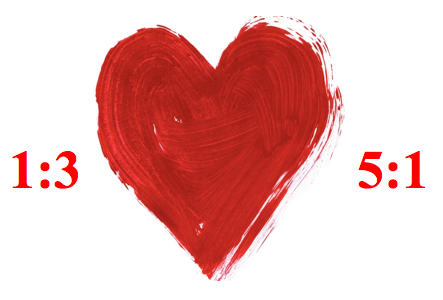
Happy couples enjoy a ratio of five positive interactions for every one negative one. Their arousal and fear mechanisms are not triggered. They feel safe with one another. They can relax. This feels good. It IS good. Their emotional landscape creates their biological reality. Happy couples literally live longer .

On the other hand, unhappy couples have more negative interactions than positive ones. These negative experiences trigger the body’s arousal and fear mechanisms. They feel less and less safe with one another. They can’t relax. This feels bad. It IS bad. Indeed, emotional toxicity undermines the immune system. There is growing evidence that bad relationships contribute to bad health. which is why Happy couples literally live longer .

Here’s how to try kindness. .

  • So – how to get this 5:1 ratio of good to bad interactions?
  • What does this look like in real life?
  • What’s an example of a “good” interaction versus a “bad” interaction?

It’s not what you think!

Sure the “bad” list includes what you’d expect:

  • Physical, verbal or sexual abuse
  • Abandonment
  • Criticism
  • Defensiveness
  • Contempt
  • Stonewalling

[By the way, these last 4 in italics have been identified by John Gottman as The Four Horseman of the Apocalypse because they do so much harm. If you are interested I’ve embedded a short video from Gottman’s website . These are the poster children for Not Kindness!]

But the “bad” list also includes some seemingly “normal” responses to the irritating scenarios above. In other words, you may be unwittingly triggering a negative response in your partner through these small daily interactions that add up to no good.

Here are three responses to a chronic lost-key scenario. Which would you prefer if you were the key looser?

  1. You see your partner roll their eyes, sigh, check their watch and drift off leaving you alone to find the keys.
  2. Your partner notices you are key hunting and says in a neutral tone, “Oh, you’ve lost the keys?”
  3. Your partner comes to you a few minutes before it’s time to leave and cheerily says: “So, are we on a key hunt this morning, or have you rounded up those bad boys already?

Personally I’d choose door number 3. There’s a playfulness, lightness, acceptance of the probability of a key-hunt and the use of “we” not “you.”

Option #1 is most likely to be experienced as negative. Eye rolling is a form of contempt.

Option #2 is most likely to be experienced as neutral. No one is angry or contemptuous. But there’s not a whole heap of warmth either.

Option #3 is most likely to be experienced as positive. It’s a kind response. The sort of thing good friends do for one another.

Is that so hard?

What does it take to help move a person from irritation to kind acceptance?

I’ll come back to this question over this month of July because it’s a great one, but for starters here’s how I’d answer that question.

Moving to kindness needs two things:

1. It’s a conscious decision to exercise your inner capacity to be kind.

2. Your inner capacity to be kind is like a muscle – it is weak when not used, and needs to be exercised to be effective.

So meanwhile – try it out! Catch yourself in one of your typical moments of exasperation and think through what a kind response might look like. Then try it. I’d love to know what you notice!

More next week.

FIRST TIME HERE?

This is the latest article in a year-long series on the “12-most-important-relationship-skills-no-one-ever-taught-me-in-school-but-I-sure-wish-they-had.”

Click the box for the full list.  → Top 12 Relationship Skills
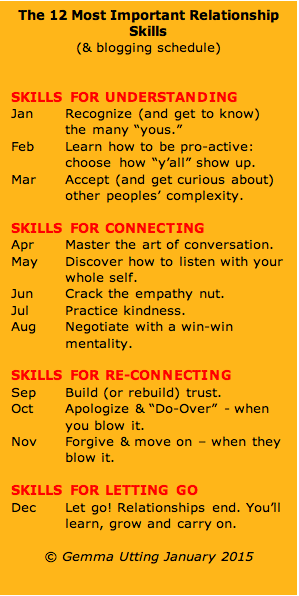
If you’re interested in reading this blog in sequence, below are links to the series to date, beginning with the first posting at the top.

OVERVIEW

SKILLS FOR UNDERSTANDING

SKILL ONE ~ Recognize (and get to know) the many “yous.”

SKILL TWO ~ Learn how to be pro-active: choose how y’all show up.

 SKILL THREE ~ Accept (and get curious about) other peoples’ complexity

SKILLS FOR CONNECTING

SKILL FOUR ~ Master the Art of Conversation

SKILL FIVE ~ Learn How To Listen With Your Whole Self

SKILL SIX ~ Crack The Empathy Nut

SKILL SEVEN ~ Practice Kindness

  •  Kindness Is Key

Living Empathically

A thoughtful reader responded to my Teaching Empathy to Children post with this comment:

So often I’ve seen parents making the mistakes you list at the top of the article. It’s sad because some of the children who have grown up with my own children have indeed become emotionally stymied and unhealthy. Since it takes a village to raise emotionally healthy young people, can you suggest ways in which you can intervene diplomatically and with skill when you see a situation going bad in which parents make those mistakes and lose sight of the big picture?

It’s such a great question I wanted to use it as the focus for this final post on the subject of empathy.

I’d also love to open up a conversation – I am sure there will be readers who have ideas to add. Hit the Leave a Reply link at the beginning of this post. We’d all benefit.

As a licensed therapist I’d be remiss not to note the obvious: there’s a triage to be considered in these parenting issues.

  1. Active Abuse – get involved, because the situation is out of control and the family system needs professional attention
  2. Parent out of control – get involved, because the parent has lost it and the child needs your help
  3. Child out of control – get involved, because the child has lost it and the parent needs your help

1.  Active Abuse

Screen shot 2015-06-24 at 12.13.57 PMChild abuse is taken very seriously in most countries around the world. For US readers, here’s a Mandatory Reporters of Child Abuse guide, as a short handout from the government’s Child Welfare division. It’s worth a read if you’ve ever found yourself wondering  “is this abuse?” and “should I report this to someone?”

In brief,

The Definition of abuse ~ varies, but in most areas it’s along the lines of conditions that would reasonably result in harm to a child . However, to be sure, and to empower you in case you witness something that has you wondering, check the legal definition in your area. US readers can search their State’s definition of what constitutes abuse .

Who can report child abuse? ~ Anyone may report, and some people must report. Once again this varies by region but certain professionals are mandated to report child abuse and this is a comprehensive list. It includes at least –

  • social workers
  • teachers and school personnel
  • doctors, nurses and all health care workers
  • school counselors, therapists and mental health professionals
  • child care providers
  • medical examiners and coroners
  • law enforcement
  • and can include the directors, employees and volunteers at places which provide organized activities for children such as day camps, youth centers and recreation centers.

In no state it is wrong to report your suspicions of child abuse.

So, IF you have “knowledge of, or observe a child being subjected to, conditions that would reasonably result in harm to the child” (excerpted from the Mandatory Reporters publication linked above) you should call the police, or if in the USA, you can call your state-specific child abuse hotline,

If you have witnessed a nasty, vicious incident and can report it, you’ll at least feel you did something. But if you know nothing about the people involved, and can’t give names, addresses or even any static geographic area where the police could reasonably be expected to find these folks again (you’re at an airport, on a train or bus etc) you can at least take some comfort in knowing that if there is chronic abuse there is a good chance the child will be witnessed by one of the numerous mandated reporters.

2.  Parent out of control

Screen shot 2015-06-24 at 12.19.47 PM OK, so you’re right there when a parent looses it. They yell, handle the child roughly, use abusive language, make threats and even slap or swat the child, but awful as this is for the child (and for you to witness) it does not seem “bad-enough” to report to the authorities.
What can you do?

Apparently lots of folks have opinions about this, and a quick internet search brings up some pretty dismal ideas, mostly along the lines of shouting at, and shaming, the already beleaguered parent. I was horrified!
Think about it.

What’s happened?

The parent is out of control. They’ve [temporarily we hope] lost touch with their mature, capable, resourceful self. They are behaving childishly, in an unskilled, reactive and volatile way. They are – essentially – throwing a grown-up tantrum, except it’s not their parents they are throwing it for, it’s their child. Truth is, we’ve all been there! Maybe for us we’ve been fortunate enough not to loose it when we were out in public. The last thing we need at times like these is public shaming.

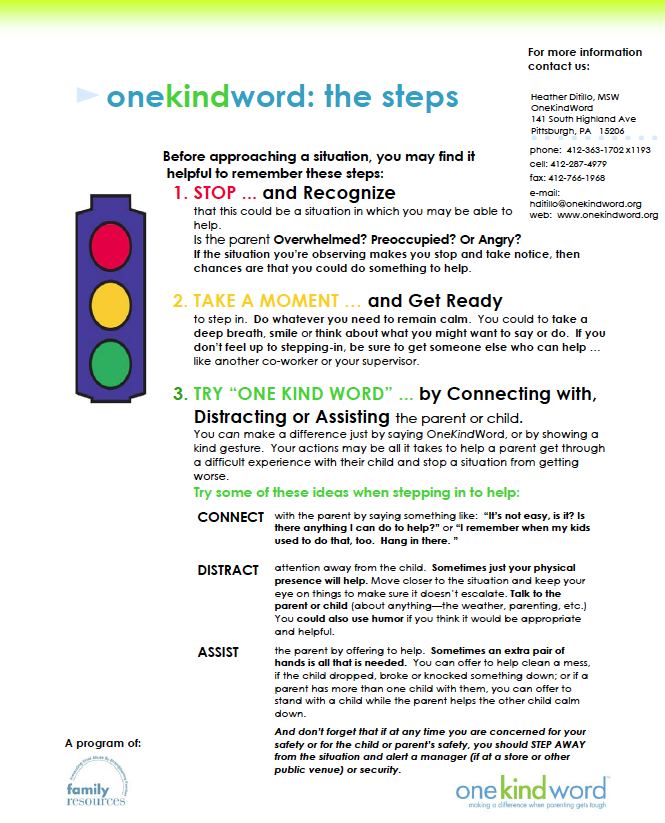
I’ve come across a wonderful resource for just these moments that I’d love to share, called OneKindWord. This is a public education program developed by Pennsylvania-based Family Resources  and Family Communications, thanks to Mr. Roger’s on-going legacy

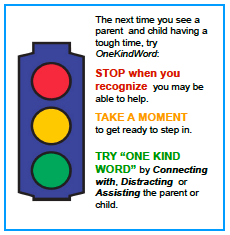
With a mission to raise awareness about parent-child conflicts in public and empower people to step in helpfully when they see a stressed parent or a child who is unsafe, they offer three simple steps which go a long way to help us dump the judgment and connect empathically.

Screen shot 2015-06-24 at 12.26.35 PM

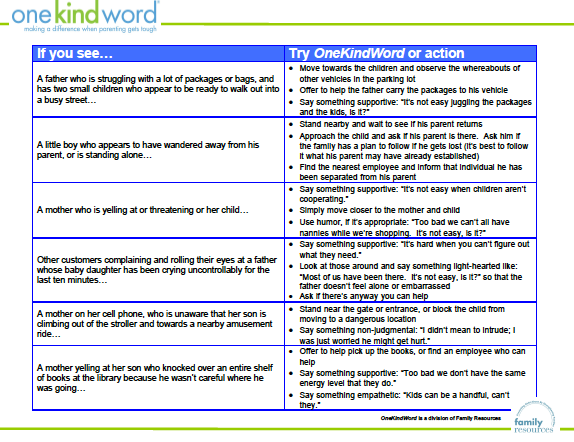
And you can download a One Kind Word Overview  as a PDF, and here’s a short Tip Sheet.

Screen shot 2015-06-24 at 12.43.25 PM

3.  Child out of control

Screen shot 2015-06-24 at 12.18.42 PM

If the parent is on their game and can handle it, great.

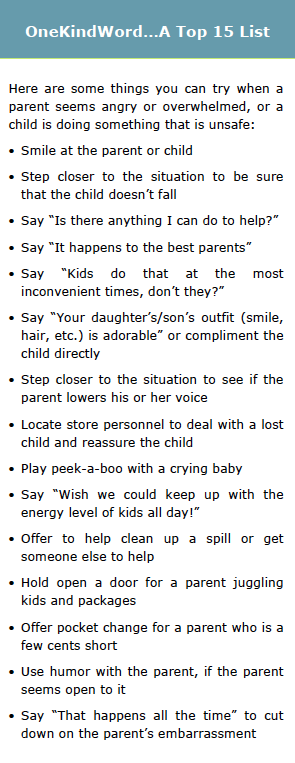
If not, making eye contact, saying something kind, and helping the parent keep the child safe can all make a huge different to the outcome.

Here’s another list from OneKindWord .

Screen shot 2015-06-24 at 12.30.44 PM

Living empathically can become a habit. Enjoy!

FIRST TIME HERE?

This is the latest article in a year-long series on the “12-most-important-relationship-skills-no-one-ever-taught-me-in-school-but-I-sure-wish-they-had.”

Click the box for the full list.  Top 12 Relationship Skills

If you’re interested in reading this blog in sequence, below are links to the series to date, beginning with the first posting at the top.

OVERVIEW

SKILLS FOR UNDERSTANDING

SKILL ONE ~ Recognize (and get to know) the many “yous.”

SKILL TWO ~ Learn how to be pro-active: choose how y’all show up.

 SKILL THREE ~ Accept (and get curious about) other peoples’ complexity

SKILLS FOR CONNECTING

SKILL FOUR ~ Master the Art of Conversation

SKILL FIVE ~ Learn How To Listen With Your Whole Self

SKILL SIX ~ Crack The Empathy Nut

Thriving Through Tough Times

Screen shot 2015-06-03 at 12.08.47 PMYour partner is going through a rough patch. You suspect they may be slipping into a bit of a depression. Maybe a chronic injury is preventing much-needed regular exercise. Maybe they’ve been skipped over for a promotion again and now feel both undervalued and trapped.

You love this person – in theory. But you don’t feel those loving feelings right now, and its been a while. You’ve checked your relationship tool kit and tried a bunch of stuff.

You’ve met with those Parts of you who feel triggered by depression and/or work-place inertia so you could listen to your partner non-reactively. You recognize your partner might be stuck in a Part of him or herself which is young and vulnerable and right now this is just how your partner is facing the world.

But none of this is helping your background ticker-tape-script of frustration, resentment, and exhaustion. There’s this nagging “I could do better! I deserve more! Is this it?”

What happens now in a relationship is often what sets a mediocre or doomed relationship apart from a great and robust relationship.

  • How do we thrive through tough times?
  • What allows a relationship to survive after those fuzzy “in love” feelings fade?
  • What’s the antidote when resentment and disappointment creep in?
  • How can we dwell in the presence of another human being for years and manage to not allow familiarity to breed contempt?

Two things.

  • Empathy – for your partner
  • Compassion – for yourself.

What do I mean by empathy for the other?

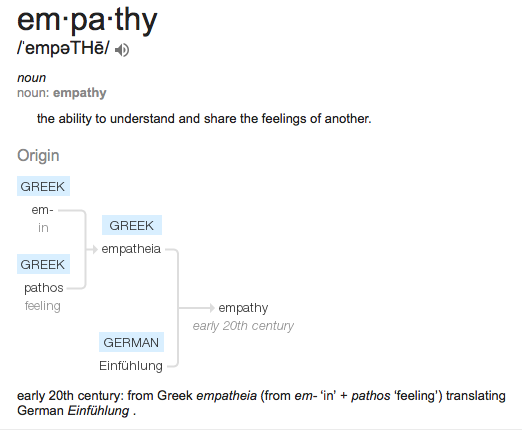
Screen shot 2015-06-03 at 10.08.29 AMIt’s the social and emotional glue that connects us to one another. It allows us to see things from the other chap’s point of view by going within ourselves to cross-reference our own experiences and feelings.

We can imagine the joy of another by remembering our own joy. We can imagine the sadness of another by remembering our own sadness. We feel into ourselves in order to extend outward.

The limit to empathy might be, of course, our inability to cross-reference every human condition.

If your partner is injured, or flat-lined at work, it’s very possible you can dig into your own life-story and remember how you felt when you were prevented from exercising or overlooked at work. You can allow an upwelling of understanding through shared experience. Thus reminded, thus equipped with a memory for who you were under these same burdens, you can also remember what helped you.

Probably you responded well to patience, understanding, kindness. And, if you came through those tough times, you have a sense that ‘this too shall pass.”

Screen shot 2015-06-03 at 12.20.11 PMSo, the extent to which you can dig back into your own experience and resonate with your partner allows you to stay the course. You’d hate to have been ridiculed, chivvied, belittled or worse – abandoned – at a time such as this.

It’s the good old Golden Rule ~ “Do unto others as you would be done by.”

What do I mean by compassion for oneself?

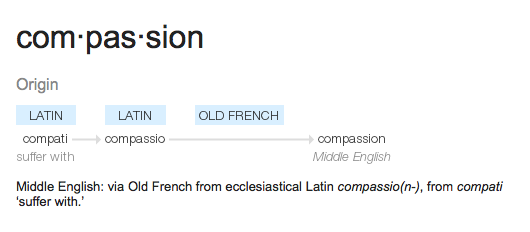
Screen shot 2015-06-03 at 10.10.23 AMThis is the astonishingly transcendent ability we humans have to stand beside, to be with, in the face of the unknown.

You may not be able to tap into your own experience of someone else’s difficult situation, but you are willing to stand beside them: with feeling; with caring; with an outpouring of human-to-human connection.

And (or, but) the magic of compassion is that “It has to begin with me”: With compassion for Self.

Right there inside your wonderful complex inner world of opinion and judgment, right there where your background ticker-tape-script of frustration, resentment, and exhaustion deliver the nagging sense of “I could do better! I deserve more! Is this it?” you get to STOP . . .

and stand beside your Self with love. With a hug. With a sort of “welcome to the deliciously imperfect human condition – isn’t it amazing! Aren’t I amazing, to be standing here right now noticing my judgments. Noticing my partner’s frailty. Maybe there never was a memo that life should be easy. Maybe simply being present to this particular version of imperfection is perfect.”

Screen shot 2015-06-03 at 12.26.50 PMFrom this place of deep compassion for yourself, you can respond using the lesser known Platinum rule ~

Do unto others as they would be done by

Untethered from your experiences of what might be their pain, you are free to simply BE. It’s a form of radical acceptance.

Here are 2 quotes from one of my favorite mentors ~ and John Gottmans’ pick for the best living couples therapist ~ Dan Wile.

  • Despite what you might have been told, you can expect your relationship to solve your problems, fill gaps in your personality, and help you love yourself.
  • When choosing a long-term partner, you will inevitably be choosing a particular set of unsolvable problems that you’ll be grappling with for the next ten, twenty or fifty years.

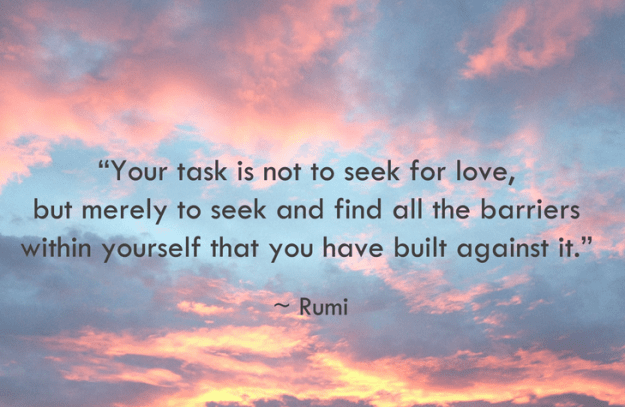
So, before we dive more deeply over the next 3 weeks into whether and how empathy and compassion can be taught, I’m inviting you to simply experience your response to this Rumi meditation.

Screen shot 2015-06-02 at 3.51.43 PM

FIRST TIME HERE?

This is the latest article in a year-long series on the “12-most-important-relationship-skills-no-one-ever-taught-me-in-school-but-I-sure-wish-they-had.”

Click the box for the full list.  Top 12 Relationship Skills

If you are interested in reading this blog in sequence, below are links to the series to date, beginning with the first posting at the top.

OVERVIEW

SKILLS FOR UNDERSTANDING

SKILL ONE ~ Recognize (and get to know) the many “yous.”

SKILL TWO ~ Learn how to be pro-active: choose how y’all show up.

 SKILL THREE ~ Accept (and get curious about) other peoples’ complexity

SKILLS FOR CONNECTING

SKILL FOUR ~ Master the Art of Conversation

SKILL FIVE ~ Learn How To Listen With Your Whole Self

SKILL SIX ~ Crack The Empathy Nut

  • Thriving Through Tough Times

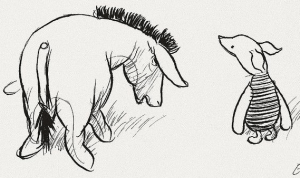
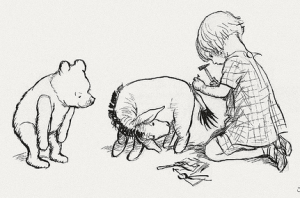
Thanks to Ernest Howard Shepard for the wonderful Winnie The Pooh illustrations. 

Who’s Listening?

Ever considered what an astonishingly powerful tool deep listening really is?

The summer holidays are coming.

David turns to his wife Judith over breakfast and sighs;

Screen shot 2015-05-20 at 12.23.34 PM

I’m dreading summer this year!”

See if you can hear how Judith responds differently to David depending upon what Part of her is doing the listening. Or, to put it another way, depending upon who Judith is as she listens.

Judith has a Part of her who likes to keep things light and fluffy…a sort of “Don’t rock the boat” Part. This Part says:

Oh heavens – what are you saying? You love the heat and going to the lake house.”

And, Judith has a Part of herself who is hyper attuned to what-is-fair between her and her partner. This Part senses the balance may be off and from there Judith responds:

Look whose talking! It’s a pain for me with both kids home all summer, you gone all day, me trying to get work done and no routine!”

And, Judith has a Part who gets easily triggered by guilt and this Part smells a guilt trip coming so she says:

OK, OK… we agreed I’d go part-time and have some flexibility to be with the kids in the summer, and now you complain….You love your job, right?”

And Judith has a Part finely honed in response to her high-achieving-but-distant-and-grumpy-Father whose expectations for year-round hard work cast a shadow on Judith’s childhood desires for fun. This Part comes out as a snarky “don’t tell me not to have fun!” teenager so when this Part hears just those 5 words from David she quips:

You’re just like my father! It drives me nuts when you pour cold water on the kids’ summertime fun. Stop being such a grouch!”

So three questions immediately arise here.

  1. What might Judith’s responses trigger in David?
  2. What did David really mean?
  3. Instead of this, is it possible for people to listen in a way that fosters ~
    • understanding and love for oneself?
    • understanding and love for others?
    • more relationship satisfaction and closeness?

What might Judith’s responses trigger in David?

Since I see variations of this theme in my offices pretty frequently I can tell you how David is most likely to respond.

When someone initiates a conversation with a partner hoping for some solace, and that partner listens only through the narrow prism of his or her needs, fears and ghosts, and responds from those places, the speaker will not feel heard at all.

In fact, they’ll feel ~

  • dismissed (answer #1)
  • attacked (answer #2)
  • manipulated (answer #3)
  • unreasonably accused (answer #4)

And when a person feels any of these emotions, they are likely to respond with some combination of

  • frustration
  • counter attack
  • anger
  • defensiveness.

Not helpful – right?

What did David really mean?

Do we know?

All he said was “I’m dreading summer this year!”

Without being curious with David about what he meant, we have no idea what’s going on for him.

How can we ever know what someone really means?

Which brings us to the last question:

Is it possible for people to listen in a way that fosters ~

i)   understanding and love for oneself?

Yes yes, self first!

Going back to Judith, she’s not wrong for having being triggered. This is the magic of relationship! Being in this relationship with David allows Judith to discern these Parts of her. They all have a role to play. To grasp this point more fully if “Parts language” is new to you, you might find this post helpful.

The work – for yes, coming to understand and love yourself does take effort – is to cultivate a relationship with these Parts of you so that you can:

a) know what triggers this pattern of feelings, fears and beliefs (what I call a Part of you),

For Judith, can she become aware of situations that get interpreted by this Part of her as “Potential for some upsetting boat-rocking here.” ?

b) understand why this Part is concerned since all Parts are trying to help and protect you;

For Judith, can she hear that this Part is on high alert because it vividly remembers a time she was disobedient as a child and her mother yelled at her saying “Can’t you see how tough things are for me? How dare you rock the boat! Your father and I are at breaking point!” ?

 c) listen for the deeper beliefs which fuel this Part’s protective triggers

For Judith, can she allow herself to connect the dots between her belief that emotional instability leads directly to overwhelming pain and chaos and that it’s all her fault? That she has a belief if she does not keep things calm, bad things happen?

d) and might she be interested in releasing these long-held but unhelpful beliefs?

For Judith, can she witness this inner pain and let go of the belief that emotional pain is dangerous and it’s up to her to never let it be expressed?

This is the gift of relationship: it offers opportunities for us to understand, love and unburden (or de-trigger) ourselves.

ii)   understanding and love for others

To the extent we allow this gift of relationship to help us understand, love and unburden (or de-trigger) ourselves, we can offer the gift back.

If we can be clear about how we get triggered, and bring compassion to our own inner Parts so we can stay clear, present and untriggered as we listen to those we love, we can help others come to understand, love and unburden (or de-trigger) themselves.

Let’s see what that looks like for Judith and David.

Here’s their “do-over.”

The summer holidays are coming.

David turns to his wife Judith over breakfast and sighs;

Screen shot 2015-05-20 at 12.23.34 PM

I’m dreading summer this year!”

Judith’s been doing some emotional homework.

She’s immediately aware of a bunch of feelings which bubble up inside of her.

She notices a pang from her “Don’t rock-the-boat Part” which she quickly calms with a warm inner hug and a reminder to this younger Part of her that she is safe in her adult relationship and not vulnerable to her parents’ volatility;

She has a momentary pang from her Part who worries David might be saying he is working harder than her and reassures this Part that she and David check in each week with how each is feeling in their respective worlds and both are mature enough to take responsibility for getting their needs met;

Her guilt-detector runs a quick scan but knows David doesn’t do guilt-trips, and she’s been working to liberate herself from the grips of this bad-boy for a while now;

And that Part who got so triggered by adults preventing kids from having summertime fun also gets a warm inner hug of acknowledgment.

Now Judith feels clear. She is centered in a calm and curious inner space from which she can say, with warmth and genuineness:

I’m sorry you’re dreading the summer David. Do you want to talk about it? What’s going on for you?”

David might need to test the waters a bit to see if he really does have permission to be curious; to be sure Judith is not going to pounce on him if he is not coming up with what she needs to hear.

I’m not sure. It’s odd – I usually love the summer but lately I’ve been feeling this sense of gloom and dread. Are you sure you want me to talk about it?”

Judith can reassure him with a compassionate nudge.

“Yes absolutely. Tell me more. You’re right, it’s odd. You do normally love the heat and the lake. What do you think is going on for you?”

Screen shot 2015-05-20 at 12.59.40 PMNow Judith is listening.

She’s created a deep pool of space, permission, curiosity and compassion for David to explore what is going on for him.

In that place of quiet permission, David can explore.

“Well, now that you ask, I think there’s a mix of issues.

I DO love the summer, and time with you and the kids up at the lake. It’s one of my favorite places. And, I feel good about my work right now. I’m getting ahead and doing well. I guess one of the issues is I feel so pulled. I want to be with you, and yet I’m needed more at work to cover when others are on vacation. And then I feel bad – whichever I choose, I’m letting the other one down. I think that’s what it is.”

What a difference – right?

iii)   more relationship satisfaction and closeness?

Need I say more?

When one partner can bring self-awareness and self-compassion to his or her listening, it’s a game changer.

How much more deeply satisfying is an exchange like this, than the Parts-triggered and Parts-led alternative?

Hence my question at the top of the page: “Who’s Listening?”

If you want to build great relationships, do your best to clear the decks and show up with curiosity and compassion. For the both of you.

FIRST TIME HERE?

This is the latest article in a year-long series on the “12-most-important-relationship-skills-no-one-ever-taught-me-in-school-but-I-sure-wish-they-had.”

Click the box for the full list.Top 12 Relationship Skills

If you are interested in reading this blog in sequence, below are links to the series to date, beginning with the first posting at the top.

OVERVIEW

SKILLS FOR UNDERSTANDING

SKILL ONE ~ Recognize (and get to know) the many “yous.”

SKILL TWO ~ Learn how to be pro-active: choose how y’all show up.

 SKILL THREE ~ Accept (and get curious about) other peoples’ complexity

SKILLS FOR CONNECTING

SKILL FOUR ~ Master the Art of Conversation

SKILL FIVE ~ Learn How To Listen With Your Whole Self


5 Ways To Be A Better Listener

Screen shot 2015-05-06 at 12.13.14 PM

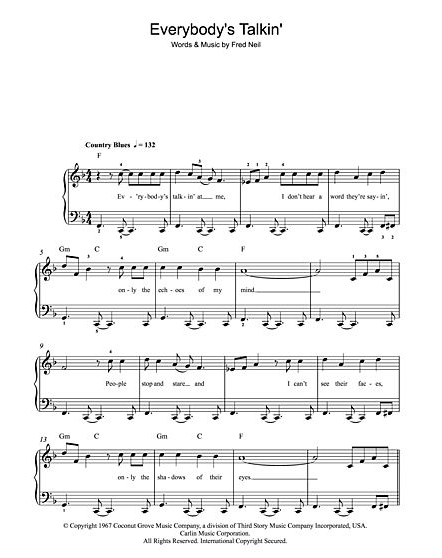
Everybody’s talkin’ at me
Can’t hear a word they’re sayin’
Only the echos of my mind”

Remember that Fred Neil song?

Popularized by others – chiefly Harry Nilsson in Midnight Cowboy –  and covered by over 100 other artists, that lonesome feeling it evokes is perfect for today.

Not being heard, especially when surrounded by others, is as lonesome as it gets.

It’s sad when we feel this way. And, maybe it’s sadder still when we are the one’s not listening.

So, listen up folks – here’s the low down on listening.

  1. We’re all pretty bad at it. So first-off I’m inviting you to invest a delightful 7:46 minutes watching Julian Treasure’s TED Talk “5 Ways To Listen Better”. For those who don’t like to watch videos, I’ve printed out the main take-aways after the video, below.
  1. Ever noticed how you listen to yourself? I find we’re masters at ignoring, distorting, minimizing, ridiculing and avoiding ourselves. What’s with that? Tune-in on May 13th to re-tune your inner cacophony.
  1. Guess what? All those “skills” we use on ourselves – all that ignoring, distorting, minimizing, ridiculing and avoiding – this is how we treat others too. Not to mention the astonishing filters we employ to be sure not to let the words’ of others resonate within our hearts. May 20 we’ll attend to our attention.
  1. Once Upon A Time . . “  And finally, on May 27th, I invite you to pull up a rocker, snuggle up with a Blankie and allow yourself to be lulled by the magic of “Once Upon A Time.” There’s so much we can learn from listening like children; from listening as children. And, it’s great fun!

NOTE FOR THE DEAF

“Listening” in this series of articles is not just about sound. Julian’s TED talk is – but really for me this is about attention. Where and how we pay attention. I’d love to hear from any readers whose attention is exclusively brokered visually rather than both auditorily and visually. But please know I am thinking of you as I compose these pieces.

Here’s Julian’s TED talk.

Or, if you prefer, here are his ~

Five Simple Exercises to Improve Your Own Conscious Listening.

SILENCE

Just three minutes a day of silence is a wonderful exercise to reset your ears and to recalibrate your attention so that you can hear the quiet again. If you can’t get absolute silence, go for quiet, that’s absolutely fine.

THE MIXER

Even when you are in a noisy environment, like a hectic coffee shop for example, let yourself notice how many individual channels you can identify. Maybe an espresso machine; cups rattling; a dishwasher; distant conversation; close-up conversation; an ambulance siren. Or, take nature. How many distinct noises do you hear? How many birds am I hearing? Where are they? Where are those ripples? It’s a great exercise for improving the quality of your listening.

SAVORING

This is a beautiful exercise. It’s about enjoying mundane sounds. Focus on one familiar sound. Julian notices his tumble dryer and observes ~ “It’s a waltz. One, two, three. One, two, three. One, two, three. I love it !” Mundane sounds can be really interesting if you pay attention. I call that the hidden choir. It’s around us all the time.

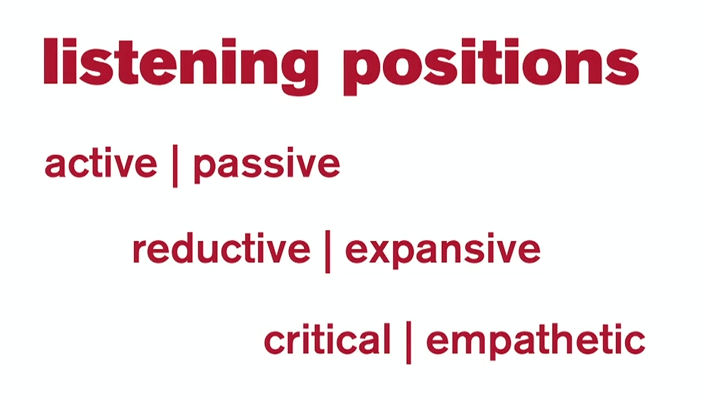
LISTENING POSITIONS

Screen shot 2015-05-05 at 3.14.52 PMThis is the idea that you can move your listening position to what’s appropriate to what you’re listening to.

Try these for a start 

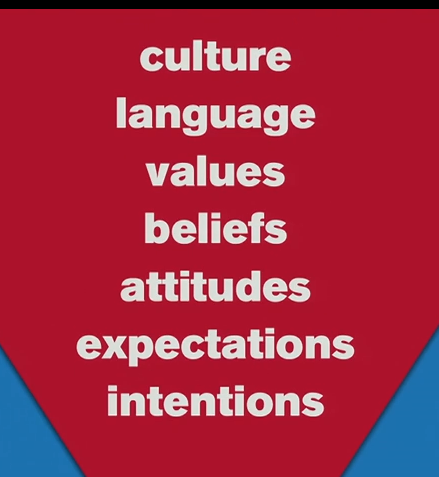
Screen shot 2015-05-05 at 2.54.24 PMIt’s playing with those filters. It’s starting to play with them as levers, to get conscious about them and to move to different places.

Here are some typical filters

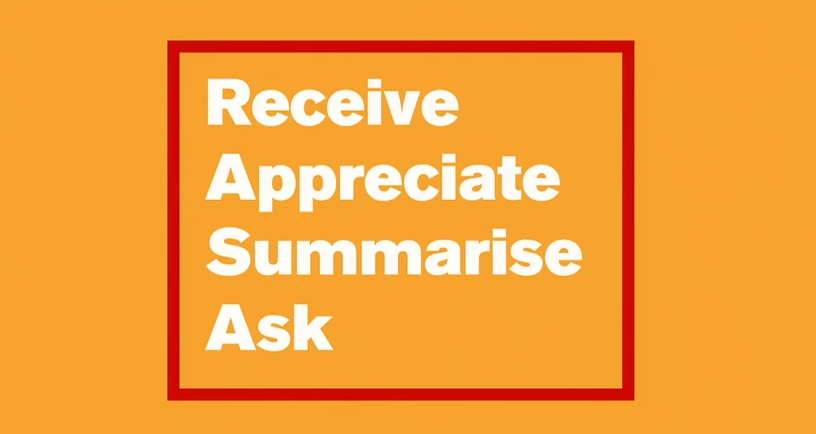
AN ACRONYM

RASA, which is the Sanskrit word for juice or essence.

And RASA stands for

Screen shot 2015-05-05 at 3.15.08 PM

Receive, which means pay attention to the person;

Appreciate, making little noises like “hmm,” “oh,” “okay”;

Summarize, the word “so” is very important in communication;

Ask, ask questions afterward.

FIRST TIME HERE?

This is the latest article in a year-long series on the “12-most-important-relationship-skills-no-one-ever-taught-me-in-school-but-I-sure-wish-they-had.

Click the box for the full list.  Top 12 Relationship Skills

If you are interested in reading this blog in sequence, below are links to the series to date, beginning with the first posting at the top.

OVERVIEW

SKILLS FOR UNDERSTANDING

SKILL ONE ~ Recognize (and get to know) the many “yous.”

SKILL TWO ~ Learn how to be pro-active: choose how y’all show up.

 SKILL THREE ~ Accept (and get curious about) other peoples’ complexity

SKILLS FOR CONNECTING

SKILL FOUR ~ Master the Art of Conversation

The 7 Deadliest Fights – Part 2

Last week and this I’m exploring the 7 deadliest fights.

Not those knock-down-drag-out-referee-over-the-body fights.

But those we launch with words, looks and silences on those we love.

I actually believe fights can be good. They are a sign of robustness and courage and can clear the air. I’m almost worried when I meet “nice” folks who tell me with pride they’ve “Never had a cross word…”

But, there are fights, and then there are FIGHTS.

These 2 weeks are dedicated to helping you bring things down a notch or two.

So here they are ~ The 7 Deadliest Fight Strategies

  1. Attacking
  2. Belittling
  3. Criticizing
  4. Contemptuousness
  5. Defensiveness
  6. Escaping
  7. Escalating

(Today I’m writing about 5 – 7. Last week was 1 – 4. Too long for one week.)

Deadly Fight #5 – DEFENSIVENESS

Screen shot 2015-04-28 at 3.56.19 PM

One of the most subtle and common of the deadly fight strategies, it is the rare person who has not responded to an attack with excuses, explanations, justifications or a counter attack in the form of blame. “The other chap started things, of course I’ll defend myself!”  you righteously think.

Maybe it sounds like ~

  • “But I didn’t mean to!”
  • “That was so not my fault!”
  • “No, no, no. Let me explain.”
  • “Well obviously I had to do this because…”
  • “You know, if you would have done this first we’d not be in this mess.”

What you’re doing is pushing away what the other person needs you to hear. It might well be that this person is coming on strongly and is angry so you find yourself feeling the need to defend yourself. But not listening to what this upset person has to say will not solve the problem. The more close to the bone the complaints, the more likely you are to reach for those innocent sounding explanations and excuses.

The problem with this is ~

No one is listening! If you’re not listening to what this other person is trying to tell you, for sure they will be in no mood to listen to you. All your excuses, explanations, justifications and blaming will not only fall on deaf ears, it will fuel the flames.

INSTEAD TRY THIS ~

Get curious. If you’re in the habit of responding to criticism or “feedback” with excuses, explanations, justifications or a counter attack in the form of blame – switch to asking questions.

Stop. Breathe. Listen. If you feel defensiveness bubbling up, the deeper truth is that if you could only stop long enough to listen, maybe you’d agree just a little… but instead of exposing that vulnerability, you launch a (clearly justifiable!) defensive mission. If the other person is shouting by all means let them know you’d love to listen when they can calm down. Then, if they can talk to you without shouting, really listen. Ask questions. Get curious. Your goal is to fully understand what is upsetting them. This is important:

Seeking to understand is not the same as agreeing with their point of view or admitting any fault.

Understanding is simply that – understanding. You are the anthropologist seeking – in a non-judgmental way – to see things from the other culture’s point of view. You want to briefly inhabit their worldview so you genuinely see what they see. There is no salve as calming as feeling heard.

I know this can seem like nothing. Or not enough. But once you try it, I think you’ll find its a hugely helpful way of being in the face of someone’s anger. Often indeed, simply listening deeply, non-defensively and with genuine curiosity will allow both of you to flush out what the other person needs to express. And that can be enough.

Deadly Fight #6 – ESCAPING

Screen shot 2015-04-28 at 4.04.27 PM

You escape – either physically or emotionally – without letting your partner know you need a time out. You just walk out, drive away, slam a door, hole up, or get lost in the TV, internet, or music.

Maybe it looks like ~

  • A door slamming.
  • A car engine revving.
  • The TV on full blast.
  • A person lost in distractions, buffeted by headphones.

What you’re doing is running for all you are worth away from the pain. You are possibly flooded with sadness or rage; shame or guilt. You are spent, exhausted and done with the effort of figuring out what anyone needs or wants, yet everything is left hanging and no resolution is in sight.

The problem with this is ~

It’s abandonment! If you do this to a friend, it’s unkind. But if you do this to your committed partner it’s devastating. It triggers deep places within people in primary relationships when a partner makes a unilateral move to withdraw with no warning, no explanation, no reassurance. And, right when the stakes are high, your partner’s anxiety will go through the roof.

He or she is left thinking:

  • “When will s/he come back?”
  • “Will s/he ever come back?”
  • “Will s/he do something stupid?”
  • “What should I do now?”

INSTEAD TRY THIS ~

Ask for a break. If you are in the habit of leaving abruptly, either physically or emotionally, without letting your partner know you need a time out, please – pause before you leave. Right when that “I am not taking this any more” button gets pushed see if you can tell your partner what’s going on for you.

Don’t leave them hanging. Before you take that break tell them “I’m totally overwrought. I need to take 15 minutes. I’ll be back.” Then go. But come back when you said you’d come back. If you know you need an hour, say you need an hour, but come back in an hour. If you feel you want to run away for a longer period of time, it works better to move a bit more slowly. Take a 15-minute break and then come back and negotiate a longer space, like a weekend away. The idea is to not lose sight of the goal – which is to reconnect with your partner and heal the problem. If you just take off without negotiating this space, you run the risk of making the issues so much worse because now you’ve got whatever the initial issue was, plus abandonment. And believe me – the latter is a hard repair.

Deadly Fight #7 – ESCALATING

Screen shot 2015-04-28 at 4.13.44 PMYou know you’re way too far gone when your partner has de-escalated their part of the fight, is trying to listen to you, is making soothing noises, is asking you to calm down, and is clearly telling you they want to stop. But you are so overwrought, angry, righteous and caught up in emoting that you don’t notice the cues. You just keep on punching the air like a blind fighter alone in the ring.

Maybe it sounds like ~

  • ”No I’m not willing to calm down and take a break”
  • “Don’t change the subject on me now…”
  • “No I don’t want to sit next to you and talk calmly!”
  • “We need to figure this out right now!”

What you’re doing is throwing a “Fire & Brimstone Anger Party” for one. No one else wants to come. You’re horrid company. You make no sense, and you look like you have no intention of stopping any time soon.

The problem with this ~

You are pouring gas on your own internal fire. You are, effectively, fighting with yourself. Your partner is not the issue anymore. You are not listening to anyone, most especially yourself.

INSTEAD TRY THIS ~

Get some firefighting skills. If you know there are times when you loose the plot and escalate conflict, it’s time to get some pre-emptive, flame dousing skills. Here are three tips to get you on your way. The fourth, if these are not helping you, would be to let yourself go talk with a good therapist.

  1. Think of this out-of-control behavior as a Part of you, not the all of you. Say to yourself “I have a Part who escalates fights in certain situations.” (See here for more on the idea that we have distinct inner Parts)
  2. If you can see that you are not only your anger, then immediately new possibilities open up. You may notice other Parts of you who get judgmental and critical of this fearsome, escalating angry Part, but you might also find it within you to be curious about it. What does that Part of you need right then? Quite possibly something about the fight has triggered deep emotional pain, and this aspect of you – this Part of you – tries to protect you from emotional pain by escalating the external mayhem to distract you from the internal maelstrom. This behavior probably made sense at some point in your life and this Part does not understand that it’s not such a great approach today.
  3. Tell your partner about this Part and make a firefighting plan together. If you fight and your partner notices this super angry Part is on a path of escalation, what do you want to do? Some partners come up with a protocol which keeps the non-escalating partner away from receiving the brunt of the escalation without shaming or abandoning the partner who has been overtaken by this pained Part.
  4. Or, seek good therapy. It is so wonderful to de-trigger these Parts of ourselves who hold on to old pain and trauma.

NOTE ~

In truth, the tips above about thinking of a potentially problematic behavior as a Part of you – not the all of you – help with all of these tough fighting scenarios. If you attack your partner verbally it”s not the all of you attacking, but you sure have a Part in attack mode.

Or maybe a Part who is

  • Belittling
  • Criticizing
  • Contemptuous
  • Defensive
  • Escaping
  • Escalating

If you want to thrive in your relationships, remembering that different Parts of you show up in different contexts is very liberating. Go back here and here to explore this some more and to let the implication of thinking of ourselves as having Parts sink in a little deeper.

FIRST TIME HERE?

This is the latest article in a year-long series on the “12-most-important-relationship-skills-no-one-ever-taught-me-in-school-but-I-sure-wish-they-had.

Click the box for the full list.  Top 12 Relationship Skills

If you are interested in reading this blog in sequence, below are links to the series to date, beginning with the first posting at the top.

OVERVIEW

SKILLS FOR UNDERSTANDING

SKILL ONE ~ Recognize (and get to know) the many “yous.”

SKILL TWO ~ Learn how to be pro-active: choose how y’all show up.

 SKILL THREE ~ Accept (and get curious about) other peoples’ complexity

SKILLS FOR CONNECTING

SKILL FOUR ~ Master the Art of Conversation

The 7 Deadliest Fights & How To Fight Fair

“We don’t have conversations – we have fights!”

writes one honest reader.

OK – let’s talk about fights. Not what I’d planned, but a very fair point which needs addressing somewhere in a year dedicated to building skills for great relationships.

Of course fights happen, but fighting per se is neither a predictor of divorce nor the death knell for friendships. What matters is HOW you fight. In my experience fights can bring you closer. Fighting means you still care, you are hot and passionate about an issue. And, fights can allow you to get real with one another. But, the wrong sort of fight creates so much pain it can become impossible to stay married.

I’m indebted to Dr. John Gottman for the main ideas here – particularly these 2 books: .

The Seven Principles for Making Marriage Work

Why Marriages Succeed or Fail: And How You Can Make Yours Last

So this week and next I’m exploring the 7 deadliest fights. We’ll look at what makes a particular way of fighting so damaging and then – since this blog is about fostering great relationships – we’ll look at how to take that anger and transform it into a fight where you can be real about your thoughts, feelings and needs whilst also being decent and kind.

So here they are ~ The 7 Deadliest Fight Strategies

  1. Attacking
  2. Belittling
  3. Criticizing
  4. Contemptuousness
  5. Defensiveness
  6. Escaping
  7. Escalating

(Today I’m writing about 1 – 4. Next week, 5 – 7. Too long for one week.)

Deadly Fight #1 – ATTACKING

Screen shot 2015-04-17 at 1.13.00 PM

This is when, in the heat of the moment, you launch verbal missiles at your partner. Often this is a unilateral strike that comes, according to the other, out of nowhere. You launch an angry attack with both guns loaded and firing in such a way that your partner experiences you as angry, hostile, frightening and accusatory.

Maybe it sounds like ~

“I’m so mad at you I could scream!”
“You never listen!”
“How come you are so inconsiderate?”
“How dare you look at me that way!”

What you’re doing is letting off steam regardless of the impact of your anger. You’re probably too upset to know what you feel or need in this moment, so you just emote. It’s a grown up version of a toddler tantrum.

The problem with this is ~

Two-fold. An attack won’t help you solve the problem that precipitated your rage. Conversations tend to end at the same level of emotional heat they began with. In other words, if you start the conversation by shouting, it will likely end with shouting.

But, perhaps even more of a problem than the level of noise is the impact your attack is having on your partner.

Right when you need to be available to one another to solve a problem, your attack will have effectively undermined your “opponent’s” resourcefulness. Fighting is stressful, and stress causes vivid but different responses in men and woman.

The classic “fight/flight” response (coined by Walter Cannon in 1932 and understood as acurate for men and women through 1995 in studies with only 17% female participants!) will kick in for men. This means a hormonal cocktail including epinephrine and norepinephrine will cascade through their system, sending blood from the brain to the extremities preparing them to fight or run. So – if a woman yells at a man, he’s going to either stand there while his body prepares him for a fist fight (not an option in loving relationships) whilst depriving him of his thinking capacity (what he needs when the fight is with words), or of course, he might just leave with an impressive door slam.

Women’s hormones will be inducing the “tend and befriend” response. They will want to reach out – possibly using more words to seek connection, which is not a good match for the now semi-wordless male. Or, they’ll reach out to other women to process the event and get back to the man when they have both cooled down. Not a bad idea – but it would be even better without that initial damaging attack.

Gay? Research seems to indicate that it’s the level of testosterone which determines how the stress response is experienced by any particular individual.

Interested in reading more about the biological responses to fights? Here is one about the male/female contrast
And here is one about the new 2000 study on the female stress response.

INSTEAD TRY THIS ~
STOP!  Right when you feel that flare-up of rage, stop and give yourself a time-out. But, you must tell your partner what is happening. Don’t just storm off. Say something like this: “I’m really angry. I don’t want to attack you as I usually do since I know that’s hurtful. I need some time to sort through what’s making me so mad, and then perhaps we can talk about it more calmly.”

Deadly Fight #2 – BELITTLING

Screen shot 2015-04-17 at 1.11.57 PMThe saddest thing about belittling your partner is that putting someone down tends to stem from a deep place. You can only belittle another person when you actually see them as “less than” in some way.

At some point you convince yourself that your partner is not pulling his or her equal weight in the relationship and you begin to tell yourself a story about this.

You don’t recognize or value whatever it is your partner is doing. To the extent you married someone you once found to be intelligent and wonderful, they will know your put-downs come from some judgment about them, which makes this a very hurtful fighting tactic to be on the receiving end of.

Maybe it sounds like ~

“I don’t have time for this stuff just now.”
“You’ve no idea how much I do around here.”
“Look, if I stop doing what I’m doing, we’ll all suffer.”
“Oh, what you did was supposed to be helpful?”

What you are doing is focusing too narrowly on your contribution and your need to have your partner recognize everything you are doing. You are, however, most likely not taking the time to reciprocate. You may be feeling too indignant at your perception of the unequal distribution of effort, but you are most likely missing a great deal of the bigger picture here too.

The problem with this is ~

That it won’t work to elicit gratitude or renewed effort on behalf of your partner. Indeed, the more you see your partner’s contribution as lacking, the more your partner will feel insignificant in your eyes. When this happens, your partner will seek significance elsewhere. This can lead to infidelity or separation at worst, or to a growing distance between you in which you live parallel lives seeking attention and significance outside the relationship.

INSTEAD TRY THIS ~
APPRECIATE one small thing. Stop before you make any more observations about your partner’s lack of effort or contribution, release the comparison, the  judgment, the habit of focusing on the negative. Allow yourself to become aware of what your partner IS doing.

Right before you lob out another put down, swallow hard and think of something your partner did that you do appreciate, however small. Maybe one of these is true? “Hey, I really appreciate that you . . .”

  • “Earn a good living for our family;”
  • “Shopped for the groceries on the way home; “
  • “Rub my feet when we watch movies.”
  • “Made the bed;”
  • “Walk the dogs regularly.”

Small appreciations, noticed regularly will allow your partner to stop experiencing him or herself as insignificant in your eyes. This may empower them to behave in ways that are more impressive to you.

You are effectively honoring and elevating the behaviors you want more of rather than focusing exclusively on those you want less of.

Deadly Fight #3 – CRITICIZING

Screen shot 2015-04-17 at 1.10.13 PMCriticism takes legitimate complaints – about specific actions or attitudes – to a whole new level by changing the issue from the specific problem to a character assignation.

Maybe it sounds like ~

“You just don’t care about our home.”
“You’re so lazy, look at all those dishes in the sink!”
“You were unbelievably rude to my friend.”
“You’re hopeless – I have to remind you all the time to do this.”

What you’re doing is moving into the dangerous ground of globalizing one specific problem into a general personality flaw. This is a bad habit to get into because once you start to use words like “You’re lazy!” when you see a few things left undone, you begin to believe yourself. And there is a big difference between living with a partner who leaves the occasional task undone and being with a partner who is fundamentally lazy. And your partner knows this too.

The problem with this is ~

That criticism is not a motivator. It has the opposite effect. Most people can’t tolerate criticism from family members. It drives a wedge and creates unnecessary friction.

INSTEAD TRY THIS ~
Make a SPECIFIC COMPLAINT.

First, ask yourself this:

“Do I want to live with a lazy, rude, uncaring and hopeless partner, or
do I want to live with someone who blows it from time to time but is a good person?”

You live with the person you see. So, start seeing them as forgetful by all means, but stay
focused on the specific complaint with a request for them to keep commitments. Lose the
character assignation.

So,

  • “You just don’t care about our home.” BECOMES “When you leave clutter behind you everywhere you go, I begin to think you don’t care about our home. Would you be willing to pick up your things when you’re done with them?”
  • “You’re so lazy, look at all those dishes in the sink!” BECOMES  “Hey – would you be willing to either wash your dishes after a meal or put them in the dishwasher?”
  • “You were unbelievably rude to my friend.” BECOMES “Not sure if you noticed, but you interrupted Meg at least three times tonight. I know she’s quiet and shy, but in my book, interrupting is rude.”
  • “You’re hopeless – I have to remind you all the time to do this.” BECOMES  “Can you shut the door?” (Just remind them if they need it. Ditch the character assignation.)

Deadly Fight #4 – CONTEMPTUOUSNESS

Screen shot 2015-04-17 at 1.11.06 PM

Contempt is the most damaging response you could possibly offer (short of physical violence) to a disagreement. If you are in the habit of feeling contemptuous of your partner – of mocking them, of rolling your eyes in response to something they say or do, of smirking behind their back in a private joke with someone else – this is contempt.

Maybe it sounds like ~

“You really think I’d read a book you recommend?”
“Oh yes, well see how that works for you then!”
“Great, now you have an idea and you expect me to hear it.”
“Oh heavens!” (
with an eye roll)

When you express contempt for someone it means you have (maybe unwittingly) made a negative judgment about their moral or social standing. And at the same time, you see yourself as above this. In a way you are bordering on a feeling of disgust for the other person’s speech, thoughts, looks, behavior, gender, essence.

The problem with this is ~

It’s deadly! To feel you are the object of disgust in the eyes of the person you love is devastating. Studies show that once contempt has moved in, the relationship is close to death.

INSTEAD TRY THIS ~
CHERISH
one thing. Take a breath. If you are genuinely beginning to feel disgust for the person you live with and in theory love, you need to get help. You can turn this around, but you are on very dangerous ground. Give yourself a time out. Do all you can to remember what you used to cherish about this person.

Even if that quality seems to have vanished – remember it now. Where did that person go? If you look for that person, might you find them? If you are using contempt toward your partner to gain status with those around you, take a good hard look at yourself. Your attempt to make yourself bigger at the expense of your partner might just drive your partner away.

FIRST TIME HERE?

This is the latest article in a year-long series on the “12-most-important-relationship-skills-no-one-ever-taught-me-in-school-but-I-sure-wish-they-had.

Click the box for the full list.Top 12 Relationship Skills

If you are interested in reading this blog in sequence, below are links to the series to date, beginning with the first posting at the top.

OVERVIEW

SKILLS FOR UNDERSTANDING

SKILL ONE ~ Recognize (and get to know) the many “yous.”

SKILL TWO ~ Learn how to be pro-active: choose how y’all show up.

 SKILL THREE ~ Accept (and get curious about) other peoples’ complexity

SKILLS FOR CONNECTING

SKILL FOUR ~ Master the Art of Conversation

The 5 Principles For Great Conversation

Great conversations don’t just happen.

Good ones – maybe.  Mediocre ones – sure.

But to cultivate the habit of robust, satisfying conversations with your ~

  • Sweetie
  • Spouse
  • Child
  • Sibling
  • In-laws
  • Friend

pull up a chair.

Here are 5 (I think fun) principles to help keep your conversations working for you, rather than against you.

1. Every Conversation Counts

Screen shot 2015-03-18 at 9.42.40 AMRemember the 5:1 ratio (see here).

Relationships sink or swim one conversation at a time.

It’s not as if we need to be on high alert every time we open our mouths. But it is good to be prepared.

Just as you’d be unwise to show up for a multi-day back-packing trip with an injury, no  map, no route, no clear destination and no provisions, so likewise you’d be daft to to launch into an important conversation in a foul mood, with no idea of where you want this to go, no thought for what you need from your conversation partner and no energy for the effort.

Since every conversation you have with someone important to you will bring you closer or push you apart, it pays to figure out what’s happening.

Remember the five types of conversation?

  • Connecting – the frequent comings and goings and ins and outs of relating;
  • Deepening – the processing of life’s ups and downs;
  • Transacting – the tasks of living, giving-&-taking that demand some finesse;
  • Transforming – that invitation to grow oneself up that relating invites;
  • Healing – that loving solace we find in one another.

So the first principle – that every conversation counts – means being aware of what’s going to happen. Is this “just” a connective “Hi, you’re on my radar!” few sentences. Or do you need to talk with your best friend because you felt hurt by her actions? The latter will need a bit more emotional preparedness.

2.  Attend to what you feel and need.

Screen shot 2015-04-15 at 10.29.43 AMEver been in a conversation where the speaker’s words and body language/energy were at odds? That dis-connect feeling?

The gritty fixed grin that comes with the words, “No no, I’m fine.”

The fleeting sigh of anguish accompanied by “No, there’s nothing you need to do.”

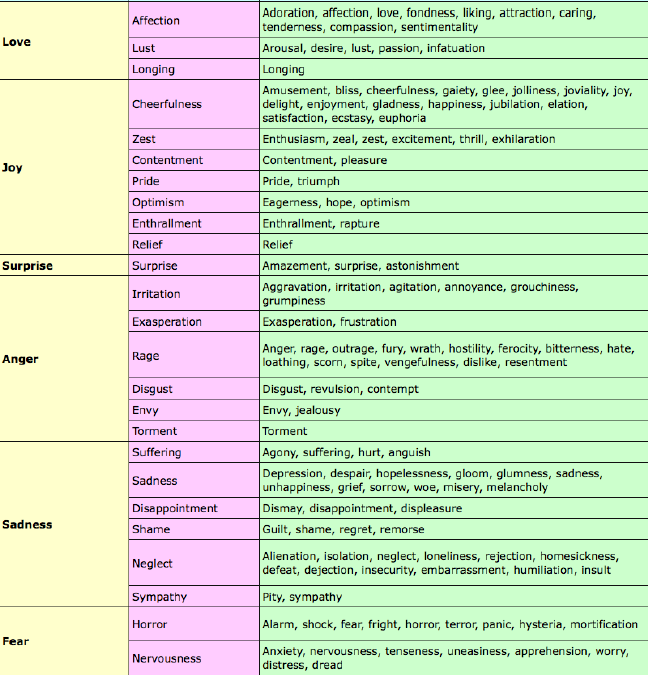
(Click the image for a list of words for feelings – or you can click this Words for Feelings-2015 )

Say you need to have a transacting conversation with your spouse. “Transacting”? That’s when you need to talk about something important and make some decisions. It’s way more than a simple connecting “Hi, you’re on my radar”. It’s going to need a deeper level of attentiveness and care.

You’ve been offered a huge promotion and need to talk through whether to take it. Before you launch into the conversation, check in to see what you feel and need.

Are you feeling ~

  • Flattered – it’s about time they valued you!
  • Frightened – holy smokes that will mean a lot of work!
  • Frustrated – you’d love to take the job but it means a move and the family is finally rooted.

Now you can begin the conversation by bringing all of this to the table:

“You know – I finally got offered that promotion I’ve been hoping for and now that I have it within my grasp, I’ve got really mixed feelings.”

Knowing you have mixed feelings, you’ll be clearer about what you need from your listener to start with:

Can we just go back and forth with the pros and cons for a while before we even think about the logistics of a move?

 3.  Attend to what they feel and need.

 Screen shot 2015-04-15 at 11.02.51 AMThe other day a client told me how she recently had the chance to do just what I recommend in #2 above. She saw a friend who’d hurt her feelings badly and was finally able to snag her at a party and tell her how these actions had made her feel and what she’d needed from this woman that would have helped.

It bombed! The woman appeared to listen but right after, got up and left the party. My client has neither seen nor heard from her since.

What went wrong?

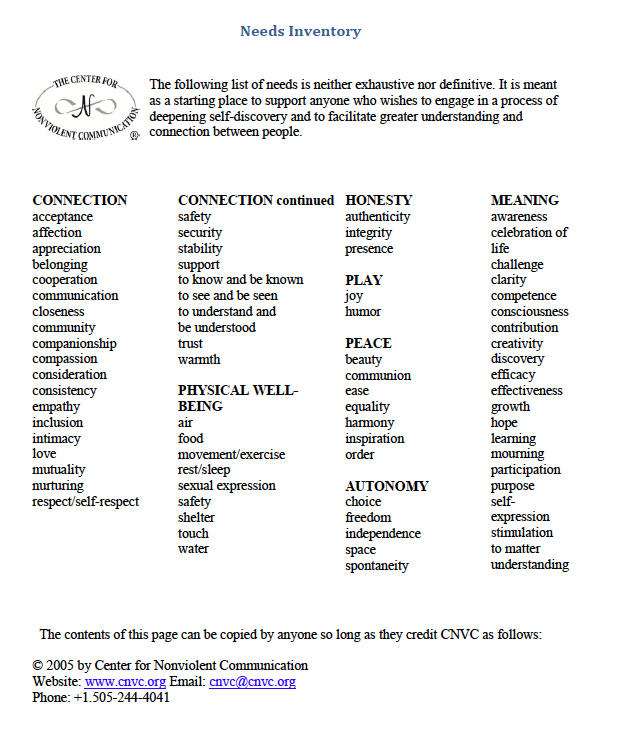
(See above for a list of needs.)

My client forgot to consider what her friend might feel or need right then.

Remember, this is an article about conversation. It’s a pas-de-deux, not a solo. We have to keep alert for how our steps in the dance impact our partner.

How to do this?

If you’re about to embark on a tough conversation, like the one my client faced, check in first.

Hey Mandy. Good to see you again. I’ve not seen you since we had that difficult situation go down. I’ve been feeling sort of sad and distant ever since. I’m wondering how you’re doing. Is this a good time to talk about it? “

Stay alert to the idea that it really does take two to tango. You may be aware of your feelings and needs, but if you are trying to have a “deep and meaningful” conversation with someone else you’ll do much better knowing as much as you can about their inner state.

4.  Think “Improv” not Tennis.

Screen shot 2015-04-15 at 11.16.55 AMGood, mutually satisfying conversations look like great improv scenes with Tina Fey and Amy Poehler, not like foul-mouthed Jimmy Conners slamming the ball back and forth with tantrum-prone John McEnroe.

To take a ho-hum conversation to the “great” and even “great fun” level, definitely go improv over tennis.

Here are Four Rules of Improv, from Tina Fey’s ideas in Bossypants. I really encourage you to click this one page excerpt from the book – Tina Fey’s Rules of Improv and read Tina’s words. She writes as well as she improvises.

RULE #1 ~ Say “Yes.”

  • Start by agreeing with their point: you can shift directions in a moment.
  • Show respect for them as a person: who wants to build a relationship with anyone who disrespects us?

RULE #2 ~ Say “Yes, and . . . “

  • Agree, and add a gift.
  • Contribute something of your own.

RULE #3 ~ Make statements

  • Stop hiding behind questions to much.
  • Think a bit.
  • Be part of the solution.

RULE #4 ~ There are no mistakes.

  • Only opportunities!
  • Beautiful happy accidents.
  • New venues to explore.

5.  Know When to Insert A Period

Screen shot 2015-04-15 at 11.38.30 AM

If you are in a long-term relationship with someone, conversations really never end. They just get punctuated. Maybe you have fifteen minutes to talk about the job promotion but then life interferes – one of you gets tired; or the boss calls; or a kid needs you; or you remember that other conversation you were mid-way through from this morning . . .

It’s OK to punctuate your conversations. Maybe this one needs a comma? “Shall we continue whilst we prep dinner together? Right now I‘m distracted by my rumbling stomach?”

A period? “I’m swiped. I think I’d appreciate sleeping on this. Can we pick this back up on Thursday after work?”

Again, good, satisfying conversations are the thread that stitches your relationship together over time, across space. As much as you can, allow the reality of both protagonists to influence the winding journey any conversation might take.

CAVEAT

Here we are on week 3 of a month-long exploration of great conversations and I’ve not focused on listening.

That’s not because I don’t think it’s important!

It’s because it is SO important it gets its own month.

May is all about listening.

FIRST TIME HERE?

This is the latest article in a year-long series on the “12-most-important-relationship-skills-no-one-ever-taught-me-in-school-but-I-sure-wish-they-had.

Click the box for the full list.Top 12 Relationship Skills

If you are interested in reading this blog in sequence, below are links to the series to date, beginning with the first posting at the top.

OVERVIEW

SKILLS FOR UNDERSTANDING

SKILL ONE ~ Recognize (and get to know) the many “yous.”

SKILL TWO ~ Learn how to be pro-active: choose how y’all show up.

 SKILL THREE ~ Accept (and get curious about) other peoples’ complexity

SKILLS FOR CONNECTING

SKILL FOUR ~ Master the Art of Conversation


Five Conversations

When I was twenty-something my boss, who was thirty-something, told me “When you’ve been married a while, you begin to have the same conversation over and over again.”

I was newly in love and this seemed like an impossible nightmare. We – Mark and I – would never run out of things to learn, to say, to inspire, to challenge, to encourage, to deepen our love.

Now we’ve been married for thirty-something years and we’re working to keep things fresh: Mostly. It’s a journey. It’s a conscious effort. When you say “’Til death do us part” these days – man – that can be a L O N G time. How do folks keep conversations fresh, connective, helpful, real?

And, that’s only one challenge for “The Conversation” – that relationship heavy lifter; that bridge over troubled waters; that small brave rocket launched from one soul to another across unfathomable distances of culture, meaning and interpretation to land into what – hostile waters? Toxic air? Fertile ground? We often don’t know, when we launch that first “Hello!”

But, if we are to be in relationship to someone else we must keep launching our words as emissaries of hope and tentative connection else – what? Radio static? Terrifyingly unfathomable silence?

OK – enough of the hyperbole. I had fun there.

But I have – through years of conversations as a professional therapist, wife, mother, sister, friend – discovered The Rule of Five when it comes to learning about and engaging in great, powerful, connective conversations.

I figure there are ~

  1. Five Assumptions I’m Making
  2. Five Conversations
  3. Five Principles of Great Conversations
  4. Five Levels of Intimacy
  5. Five Conversation Killers

And, as luck would have it, there are five Wednesdays in April for me to share each of these!

Today I’m going with 1 and 2 since you’ll need to know my assumptions. And besides, I need week five for that little something special I have up my sleeve!

 Five Assumptions I’m Making

  1. You want great relationships – not mediocre ones. This teaching goes beyond Conversation 101.
  2. You are self-aware and learning all the time. These ideas are not for the denizens of denial.
  3. You are willing to take responsibility for quality conversations. This is not for the whiners and complainers.
  4. While you can use this information at a one-off work social, these tips are intended for those wanting, or in, longer-term relationships.
  5. “Conversation” is not just about the words. It includes the silences and non-verbal overlays.

The Five [Types of] Conversations

When you’re in a relationship for the long haul (think partner, parents, in-laws, kids) your conversations have to be versatile. Marriages don’t survive on the “What’s your favorite movie?” or “How was lunch?” level.

You need to navigate the ~

  1. Connecting – the frequent comings and goings and ins and outs of relating;
  2. Deepening – the processing of life’s ups and downs;
  3. Transacting – the tasks of living and giving and taking that demand some finesse;
  4. Transforming – that invitation to grow oneself-up that relating precipitates;
  5. Healing – the willingness to apologize and forgive when we hurt one another.

These are different skills.

1.  Connectingthe frequent comings and goings and ins and outs of relating

Screen shot 2015-04-01 at 8.11.51 AMSo OK – every relationship starts someplace. Maybe even at the office social. At one end of connecting therefore is that “What’s my opening gambit?” fear. How do I know if I even want to get to know X or Y more fully if I can’t pluck up the courage to say “Boo.”

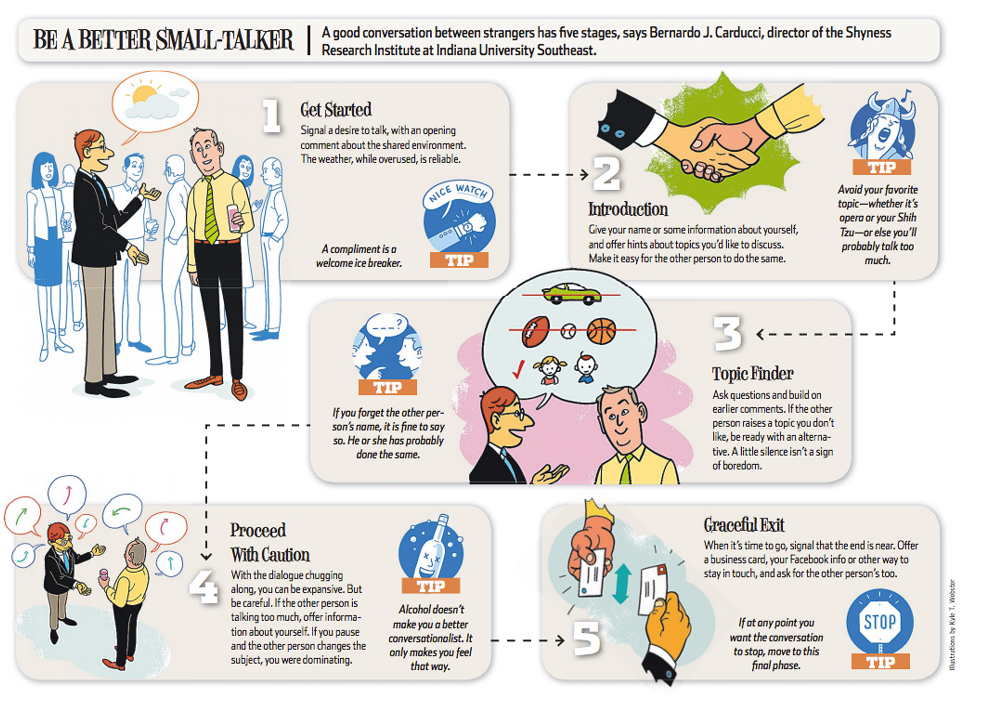
Here’s an info-graphic based on shyness-expert Professor Bernardo J. Carducci’s five (that “Five” again!) stages of a successful conversation.

But out beyond the initial connection, every-day connecting and re-connecting comprise the warp threads of long term relating. All day, every day – with people who matter to us – we’re structuring our relationship through conversational bids for connection. They look like this:

  • Did you see that sunrise? Boy it was breathtaking today!
  • I found a new farm for happy-chicken, free-range eggs. What do you think of them?
  • Oh, the neighbors are putting in a new planter box – I wonder what they’ll grow.

Yup – seriously folks. These are long-term-relationship conversational bids for connection. You know how you could blow it? By hearing them as slightly mad one-liners, instead of conversational openers. Sure they could be the mad mutterings of the old cat lady down the road, but if you want a great relationship with the mutterer in your life then you need to also hear what is underneath: you need to listen for the unspoken sub text, which is “Hi there! You’re on my radar. Am I on yours?” And yes, you need to respond.

These Connecting Conversations do not have to be long. A little friendly volley works wonders. Not in the mood? Nurturing the inner grump today? No worries, as Dan Wile writes, you can still honor the spirit of a Connecting Conversation by simply commenting on your state: “Hon, I’m all over those eggs. Right now I gotta dash. See you tonight – good luck with that meeting.” That right there – while brisk, is not brusque. It lets a partner know you heard and they are indeed still an important blip on your radar.

2.  Deepeningthe processing of life’s ups and downs

If Connecting is the warp thread, Deepening is the woof. Every day we rally forth into the world to study, work, play, teach, shop, search – whatever. And we come back with our share of triumph and tragedy. It’s with our loved ones that we process this stuff – or at least, ideally. It’s how we converse about these daily experiences that builds or erodes our mutual trust, love and attachment.

Screen shot 2015-04-01 at 2.01.31 PMThese conversations tend to go well to the extent one or both parties have some emotional fluency. For a brief overview I’m going to paraphrase from that master of emotional intelligence, Haim Ginott as explained in Chapter 1 of Faber & Mazlish’s  How To Talk So Kids Will Listen (yes, this works for grown-ups too).

So, imagine it’s the end of the day and you’re regrouping as a family. One of you has suffered some sort of indignation and wants to use this Deepening Conversation (though they don’t use that term!) to process what went down. They want to feel better. To understand why it felt so bad. To see if they need to respond. What do they need to keep this conversation feeling helpful and good?

Here are 7 things they do not need!

  1. Denial of feelings ~ “There’s no reason to be upset. It’s foolish to feel that way. You’re probably just tired and blowing the whole thing out of proportion. Come on, cheer up!”
  2. Philosophy ~ “Look, life’s like that. You can’t always get what you want. You need to learn how to take things in stride. Nothing’s perfect.”
  3. Advice ~ “Here’s what I think you ought to do. Tomorrow go here and say that. Don’t get sidetracked…”
  4. Questions ~ “Well what did you do that precipitated this whole thing? Didn’t you think of that? Didn’t this same thing happen last month?
  5. Defending the other person ~ “No wonder X did this. You were a total jerk! You’re lucky it wasn’t worse!”
  6. Pity ~ “Oh you poor thing! That’s just terrible! I feel SO sorry for you.”
  7. Psychoanalysis ~ “Has it ever occurred to you that the real reason you are so upset is that this reminds you of how your father treated you, and you always over-reacted to him?”

So, what might forward this conversation in a way that deepens your relationship?

  • Empathy ~ “Boy that sounds like a rough experience. To have that happen at work, in front of X and Y, especially after all the effort you put in, must have been pretty hard to take!”
  • Follow-up ~ “What do you need right now, to move forward with this?

So, deepening conversations do more than Connecting. They let the other person know you not only heard them, but you are seeking to understand their experiences and get on their team. Once you respond thoughtfully, empathically, these conversations will keep spiraling deeper – have a go. See what you notice.

3.  Transactingthe tasks of living and giving and taking that demand some finesse

Screen shot 2015-04-01 at 2.21.48 PMThese are those grittier conversations which often take place at that edge where we bug one another.

The proverbial toothpaste and toilet seat perennial arguments that marriages are purported to crash upon.

No more!

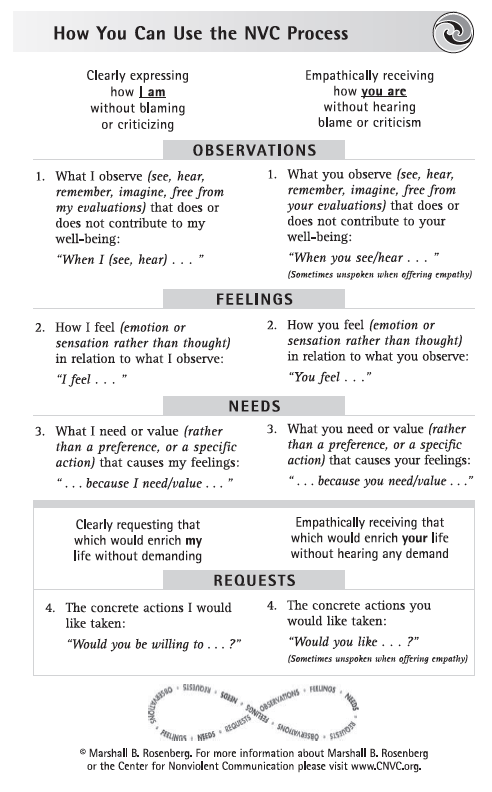
For these conversations, I am totally indebted to Marshall Rosenberg and his work in developing and teaching a process he calls Non-Violent Communication.

Whether you click on the graphic or download the PDF here – 4part_nvc_process – you’ll have a brief over-view of a hugely helpful 4 part process for figuring out how to have a conversation about needs that not only helps you get those needs met, but also deepens your relationship.

This is such a super important issue for great relationships, I’m dedicating the whole month of August to the topic. So – do please come back!

4.  Transformingthat invitation to grow oneself-up that relating precipitates

The origin of the word and concept behind “conversation” – according to the online etymology dictionary, is ~

mid-14c., “living together, having dealings with others,” also “manner of conducting oneself in the world;” from Old French conversation, from Latin conversationem (nominative conversatio) “act of living with,” noun of action from past participle stem of conversari “to live with, keep company with,” literally “turn about with,” from Latin com- “with” (see com-) + vertare, frequentative of vertere (see versus).

which seems to imply a more snap-shot of what is than a transformative anything.

Screen shot 2015-04-01 at 2.51.17 PMHowever, the fact of living together and being with one another can be transformative.

I’ve seen it in my work for years. We can be called forth to be better.

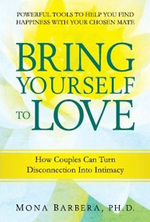
Again, a lofty topic worth taking time over, and here is a wonderful little book that will help you get there, from Mona Barbera.

Two key concepts to whet your appetite?

  1. The intense pain you think [the other person] is causing is really your own.
  2. No matter what [the other person] is dishing out, you can choose to give better back.

Mona’s book is targeting couples, but her ideas are universal and can absolutely help you use these forms of Transformative Conversation to do just that – to become a bigger you.

5.  Healing – the willingness to apologize and forgive when we hurt one another

Screen shot 2013-06-07 at 2.35.49 PM

Another whopper as far as relationship resiliency goes, and one that is getting covered in depth in October (Apologizing) and November (Forgiving).

If you are keen to get a feel for how these conversations might look, you could visit these articles I wrote in 2012:

Come Fall, I’ll rework these articles – so again, do come back!

FIRST TIME HERE?

This is the latest article in a year-long series on the “12-most-important-relationship-skills-no-one-ever-taught-me-in-school-but-I-sure-wish-they-had.

Click the box for the full list →    → Top 12 Relationship Skills

If you are interested in reading this blog in sequence, below are links to the series to date, beginning with the first posting at the top.

OVERVIEW

SKILLS FOR UNDERSTANDING

SKILL ONE ~ Recognize (and get to know) the many “yous.”

SKILL TWO ~ Learn how to be pro-active: choose how y’all show up.

 SKILL THREE ~ Accept (and get curious about) other peoples’ complexity

Is Understanding Overrated?

I’ve never forgotten the night my friend Peter agreed to wash his wife’s feet.

He had absolutely NO clue as to why she wanted those feet washed. But he accepted her request at face value, helped her to the edge of the bath, and washed them carefully.

They were trying to get out of the house around 3:00am so Anne could give birth in the hospital – not their living room. Water had broken. Labor was coming on hard. Anne simply insisted. “Peter – you have to wash my feet. Now.

Imagine how things might have gone if he’d said,“Now honey, why on earth do you want to wash your feet?

Right there, between “understanding” and “acceptance,” what did Anne need most?

In creating a year-long series about great relationships, I’ve just spent the first 12 weeks promoting “understanding.”

You know, stuff like understanding yourself and ~

And, enough of yourself already. I’ve been encouraging you to understand ~

I find myself wondering, if I have overestimated understanding?

Why do you ask “why?” ?

Possibility A ~ Because you are genuinely curious and want to understand as much as possible about this person in order to fully accept and appreciate them? This builds relationship – we all love to feel accepted and appreciated.

Possibility B ~ Because you think this person is a fruit loop and you want ammunition to prove this to them? This undermines relationship because it’s a slippery slope from here to contempt.

We might try and believe we’re “give-the-benefit-of-the-doubt, curious, A folks”. But my guess is more often than not we’re  “hang-’em-by-their-own-rope”  B folks.

In the normal scheme of things you can get away with that. But if you want a great relationship with someone you’re going to have to tone down that poised-for-attack “why” – which sounds more like “WHY!” than “why?”

Even more than understanding, great relationships rely on a whole heap of  ~

Screen shot 2015-03-18 at 9.56.55 PM

WHAT TO DO?

When you find yourself about to blurt the “why” bomb,  try this.

Be honest  –  What are you up to?

Do you want to understand this person so you can love and accept them more wholeheartedly?

Or have you already decided “Fruit-Loop!” and your “Why!” is more in scorn, disbelief and a hope they prove you right?

Consider  ~ your motive. Which of these two “why” alternatives is closest to what you mean?

A. “I’m interested. Would you be willing to tell me more about this?

B. “I can’t believe you just said that and now I want to know how nuts you really are, so do say more…

If your  thinking is closer to Option A your “why” will probably communicate interest and maybe even acceptance.

If your thinking is closer to Option B, it gets more complicated.

If you’re Peter and you love your wife and know it makes no difference how she might answer his “Why?” you could jump to “OK.”

If your kid has just announced his interest in knowing how many Oreos he can eat in 1 minute and you think this is gross and have no interest in indulging his curiosity, rather that a dismissive or scornful “Why!”  try simply acknowledging what you hear with a bit of warmth: “Wow – you wonder about that! Want to take a guess?”

If it’s your partner telling you something you don’t like try dumping the semi-hostile “Why!” (since you don’t really want to understand them anyway-right?) and try honesty. “Hum, I don’t agree. Do you want to tell me more so we can find a compromise?”

Why does this matter? ~ Respect always trumps disrespect & contempt.

I know! ~ There are loads of exceptions. Not all questions are asked because you want to get to “acceptance.” I’m writing this to move the bar a tad in that direction and invite you to notice how you use that all too ubiquitous three letter bomb.

What you discover could be interesting.

NEXT WEEK? With April, our focus shifts from Understanding, to Connecting.  First topic? Mastering the Art of Conversation.

FIRST TIME HERE? This is the thirteenth article in a year-long series on the “12-most-important-relationship-skills-no-one-ever-taught-me-in-school-but-I-sure-wish-they-had.

Click the box for the full list →    → Top 12 Relationship Skills

If you are interested in reading this blog in sequence, below are links to the series to date, beginning with the first posting at the top.

OVERVIEW

SKILLS FOR UNDERSTANDING

SKILL ONE ~ Recognize (and get to know) the many “yous.”

SKILL TWO ~ Learn how to be pro-active: choose how y’all show up.

 SKILL THREE ~ Accept (and get curious about) other peoples’ complexity