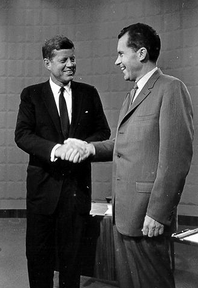
Monthly Archives: March 2015

Is Understanding Overrated?

I’ve never forgotten the night my friend Peter agreed to wash his wife’s feet.

He had absolutely NO clue as to why she wanted those feet washed. But he accepted her request at face value, helped her to the edge of the bath, and washed them carefully.

They were trying to get out of the house around 3:00am so Anne could give birth in the hospital – not their living room. Water had broken. Labor was coming on hard. Anne simply insisted. “Peter – you have to wash my feet. Now.

Imagine how things might have gone if he’d said,“Now honey, why on earth do you want to wash your feet?

Right there, between “understanding” and “acceptance,” what did Anne need most?

In creating a year-long series about great relationships, I’ve just spent the first 12 weeks promoting “understanding.”

You know, stuff like understanding yourself and ~

And, enough of yourself already. I’ve been encouraging you to understand ~

I find myself wondering, if I have overestimated understanding?

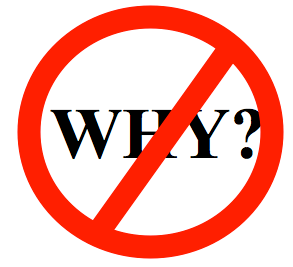
Why do you ask “why?” ?

Possibility A ~ Because you are genuinely curious and want to understand as much as possible about this person in order to fully accept and appreciate them? This builds relationship – we all love to feel accepted and appreciated.

Possibility B ~ Because you think this person is a fruit loop and you want ammunition to prove this to them? This undermines relationship because it’s a slippery slope from here to contempt.

We might try and believe we’re “give-the-benefit-of-the-doubt, curious, A folks”. But my guess is more often than not we’re  “hang-’em-by-their-own-rope”  B folks.

In the normal scheme of things you can get away with that. But if you want a great relationship with someone you’re going to have to tone down that poised-for-attack “why” – which sounds more like “WHY!” than “why?”

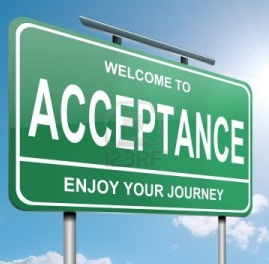
Even more than understanding, great relationships rely on a whole heap of  ~
Screen shot 2015-03-18 at 9.56.55 PM

WHAT TO DO?

When you find yourself about to blurt the “why” bomb,  try this.

Be honest  –  What are you up to?

Do you want to understand this person so you can love and accept them more wholeheartedly?

Or have you already decided “Fruit-Loop!” and your “Why!” is more in scorn, disbelief and a hope they prove you right?

Consider  ~ your motive. Which of these two “why” alternatives is closest to what you mean?

A. “I’m interested. Would you be willing to tell me more about this?

B. “I can’t believe you just said that and now I want to know how nuts you really are, so do say more…

If your  thinking is closer to Option A your “why” will probably communicate interest and maybe even acceptance.

If your thinking is closer to Option B, it gets more complicated.

If you’re Peter and you love your wife and know it makes no difference how she might answer his “Why?” you could jump to “OK.”

If your kid has just announced his interest in knowing how many Oreos he can eat in 1 minute and you think this is gross and have no interest in indulging his curiosity, rather that a dismissive or scornful “Why!”  try simply acknowledging what you hear with a bit of warmth: “Wow – you wonder about that! Want to take a guess?”

If it’s your partner telling you something you don’t like try dumping the semi-hostile “Why!” (since you don’t really want to understand them anyway-right?) and try honesty. “Hum, I don’t agree. Do you want to tell me more so we can find a compromise?”

Why does this matter? ~ Respect always trumps disrespect & contempt.

I know! ~ There are loads of exceptions. Not all questions are asked because you want to get to “acceptance.” I’m writing this to move the bar a tad in that direction and invite you to notice how you use that all too ubiquitous three letter bomb.

What you discover could be interesting.

NEXT WEEK? With April, our focus shifts from Understanding, to Connecting.  First topic? Mastering the Art of Conversation.

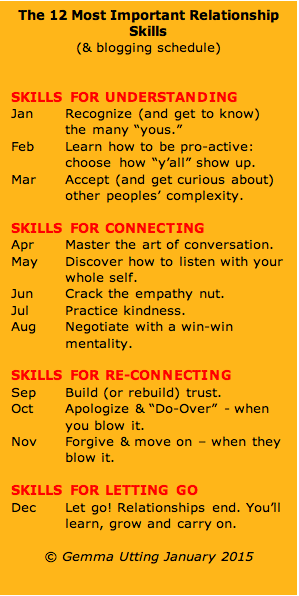
FIRST TIME HERE? This is the thirteenth article in a year-long series on the “12-most-important-relationship-skills-no-one-ever-taught-me-in-school-but-I-sure-wish-they-had.

Click the box for the full list →    → Top 12 Relationship Skills
If you are interested in reading this blog in sequence, below are links to the series to date, beginning with the first posting at the top.

OVERVIEW

SKILLS FOR UNDERSTANDING

SKILL ONE ~ Recognize (and get to know) the many “yous.”

SKILL TWO ~ Learn how to be pro-active: choose how y’all show up.

 SKILL THREE ~ Accept (and get curious about) other peoples’ complexity
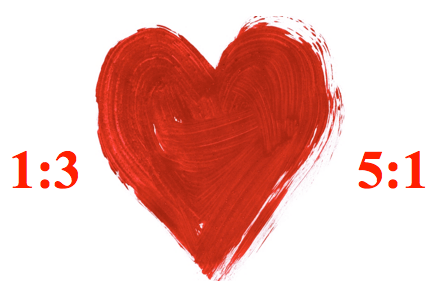
2 Magic Ratios for Great Relationships

Math that makes sense for your relationships . . .

 The 1 : 3 Rule

Every time you interact with another human being one of three things happens.

  1. You feel closer to them
  2. You reinforce what you already feel
  3. You feel more distant

Yes. Every time.

Day in and day out, you are constantly shifting position on some internal ratings scale on your partner’s scorecard. On your kid’s score card. On your boss’s score card. Though in truth these 3 constituencies are each tracking and scoring different things.

Partners want to know “Are we securely attached? Does h/she still love me?”

Children want to know “Is my parent on my team? Am I lovable?”

The boss wants to know “Is this employee worth what I pay him/her?”

More or less anyway.

We humans are counters, quantifiers and score-keepers when we are together.

Evolutionarily speaking it helped us – Is this person safe? Really safe? Not so safe?

Today we’re less evaluating physical safety (though this can be present to a certain degree), but we are evaluating emotional safety. And the thing is, this calculator never gets turned off!

Screen shot 2015-03-17 at 4.06.59 PMIf your spouse looks up in the morning when you come into the kitchen and smiles, or better yet gives you a big hug, they’ll get a point in your “I feel loved by this person” box.

Screen shot 2015-03-17 at 4.09.04 PMIf they behave in a way that seems – to a neutral observer – to be neither particularly loving nor particularly unkind, you probably won’t bother to score them. No new points get added either for or against. This simply reinforces what you already feel.

Screen shot 2015-03-17 at 4.11.03 PMIf, when you walk into the room, your partner walks out, or buries themselves in the newspaper, or gets busy with the social media so you feel excluded and unwelcome, then this person will get a point in your “I feel unloved and pushed away by this person” box.

Have you noticed this?

WHY THIS MATTERS

This matters because we live word by word. Look by look. Gesture by gesture.

Screen shot 2015-03-18 at 7.58.26 AM

Relationships are built or destroyed moment by moment.

Not “in one moment” – don’t get me wrong. But by the accumulation of moments, recorded on your scorecard. The way the stalactites and stalagmites grow in caves – one drop at a time until they are sharp enough to pierce your heart.

Moving on to a money metaphor, every day you are doing one of these three things in your relationships:

  1. Depositing good feelings.
  2. Ignoring the bank account (whilst either paying bank fees or accruing interest)
  3. Withdrawing or subtracting good feelings.

If you keep on withdrawing – you go broke. This is not rocket science!

If you are not paying attention to the balance sheet, you’ll find yourself suddenly out of love. You’ll have squandered numerous small occasions where you could have made a deposit.

And, just like your bank, if you drop below a certain minimum balance you get charged bank fees and if you are above a certain threshold the bank pays you interest, it’s the same difference with our emotional scorecards.

Even if you are behaving “neutrally” (being neither nasty nor nice) your partner will “score” you depending upon whether you’ve met certain minimum standards. If you are typically seen as loving and supportive, even your neutral behaviors will get the benefit of the doubt. But if you are typically seen as distant and unsupportive, your neutral stance will be judged negatively. You could be draining your love bank unwittingly…

WHAT TO DO?

Forewarned is forearmed.

Be aware of how anything you say or do might be received. Which scorecard will get a point if you say what you want to say right now? Can you afford this?

If what you plan to say is more likely to be perceived negatively – you better keep on reading . . .

The 5 : 1 Rule

If you want great relationships, you need to keep the ratio of positive interactions to negative interactions at a ratio of at least 5 positive to 1 negative – even in conflict.

Yup – negative interactions don’t immediately kill relationships.

You can slip up and be ~

  • Thoughtless
  • Unkind
  • Critical
  • Forgetful
  • Selfish
  • Defensive.

As long as you are also ~

  • Thoughtful
  • Kind
  • Supportive
  • Attentive
  • Generous
  • Responsible

 ~ five times more often,

And then, the odds will be ever in your favor.

This research was conducted by Dr. John Gottman and you can find out lots more on his web site.

So, no more excuses.

If you want to build a great relationship with someone remember:

1:3 ~ Every time you interact with this person you are doing one of three things

  1. Building a stronger relationship
  2. Maintain status quo (which might be good or bad)
  3. Undermining what you’ve got with this person.

&

5:1 ~ You want to have 5 positive interactions for every 1 negative one.

In April I’ll be talking more about  how to connect with people – what makes an encounter positive rather than negative (beyond the obvious!).

That’s all for now folks.

NEXT WEEK?

“Why Under-standing is Over-rated”.

FIRST TIME HERE?

This is the twelfth article in a year-long series on the “12-most-important-relationship-skills-no-one-ever-taught-me-in-school-but-I-sure-wish-they-had.”

Click the box for the full list →    →    →Top 12 Relationship Skills

If you are interested in reading this blog in sequence, below are links to the series to date, beginning with the first posting at the top.

OVERVIEW

SKILLS FOR UNDERSTANDING

SKILL ONE ~ Recognize (and get to know) the many “yous.”

SKILL TWO ~ Learn how to be pro-active: choose how y’all show up.

 SKILL THREE ~ Accept (and get curious about) other peoples’ complexity

How To Change Someone Else

I know. I know.

All those Self-Help books tell you to totally abandon any hope of changing anyone else.

Chapter upon chapter insist you recognize THE only things you have any control over are what you think and what you do.

Could the self help panoply of experts be wrong?

Could they be accused of keeping you overly ~

  • Deferential       “Goodness, it wouldn’t be right to impose my desires on someone else”;
  • Doubtful          “Oh I don’t think it ever works to try and change anyone else;”
  • Defeatist          “I tried once to change my partner and it didn’t work.”

Or maybe you’re more “It’s my way or the highway Bud!” and you wonder why you shed friends faster than an escaped lion empties a zoo.

If you’re in a relationship with someone you love (otherwise it’s not worth the effort) I hope you’ll let me persuade you to ~

  • Drop the deferential attitude – of course you are worthy of interactive relationships.
  • Ditch the doubt – trust in the power of relationship to transform.
  • Dump that defeatism – update your skill set instead.
  • Soften up the  “you’re with me or against me” attitude –  if we let them, other people help us grow in ways we could never devise on our own.

If you want to change the way someone close to you behaves, and maybe even how he or she thinks, here are four things to try.

1.   Meet them half way.

Screen shot 2015-03-10 at 11.40.36 AMLike God and Adam, both make a bit of an effort…

Depends on what you believe needs changing of course. But here are some examples I’ve seen where person A really wants person B to change. Could be a profound life transformation is desired, or a more modest habit change or temporary abatement.

Check these out.

  • A and B are married. A wants to adopt a Vegan lifestyle. B loves meat.
  • Mother A wants 15 year old daughter B to avoid all piercings while she is living at home under A’s roof. B wants a small tattoo and a belly ring.
  • A has fallen in love with B and wants to accept them as they are. But, B smokes a pack a day and A hates the habit.

Do these have to be win / loose?

If you want someone you care about to make a big change, think about it first from their point of view. What’s in it for them to make this change? Why might they want to? Is there something you can offer that might make this change more appealing? If you are inviting this person to get a bit uncomfortable, what discomfort might this request invite you into?

  • Might the Vegan be OK with their partner eating Vegan fare 3 nights a week and enjoying meat for the other 4?
  • Might the anxious Mum let go enough for a henna treatment, or one small, removable piercing?
  • Might the non-smoking partner be willing to discuss a cut-down, or smoking in designated areas?

Maybe give it a try?

2.   Get On Their Team

Screen shot 2015-03-11 at 12.23.41 PM

A man convinced against his will is of the same opinion still.”

A classic Ben Franklin quote.  So what might this look like?

Let’s take another stab at the 3 scenarios above using this idea.

What if the meat eater, the would-be body piercer, and the smoker actually wanted to make some changes?

A terrific way to “get” someone to make changes you wish they’d make, is to find out if there are any changes they want to make.  Maybe they’ve been thinking about a shift more or less in the direction you’ve been proposing. Find out. Join them. Get on their team.

Has the meat-lover ever expressed a desire to lower their blood pressure? Or grow a garden? Or only eat animals raised in humane conditions? Pay attention. Join them where they already are and support a desire they already have.

Yes great! I’d love to help you lower your blood pressure. What do you want to try? I’d be happy to research foods that might help…

Has the 15 year-old ever commented on how lovely Henna art is? Or has she noted other forms of body art that might be different and edgy but not full on tattoos and peircings – like coloring her hair or dressing differently? If she talks about some of these ideas,  get excited. Support her in expressing herself differently.

I love that you’re experimenting with new “looks.” I heard about a Thrift Shop up in Sun Valley that sells quality styles very cheaply.  Shall we check it out this weekend?

Has the smoker ever wished they could cut down? Maybe they worry that cutting down on cigarettes means they will ramp up on eating, or have no other way to manage their stress. Acknowledge their fears, join with their desires, get on their team.

You mentioned wanting outlets for managing stress as you think about lightening up on the smoking. I heard the local library is hosting a month-long series on meditation starting next week. I picked up this flyer for you.”

Screen shot 2015-03-11 at 12.25.22 PM

The solution might not be exactly what you had in mind. But your support for their goal is far more likely to be a wiin-win.

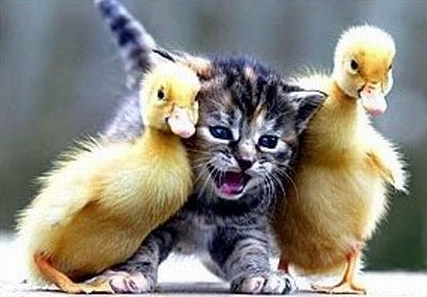
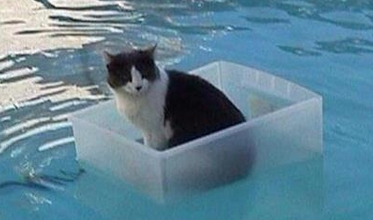
And hey – even a cat can find a way to join a duck in the water.

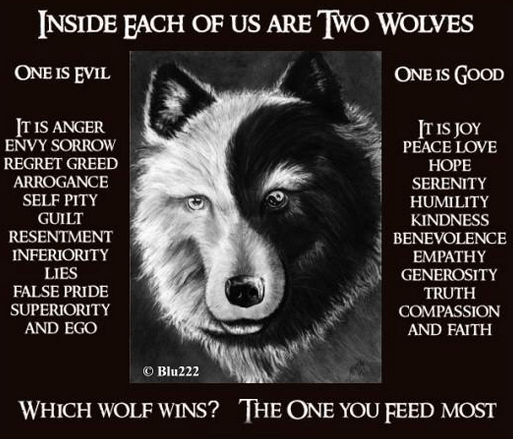
 3.   Feed The One You Love

Screen shot 2015-03-10 at 12.51.02 PM

     Remember this tale?

Well it works with the wolves around us as well as the wolves within.

We’ve all got an inner zoo. We show up in different ways. As angry wolves or serene wolves for sure. But also as ambitious and lazy; as extroverted and introverted; as nurturing and as harsh; as supportive and as critical.

Think of how often you find yourself saying “Part of me wants this, but another part wants that.”

(Check out Robin Williams as Mork and more about is idea here.)

If we can have multiple competing versions of ourselves, so can everybody else.

One of the most valuable lessons I’ve learned as a therapist is that in any relationship, we get the wolf we feed.

If we indulge or put-up-with whiny behavior from our pre-schoolers; rude behavior from our middle schoolers; disrespect from our teens; unkindness or indifference from our partners, the truth is, we’ve been feeding those wolves.

Once we get to the point of recognizing “Dang, I wish this person wasn’t  like that”  we get to behold our creation. Chances are we’ve been cultivating those very behaviors we now dislike for years.

What to do?

Feed a different wolf!

And yes – it takes time. But so did creating the wolf you’ve come to dislike.

When your toddler asks for something in a strong, clear, pleasant voice go overboard in your delight. You’ve glimpsed a different version of who this toddler is and how she can act. You want to build a relationship with that toddler – much more than you want to continue with the whiny one – right?

You can make it fun.

Well hello little Miss Sunshine, I love it when you show up. You’re way more fun than Old Grumpy! I’m certainly happy to push the swing for Little Miss Sunshine… let’s go!”

When your middle schooler rips a mighty belch and (for a change) quickly covers her mouth and says ‘Excuse me,” celebrate small victories. So easy to be sarcastic here – don’t be. Feed this polite wolf. “Thanks Betsy. Hey – I really appreciate this more polite “You”. She’s welcome to come eat in a restaurant with me any time!

When your teen momentarily thanks you for some kindness and forgets the eye roll as you say ‘You’re welcome” feed that wolf. “You know Son, I like being on your team. I hope you never forget that.”

When your partner one day asks, out of the blue, “Do you need help?” for heavens sake feed that wolf! I know how easy it can be when you’ve been hurt before to come back with some snide “Now you ask! Where have you been hibernating all winter when the drive-way needed shoveling and the kids were all sick…” but remember. When you show up like that – being that person, you’re only going to encourage the unkind and indifferent parts of your spouse.

Feed the “helpful wolf.”  “You know, you asked at just the right moment. I’d love help. Could you grab the rest of the groceries from the back of the car? I really appreciate it when you notice what I need and just show up for me like that – thanks!”

The secret here is remembering that IF this person in your life has ever exhibited the sort of behavior you wish s/he did more often, then that behavior is possible. It is already in their repertoire. That “Part” of them can be invited out more often. It’s not that you are inviting them to be someone new. You are just asking them to show up in a way that works better for you.

You are not saying

  • I don’t love you.
  • Or
  • “I want (all of) you to change.”

You are saying

  • “I particularly love this Part of you.”
  • &
  • “I love it when this Part of you shows up.”

4.   Be the change

Screen shot 2015-03-11 at 12.33.19 PMI’m sure this is not about you, but I’ve noticed that sometimes, in long-term relationships, when partner A feels stuck-in-a rut or gets bored with life, they believe it is up to partner B to “do something.” And this effort, A believes, will magically get both of them out of the rut and life will once more be  fascinating. Or at least, less boring.

So, in the unlikely event this ever happens to you and you find yourself feeling stuck and bored, and notice you are keen for your partner to ~

  • loose weight
  • try something new
  • suggest cool vacation plans
  • learn new stuff
  • get in shape

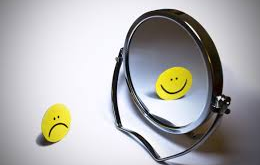
listen up and go find a mirror.

That person right there – staring glumly back at you – tell that person to

  • loose weight
  • try something new
  • suggest cool vacation plans
  • learn new stuff
  • get in shape

If you are bored in the relationship, you get to do something about it. And it’s way more liberating to grasp that fact than it is to play the grumble-criticize-hint-whine-complain game with your partner.

Be the change you want to see. Believe me – fresh energy is contagious!

That’s all for now folks. See you next week.

FIRST TIME HERE?

This is the tenth article in a year-long series on the “12-most-important-relationship-skills-no-one-ever-taught-me-in-school-but-I-sure-wish-they-had.”

Click the box for the full list →    →    →Top 12 Relationship Skills

If you are interested in reading this blog in sequence, below are links to the series to date, beginning with the first posting at the top.

OVERVIEW

 SKILLS FOR UNDERSTANDING

 SKILL ONE ~ Recognize (and get to know) the many “yous.”

 SKILL TWO ~ Learn how to be pro-active: choose how y’all show up.

 SKILL THREE ~ Accept (and get curious about) other peoples’ complexity
Join me for the whole series. You can sign up at the top of this page, on the right.

NEXT WEEK?

Find out what you are – unwittingly – doing all the time in relationships.

5 Non-Verbal Cues You Need to Know

Would you want to ~

  • Know what someone was feeling, without asking them?
  • Influence what someone thought about you, without saying a word?

This month, I’m hoping to boost your understanding of other people by beginning with the loudest messages that are coming at you – those silent, non-verbal ones.

This is definitely a brief whet-your-appetite piece since there is so much written about non-verbal communication.

However, armed with just these five non-verbal behaviors you’ll be way ahead of the game when it comes to understanding what someone else is feeling and thinking.

And – jolly helpful here – as you begin to crack these non-verbal languages, you can script what you’re broadcasting with a bit more care.

Here are 5 tips for translating those non-verbals into news you can use.

1.  The Walk

OK, gotta mention John Wayne here. Here’s a “John Wayne Moment” from The Birdcage (one of my all time favorite movies – this is the American version of  the French La Cage Aux Folles)   ~

Everyone has a walk.  John Wayne just had “such a walk”!

What matters about The Walk isn’t The Walk but rather it’s the fact you observe it.

If you pay attention, you can get to know a lot about a person by how they walk.

What is the baseline “norm” for any of these?

  • Your kid’s “I’m happy” walk?
  • Your partner’s brisk “exercising the dog” walk?
  • Your aging parent’s “grocery shopping” walk?

Once you know someone’s baseline walk, you can be aware of changes that might be telling you something.

  • When your kid comes home shoulders hunched, chin on chest, toes turned in – you might guess he’s feeling down, defeated or sad.
  • When your partner takes the dog around the block, hands thrust in pockets, forehead and shoulders leading as though into a gale force wind, you might wonder if they’re angry.
  • When your elderly parent shuffles more, or gets unsteady – it might be good to get a medical check up.

2. The Face

You – and good science – are right to look to the human face for reliable emotional feedback. Building upon Darwin’s original idea that certain specific expressions were universally recognizable, Paul Ekman has been studying facial expressions since the mid 1960s. To test the idea that there are certain universal facial expressions for emotions (even beyond the reach of global mass media which can blur specific cultural differences) click on the link below and take a brief test.

You will see the face of a Papua New-Guinea man asked to show how he would look in response to 4 experiences:

  • His child had just died
  • He stepped on a smelly dead pig
  • He was about to fight
  • Friends had come

Click below to see if you can identify how this man – from a  pre-literate, stone age culture – is feeling.

http://www.paulekman.com/universal-facial-expressions/

How did you do?

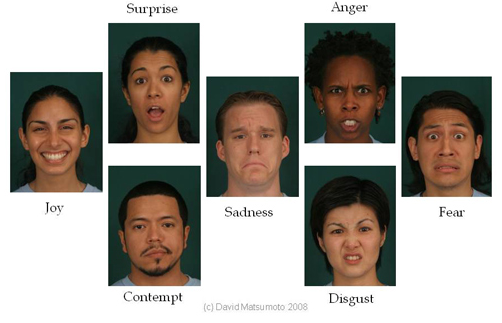
There is agreement on (at least) these 7 universal emotions – which are:

Screen shot 2015-03-03 at 6.12.58 PM

But of course, there are all sorts of nuances we can become aware of in people we know well. For a cheat-sheet, see Words for Feelings-2015

Knowing – or at least making an educated guess about – how someone else is feeling, allows you to be careful as you choose how to approach that person. This is often what we mean when we use the term “emotional intelligence.” Folks who miss facial emotional cues have a much harder time making friends. There is a non-verbal bond created when someone can both interpret and match our mood. If we are tired, it’s jarring to have a high energy encounter. If we are disappointed it can seem insensitive when someone approaches up triumphantly. When we are happy, we love it when our friends can rejoice with us.

Interested in learning more about reading emotions? Click here.

3. The Eyes

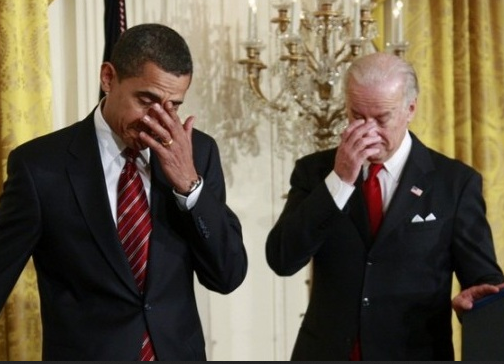
Screen shot 2015-03-04 at 11.16.37 AMWhat have President Obama and Vice President Biden just witnessed? How do they feel about it?

Dr. Jack Brown thinks it’s something like

“I wish I never saw that”, or “I can’t believe he did that”.”

Why?

Because they are using eye-blocking. Here I quote from Joe Navarro‘s book What Every Body Is Saying – An Ex-FBI Agent’s Guide to Speed-Reading People (page 176).

Our eyes . . . have evolved as the primary means by which humans receive information. In fact, we often attempt to censor incoming data through a limbic survival mechanism known as eye-blocking, which evolved to protect the brain from “seeing” undesirable images. Any decrease in the size of the eyes, whether through squinting or pupilary constriction, is a form of subconscious blocking behavior. And all blocking behaviors are indicative of concern, dislike, disagreement, or the perception of a potential threat.

Why is this useful? Here is a short vignette from Joe’s book (page 174) that might bring the relevance of this knowledge closer to home.

While walking with my daughter . . . we passed someone she recognized. She squinted slightly as she gave the girl a low wave. I suspected something negative had transpired between them, so I asked my daughter how she knew the girl. She replied that the girl had been a high school classmate with whom she had previously had words. The low-hand wave was done out of social convention; however, the eye squint was an honest and betraying display of negative emotions and dislike.

4. The Arms

OK – so you’re the boss. You have 2 teams working on a project. They have met twice before and you chance upon the teams during their third meeting.

Here is Team A

Screen shot 2015-03-04 at 11.47.33 AM

And here is Team B

Screen shot 2015-03-04 at 12.01.06 PM

If you had to put money on which team would successfully deliver the final product on time, with minimal interference from you, which team would you bet on? And why?

I’m putting my money on Team B for one main reason. Team B enjoys a much higher degree of trust. How do I know that?

Look at the arms of all 6 team members. Since our ancestors stood upright, we humans have been able to use our arms for self-defense. Here is Joe again (page 109).

In my work with the FBI, I have seen individuals shot in the arm as they used their upper limbs in an attempt to defend themselves from handgun fire. The thinking brain would realize that an arm simply cannot stop a bullet, yet the limbic brain will cause our arms to life and precisely block a projectile traveling at 900 feet per second.

Absent gun fire, we still use our arms to protect ourselves, crossing them over our chest when we feel vulnerable and withdrawing or lowering our arms when we feel fearful. Conversely, when we feel safe, happy or excited we’ll open or raise our arms, wave them about and air punch for victory.

When a person folds his or her arms across their chest or abdomen they are feeling uncomfortable in some way and are (often unconsciously) protecting themselves. If I noticed members of a working team needing to be so self-protected, I’d find a quiet moment to take each person aside and check in, specifically about trust issues. Trust can certainly be cultivated, but if you don’t notice when your employees are feeling unsafe, you may miss all sort of opportunities to make their working environment more conducive to good work.

5. The Hands

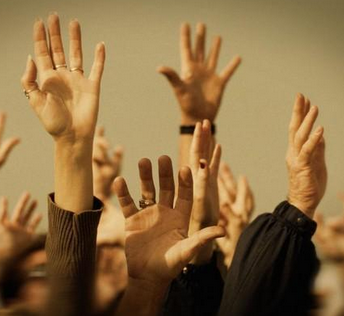
Screen shot 2015-03-04 at 2.17.25 PMHere’s a cool fact, again from Joe Navarro’s book (page 134)

The human brain is programmed to sense the slightest hand and finger movement. In fact, our brains give a disproportionate amount of attention to the wrists, palms, fingers, and hands, as compared to the rest of the body From an evolutionary standpoint, this makes sense. As our species adopted an upright posture and our human brain grew ever larger, our hands became more skilled, more expressive, and also more dangerous. We have a survival need to assess each other’s hands quickly to see what they are saying or if they portend ill (as in holding a weapon).

So, my guess is you notice when someone hides their hands in a meeting and if you want to be trusted, keep your hands visible too. But the really interesting stuff about hands?

Screen shot 2015-03-04 at 2.08.32 PMThe handshake!

Now I was raised in a household where my great grandmothers’ motto was “Manners before morals!” (Seriously!) So I learned more than I will ever pass along to my children about interpersonal etiquette, both at home and in the endless stream of prim and proper boarding schools I attended.  But, what I’ve just learned about the art of the handshake is leaving me, well shaking my head.

Here’s a list of ten different kinds of handshakes and what they communicate – enjoy! http://socialanxietydisorder.about.com/od/copingwithsad/a/badhandshakes.htm

Oh, and fun fact about JFK which you can observe in the photo above.

Did you know that every time John F. Kennedy needed to shake hands with someone in public he made a practice of standing on the left-hand side of photographers? This trick makes the one to the left of the image appear to be in control. The experts who studied gestures of J.F.K. are convinced that his persuasive body language was precisely that won him the Presidency.

Quoted from Etiquette Tips.

That’s all for now folks. See you next week.

FIRST TIME HERE?

This is the ninth article in a year-long series about the “12-most-important-relationship-skills-no-one-ever-taught-me-in-school-but-I-sure-wish-they-did.”

Click the box for the full list →    →    →Top 12 Relationship Skills

If you are interested in reading this blog in sequence, here are links to  previous articles, with #1 being the first and #8 the article before this.

  1. My Top 12 Relationship Skills
  2. Part of Me Wants . . .
  3. Little Miss Sunshine
  4. The Purpose Driven Life
  5. Report The News – Don’t Act it Out
  6. Happy Families
  7. Self Leadership
  8. When Does A Relationship Need Help?

Join me for the whole series. You can sign up at the top of this page, on the right.

NEXT WEEK?

How to bring out the best in other people.

WANT MORE?